Multi-Day Hindu and Sikh Wedding Guest Lists in the UK
If you’re planning a Hindu or Sikh wedding that runs over several days, you’re managing a guest list for every event, each with its own room, caterer and deadline. The mehndi might be close relatives in a front room and the reception a full banqueting hall.
 Rohan Kapoor
·
Updated November 2026
The short answer
Start with your family’s own order of events, then decide who comes to each one. A gurdwara or temple can limit numbers in a hall or beside the couple, so its rules come next. Each event then needs a room that fits it and a final number for its caterer before that caterer’s deadline, which for the four caterers here falls between 7 and 14 days before the event.
Which events, in which order
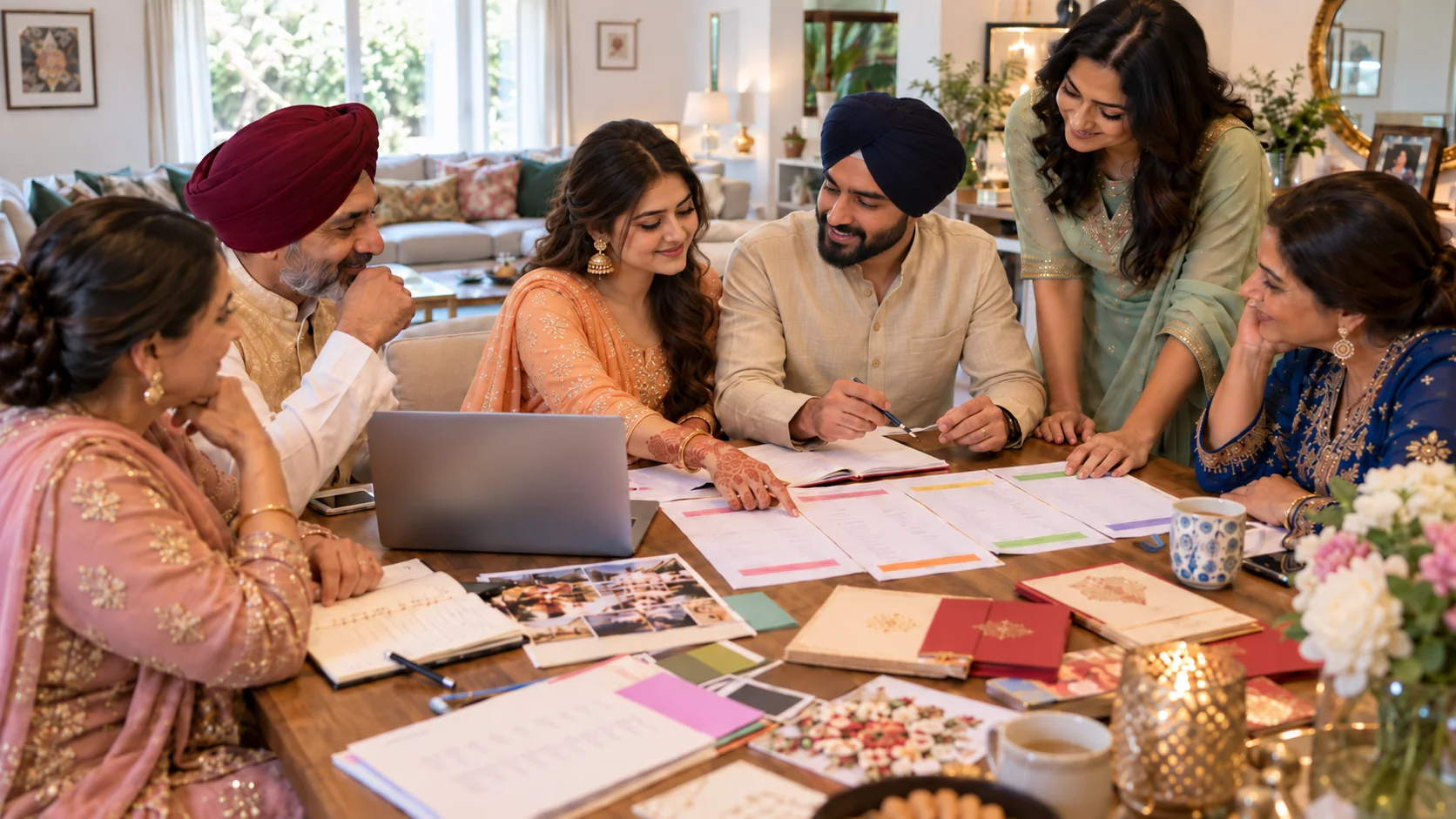
A 2016 study of Sikh weddings, focused on British Sikhs, lists the steps around the Anand Karaj: a meeting of the families to agree the match (thaka or roka) and set a date, the engagement (kurmai), mehndi and sangeet, choora for the bride and sehra bandi for the groom. It places the Jago, a ritual led by the maternal side of the family, on the evening or night before the wedding, and notes elsewhere that it usually falls one or two nights before. On the wedding morning the milni follows the Ardas prayer, and after the Anand Karaj and the reception comes the doli, the bride leaving her parents’ home.
For Hindu weddings, a UK religious education note lists an engagement and the arrival of the marriage party (often as a procession) among the pre-wedding ceremonies. After the wedding comes a welcome for the bride at her new home. It adds that Hindu ceremonies vary between regions and family traditions. A study of weddings in England and Wales describes the groom’s party arriving in a procession on the wedding day and the bride saying goodbye to her family, the vidai, at the end. So your sequence may have more events than these, or fewer. It helps to write yours down before anyone starts on names.
Who comes to what
Who comes to which event is a family decision, and the Sikh study gives some pointers. In its account of Punjab, the Anand Karaj at a nearby gurdwara is expected to be attended only by close family. In diaspora settings, it says, many people skip the gurdwara ceremony and attend only the reception afterwards. The study is critical of rising wedding spending, and describes celebrations spread over three or more parties, ending in a reception where up to 500 to 700 guests may be invited. It sets that against the Sikh Rahit Maryada’s stated preference for small marriage parties. It also notes guests and relatives travelling from India, Canada, the USA, East Africa and mainland Europe.
For Hindu families, the answer sits with your own relatives, so ask them directly: who is expected at the engagement, who at the haldi or mehndi, who at the ceremony, and who only at the reception?
Rules at the gurdwara or temple
If the ceremony is at a place of worship, its own rules come first. Leyton Gurdwara in East London describes its langar as free to all, whatever their religion, caste, gender, economic status or ethnicity. Ask your gurdwara how langar is served on your wedding day and whether it needs a number from you. Siri Guru Singh Sabha Croydon allows only five members from each family to sit next to the couple during the phere and allows only vegetarian catering on its premises, with no egg or fish. Ramgarhia Board Leeds limits its civil ceremony in the gurdwara office to six people and asks couples to tell those guests beforehand so they know where to go. Sri Guru Singh Sabha Southall permits only its approved caterers on its premises, and only strictly vegetarian, egg-free food.
Temple halls can have limits too. Shree Swaminarayan Temple Willesden’s hire terms allow no more than 700 people in its Sahajanand Hall or 300 in its Dharmajeevan Swami Hall and the hirer must keep a record of the number admitted. Its kitchen may be used only by approved caterers. Ask your gurdwara or temple for its written rules on numbers, seating and food before you send invitations.
Matching rooms to events
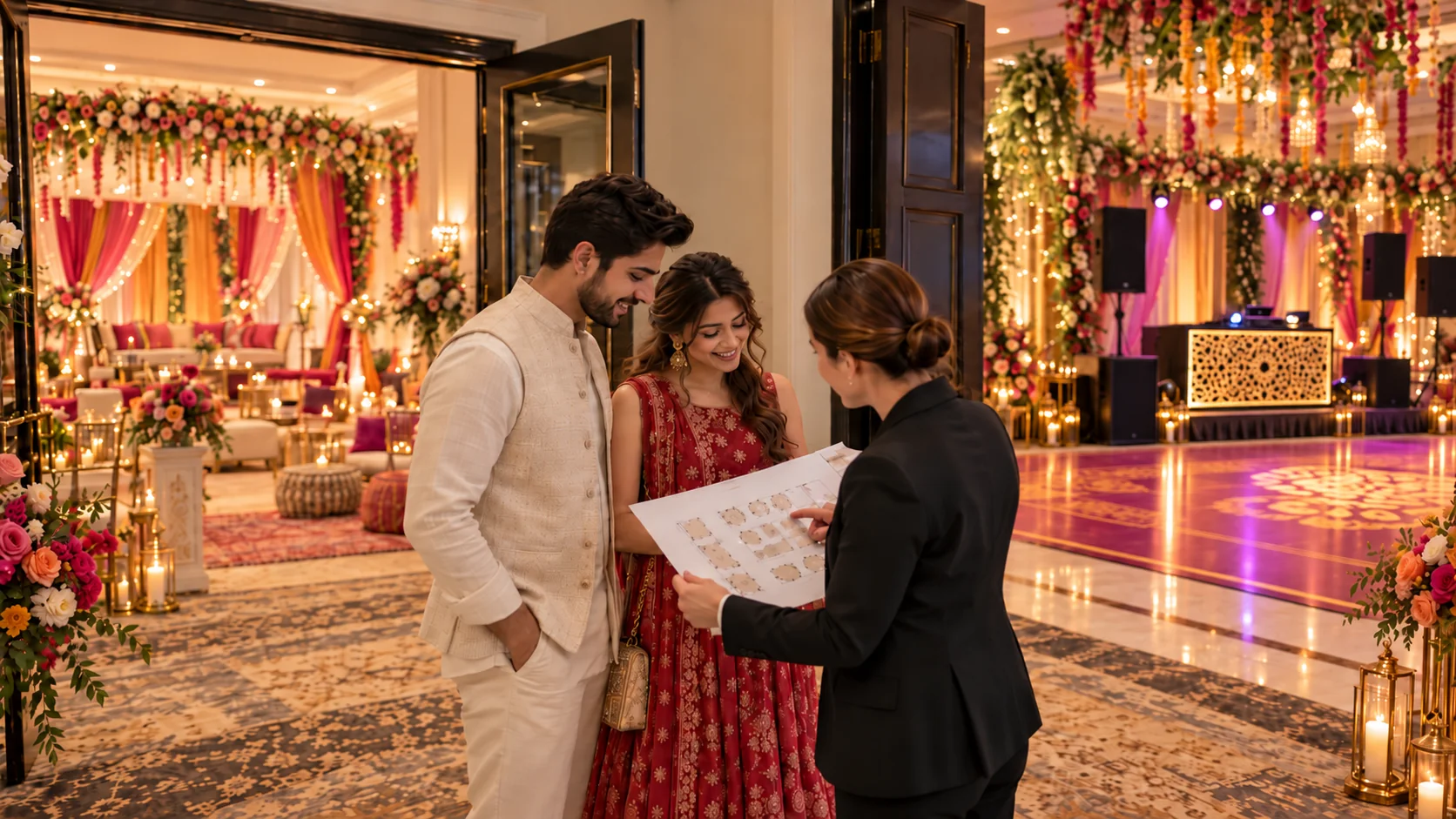
A venue with several rooms can take more than one event. Meridian Grand in North London seats 120 to 800 guests across two ballrooms, with smaller suites for up to 100 and 70. Ribby Hall Village in Lancashire lists suites for up to 350, 180 and 130 guests, and prices its Asian and multicultural weddings from £4,795 based on 51 to 150 guests. The Great Yorkshire Events Centre says its Aire Room can take up to 350 guests for larger Hindu ceremonies, and its Wharfe Room up to 450. Ask each venue which room fits the number you expect for each event, and what the price is based on.
Licensing comes in if an event sells alcohol or has music and dancing somewhere unlicensed, or at a hall whose licence doesn’t cover it. In England and Wales, a Temporary Event Notice (TEN) from the council is needed to sell alcohol or provide music and dancing on unlicensed premises, or for an activity a venue’s licence doesn’t cover; GOV.UK’s example is a wedding reception at a community centre. A TEN event must have fewer than 500 people at all times, staff included. Where a TEN is needed, it’s one for each event on the same premises, with at least 24 hours between separate but consecutive events, and must apply at least 10 clear working days before the event.
Catering numbers and deadlines
The four caterers below each set their own deadline for final numbers. Dips Foods in Stanmore asks for final numbers and details 14 days before the first event date when a client books it for more than one event, and says the price per person may rise if guest numbers are later reduced. Event Catering Group wants final numbers in writing 14 days before the event and charges for the number quoted in the final package even if fewer guests come. HOST normally needs final numbers 7 days before, unless another deadline is agreed, and says reductions after that may not lower the final price where food, staff or equipment are already committed. Nyama Catering needs them 10 days before and can’t reduce numbers after final confirmation.
On a multi-day wedding, those deadlines stack up. If the mehndi caterer works to 14 days before its event and the reception caterer to 7, you need firm answers for the earlier event first. Put every caterer’s deadline in Wedvisa’s planning timeline, which calculates booking deadlines from your wedding date.
Invitations and replies
Plan invitations backwards from the earliest catering deadline. Wellwood Wedding Stationery in Northern Ireland suggests posting save-the-date cards 9 to 12 months ahead and, for local weddings, invitations 12 to 16 weeks before, leaving at least six weeks for replies and a final headcount. It recommends a longer timeline for destination weddings. If relatives are flying in from abroad, give them as much notice as you can. The Sikh study also says it’s not unusual to book the gurdwara and the banqueting halls a year or more ahead. That makes the rough size of each event a decision you need early, before the names are final.
Keeping the list in one place
Wedvisa’s guest list manager lets you add guests, mark which side they’re on, record dietary needs such as vegetarian, note plus-ones and track replies, with totals at a glance. The public demo shows one reply status per guest. For separate events, note beside each name the events that guest is invited to, or keep a list per event. Once the reception numbers are firm, the seating plan maker lets you add round tables of 6, 8 or 10 and a top table of 12, then assign guests.
Building the lists, step by step
- Write down your sequence of events with both families, and where each one happens.
- Ask the gurdwara or temple for its written rules on numbers, seating and catering.
- Draft a rough number for each event before you book rooms, so each venue can offer the right one.
- List every guest once, with their side and the events they’re invited to.
- Note dietary needs, including vegetarian and egg-free food where the place of worship requires it.
- Collect each caterer’s final-number deadline and how it charges if numbers fall.
- Send invitations early enough for replies to arrive before the first deadline, and earlier for guests from abroad.
- Confirm numbers event by event, earliest deadline first, in writing.
A suggested timeline
This is a suggestion to adapt, built from the dates above; your venues’ and caterers’ own terms come first.
|
When |
What to do |
|---|---|
|
12 months or more before |
Book the gurdwara or temple and the halls, with a rough number for each event |
|
9–12 months before |
Save-the-date cards, especially for guests abroad |
|
3–4 months before |
Invitations for every event |
|
At least 6 weeks after invitations go out, and before your first catering deadline |
Replies due |
|
7–14 days before each event |
Final numbers to that caterer, in writing |
Questions to settle as a family
- Which events are close family only, and who counts as close family on each side?
- Who is invited to the ceremony, and who only to the reception?
- Who is coming from abroad, and which events can they reach?
- Who holds the final number for each event and tells the caterer?
- If numbers drop after a deadline, who pays the difference?
Legal and practical points
- Licensing: in England and Wales, selling alcohol or putting on music and dancing where no licence covers it needs a Temporary Event Notice; a TEN event must stay under 500 people at all times, staff included.
- Place-of-worship rules: a gurdwara’s or temple’s limits on numbers, seating and food are its own conditions of use.
- Room limits: ask each venue for the maximum for each room in writing.
- Catering contracts: read each caterer’s terms on final numbers and charges before you sign.
Guest list checklist
Tick these off in Wedvisa’s wedding checklist.
- ☐ Order of events agreed with both families
- ☐ Gurdwara or temple rules on numbers, seating and food in writing
- ☐ Rough number for each event
- ☐ One master list with the events each guest is invited to
- ☐ Dietary needs recorded
- ☐ Each caterer’s deadline and charging terms noted
- ☐ Each room’s maximum confirmed
- ☐ TEN served at least 10 clear working days ahead for any event that needs one
- ☐ Invitations sent with a reply date before the first deadline
- ☐ Final numbers confirmed in writing, event by event
At a glance
|
Event |
Number to fix |
Check with |
By when |
|---|---|---|---|
|
Pre-wedding events (mehndi, sangeet, Jago) |
The number your family decides |
The room and the caterer |
That caterer’s deadline |
|
Gurdwara or temple ceremony |
Guests in the hall; family seated beside the couple |
The gurdwara or temple’s written rules |
Before invitations go out |
|
Civil ceremony at a gurdwara |
Six at Ramgarhia Board Leeds; ask yours |
The gurdwara |
Before the day |
|
Reception |
Everyone invited to the main party |
The venue’s room maximum and the caterer |
7–14 days before, with the four caterers here |
|
Event with alcohol sales, music or dancing that no licence covers |
Fewer than 500 at all times, staff included |
Your council (TEN) |
At least 10 clear working days before the event |