Affordable Wedding Venues UK: The Complete Guide
Wedding venues in the UK can eat up a big chunk of your budget. Here are the most affordable wedding venue options available so that you can achieve your dream wedding under ten grand.
The average UK wedding in 2026 costs around £20,604. The venue alone accounts for 35–40% of that — typically the single biggest line item in the entire budget. But the assumption that a genuinely beautiful, memorable venue has to eat a significant chunk of that figure is one of the most persistent myths in wedding planning.
Some of the most extraordinary settings in the UK — ancient redwood groves, tipi clearings beside quarry lakes, working farm estates with rolling meadows, private woodland carpeted with bluebells — are genuinely more affordable than a mid-range hotel function room. Around 25% of UK couples get married for under £10,000 in total. Getting there isn't about lowering your standards. It's about knowing which venue types offer real value, how timing affects price more than almost any other factor, and where the hidden costs tend to hide.
This guide covers the full landscape: the most affordable venue types across England, Wales, and Scotland; specific venues worth investigating; what the law actually requires (it matters more than most guides admit); and how to read a quote so nothing catches you off guard.
What "Affordable" Actually Means
Before looking at specific venue types, it's worth being honest about what makes a venue genuinely affordable rather than just cheap on paper.
The headline hire fee is rarely the complete picture. A village hall at £500 a day sounds affordable until you add furniture hire, crockery, glassware, a PA system, and professional cleaning. A tipi clearing at £3,500 might look expensive until you realise it comes with full infrastructure, fairy lights already rigged, a bar setup, and on-site camping for guests — with no logistics burden on you.
The real questions to ask any venue:
- What's included in the hire fee — furniture, staffing, kitchen access, cleanup?
- Are there approved supplier lists, and what are the penalties for using your own caterers?
- Is there a corkage fee or minimum spend on alcohol?
- Does the venue hold an Approved Premises licence (essential for a legally binding ceremony in England and Wales)?
- What are the noise restrictions and when must music stop?
- What's the venue's Plan B for bad weather?
The most genuinely affordable venues are those with no hidden additions after the initial quote. The ones that look cheapest sometimes generate the longest list of extras.
The Single Most Powerful Budget Tool: Timing
Before you even start looking at venue types, understand that when you get married makes more difference to venue cost than almost anything else.
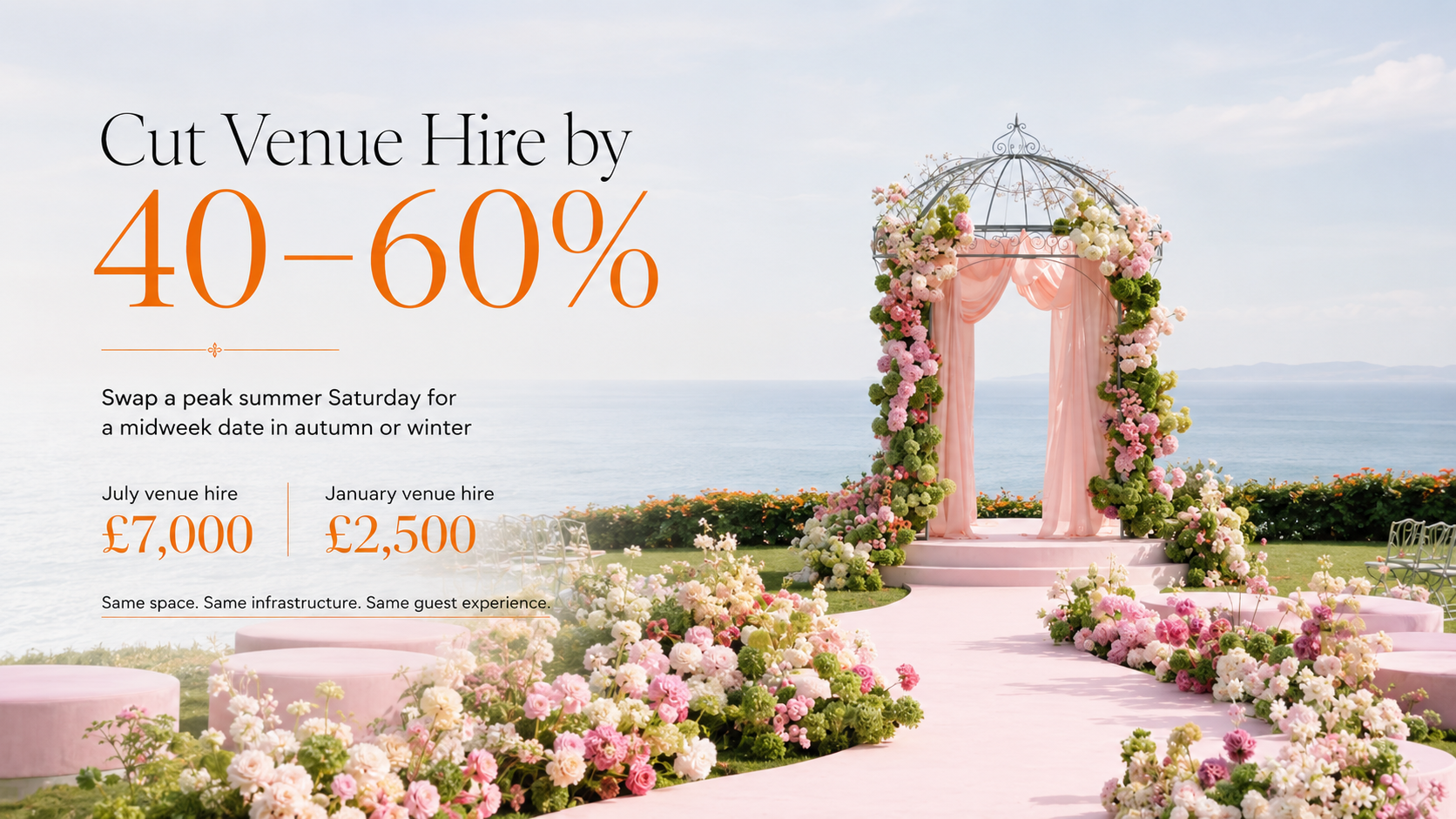
Switching from a peak summer Saturday to a midweek date in autumn or winter can cut venue hire by 40–60%. Many venues that cost £7,000 in July become available for £2,500 in January — the same space, the same infrastructure, the same experience for your guests. A venue that looks completely out of reach on a Saturday in August becomes a realistic option on a Tuesday in November.
|
Timing |
Typical Saving vs Peak Saturday |
|---|---|
|
Summer Friday |
10–15% |
|
Midweek (Monday–Thursday) |
25–30% |
|
October–March (any day) |
25–40% |
|
Winter Midweek |
Up to 50% |
If your guest list leans toward close family and friends rather than large social or work groups, a weekday celebration is well worth considering. Most couples who do it say the day felt more intimate and more personal — not a compromise.
💡 Pro Tip: Autumn and winter weddings often look more visually distinctive than summer ones. A candlelit tipi in October, a woodland ceremony in golden November light, a barn reception in February with a roaring fire — these settings photograph beautifully and look nothing like the standard summer Saturday wedding on everyone else's feed.
The Most Affordable Venue Types in the UK
1. Register Offices and Council Ceremony Rooms
The most direct path to a legally recognised marriage in England and Wales is a statutory ceremony at a register office. Notice costs £42 per person; from April 2026, the ceremony itself costs £62 — a total of around £146 for the legal marriage. Many local authorities also operate licensed ceremony rooms with considerably more atmosphere at a modest additional cost — Birmingham Register Office, Brighton Town Hall, and similar civic venues can provide a genuinely considered setting for under £500.
These aren't always the main event. Many couples complete the legal ceremony here and hold a separate celebration party elsewhere — a pub, a barn, a tipi field, a woodland clearing — without being constrained by Approved Premises requirements.
💰 Budget Save: Separating the legal ceremony from the celebration is the most underused budget tool available to UK couples. The legal paperwork costs under £150 on a weekday morning. After that, your celebration can happen wherever suits you best.
2. Pub and Restaurant Function Rooms
For couples who want simplicity, good food, and a guaranteed atmosphere without the logistical complexity of a blank-canvas venue, pubs and restaurants with private function rooms represent some of the best all-round value available.
Many operate on a minimum spend model rather than a room hire fee — every pound you commit goes on food and drink rather than an empty room. Winter packages for 50 guests at some venues start around £3,000–£3,500 inclusive of catering and hire. The major advantages: no furniture logistics, a professional kitchen already in place, no generator or cleanup burden. The key question is whether the space can be personalised enough to feel like your wedding rather than a standard function night.
3. Village Halls and Community Centres
Village halls can be hired for £200–£1,000 per day, making them technically the lowest-cost blank-canvas option available. But "blank canvas" is the operative term. Add furniture hire, chairs, tableware, a PA system, and catering infrastructure for 80 guests, and the real cost typically rises to £1,500–£2,500 before any food is ordered.
They work best when you have a committed team of helpers, a reliable external caterer, the time to coordinate multiple suppliers, and a clear vision for how you'll transform the space. For couples who are less confident about logistics, a pub package often ends up comparably priced with significantly less pressure.
4. Tipi and Yurt Venues
Tipi and yurt venues are one of the most underrated affordable options in the UK. The hire and site cost can run from £2,000–£6,000, but what that typically includes is a complete infrastructure package — the structure itself, flooring, heating, lighting, a bar setup, and often on-site camping for guests. Compare that to a barn venue where furniture, staffing, and cleanup are charged separately, and tipis often come out ahead on total value.
The experience is also genuinely distinctive. No two tipi weddings in a forest clearing look identical. A few venues worth knowing:
- Camp Katur (Bedale, North Yorkshire) — forest ceremony clearing with log benches, double tipi setup for 150+ guests, on-site glamping huts for a multi-day festival atmosphere
- Cockley Wood Weddings (Wakefield, West Yorkshire) — double tipi pre-fitted with fairy lights, handmade furniture, a woodland bar, and a firepit for toasting marshmallows; 120+ guests
- Stillington Mill (Stillington, North Yorkshire) — a family-run creative summer venue with a secluded woodland glade and covered café bar area; 100+ guests
For a curated breakdown of the best tipi and woodland venues in Yorkshire specifically, photographer Jenna Kathleen has an excellent regional guide covering venues across the county with first-hand detail.
5. Woodland and Forest Venues
Woodland venues offer extraordinary natural beauty with minimal decoration required. A clearing with fairy lights strung overhead, log seating, and a floral arch can look more beautiful than any dressed hotel ballroom — and nature does most of the work. Hire fees at woodland venues are often modest precisely because the venue itself isn't trying to impress you with interior design.
Some of the most distinctive woodland venues in the UK:
|
Venue |
Location |
Capacity |
What Makes It Special |
|---|---|---|---|
|
Two Woods Estate |
Pulborough, West Sussex |
120+ |
Ancient redwood grove for ceremonies; brick barn for indoor receptions |
|
The Woodland at Wasing |
Aldermaston, Berkshire |
Up to 250 |
Ceremonies by the Ice Pond or Woodland Stage; log benches carved from fallen trees; linked tipi dining |
|
The Green |
Liskeard, Cornwall |
Up to 140 |
Private woodland carpeted with wild bluebells in spring; oak arbour ceremony space; rustic indoor barn as backup |
|
Enchanted Garden Events |
Letchworth, Hertfordshire |
Up to 250 |
Forest clearing (The Glade), tipi-lined meadows, hay bales and firepits for receptions |
For a broader overview of the best woodland venues across England and Scotland, SquareMeal's guide to 12 whimsical woodland venues is a useful starting point beyond the well-known options.
⚠️ Watch Out: "Woodland venue" doesn't automatically mean licensed for a legally binding ceremony in England and Wales. Always confirm whether the venue holds an active Approved Premises licence before assuming your ceremony will be recognized in law. See the legal section below for the full picture.
6. Lakeside and Farm Venues
Lakeside and farm venues offer some of the most dramatic natural settings available in the UK — often at a fraction of the cost of a comparable country house or estate. Many operate as genuine blank-canvas spaces where you bring your own suppliers, which can be cheaper or more expensive depending on how you manage the logistics.
- Wilderness Weddings (Preston Court, Kent) — a fully licensed lakeside Boat House, a sustainable Naked Tipi, and a Tree House for up to 120 seated guests; handcrafted chestnut structures and an on-site Champagne Shack with lakeside views
- Noxon Farm (Forest of Dean, Gloucestershire) — a blank-canvas eco venue on lakeside fields with ample space for canvas tipis, yurts, or marquees; designed for festival-style weddings with on-site camping for up to 150+ guests
- Cornish Tipi Weddings (North Cornwall) — a secluded woodland clearing beside a quarry lake; canvas tipis for 20–200 guests; glamping village where guests can swim in the lake and paddleboard
For a wider selection of lakeside venues across the UK, Outdoor Ceremonies maintains a round-up of ten of the most distinctive options with practical detail on capacity and facilities.
7. Scotland: The Most Flexible and Often Most Affordable Option
Scotland deserves its own section — not only because costs are generally lower, but because the legal framework is completely different, and it opens up options that simply don't exist anywhere in England and Wales.
Under Scottish law, the officiant — not the building — holds the legal authority to marry you. This means couples can legally marry on a beach, beside a loch, in a private woodland, at a ruined castle, or essentially anywhere the officiant agrees is appropriate. Humanist marriages have been fully legally recognized in Scotland since 2005, so a personalized, non-religious ceremony doesn't require a separate registry appointment to be binding.
The practical result: if you're drawn to a genuinely wild or unconventional setting, Scotland lets you use it legally for the ceremony. You're not constrained to licensed buildings or their grounds.
Gretna Green, just across the English border, continues to attract couples for exactly this reason — the village hosts over 4,000 weddings a year, representing roughly one-fifth of all marriages in Dumfries and Galloway. It's been a destination for couples wanting freedom from England's stricter marriage laws since the 18th century, and the appeal hasn't faded.
The Legal Landscape: What You Actually Need to Know
Understanding where the law sits is essential before you commit to any venue, especially if you're drawn to outdoor, woodland, or celebrant-led celebrations.
England and Wales: The Building-Based System
Under the Marriage Act 1949, legal marriage in England and Wales is tied to the building where the ceremony takes place. The venue must hold an Approved Premises licence issued by the local authority, or the ceremony must take place at a registered place of worship or registry office.
In April 2022, the government permanently amended the regulations to allow civil ceremonies to take place fully outdoors or under temporary structures — but only within the boundary of an already-licensed Approved Premises. It doesn't allow legal ceremonies in unlicensed public forests, wild beaches, private back gardens, or open agricultural fields.
Currently, independent celebrants and humanist officiants are not legally authorized to perform marriages in England and Wales. Couples who want a celebrant-led ceremony must book a separate statutory registry appointment to complete the legal contract.
The Coming Reform
The Law Commission published comprehensive reform recommendations in July 2022, proposing a transition to an officiant-based system for England and Wales — similar to Scotland. Under this model, authorized officiants could legally marry couples anywhere deemed appropriate and dignified, and humanist marriages would receive full legal recognition.
The government announced plans to modernize marriage law in October 2025. Due to parliamentary schedules, actual implementation is estimated for 2027 or later. Until that legislation is enacted, the existing rules apply in full.
💡 Pro Tip: If you're planning an outdoor or woodland ceremony in England or Wales right now, the cleanest approach is a brief statutory registry ceremony on a weekday (total under £150) and a fully personalized celebrant-led celebration at your chosen outdoor venue on the same or a different day. The celebrant ceremony can be as personal and meaningful as you want — the legal paperwork is a separate administrative step.
Budget-Friendly Catering to Match Your Venue
The catering format you choose has an enormous impact on both cost and atmosphere. Moving away from a formal three-course seated dinner opens up genuinely better options for many venue types.
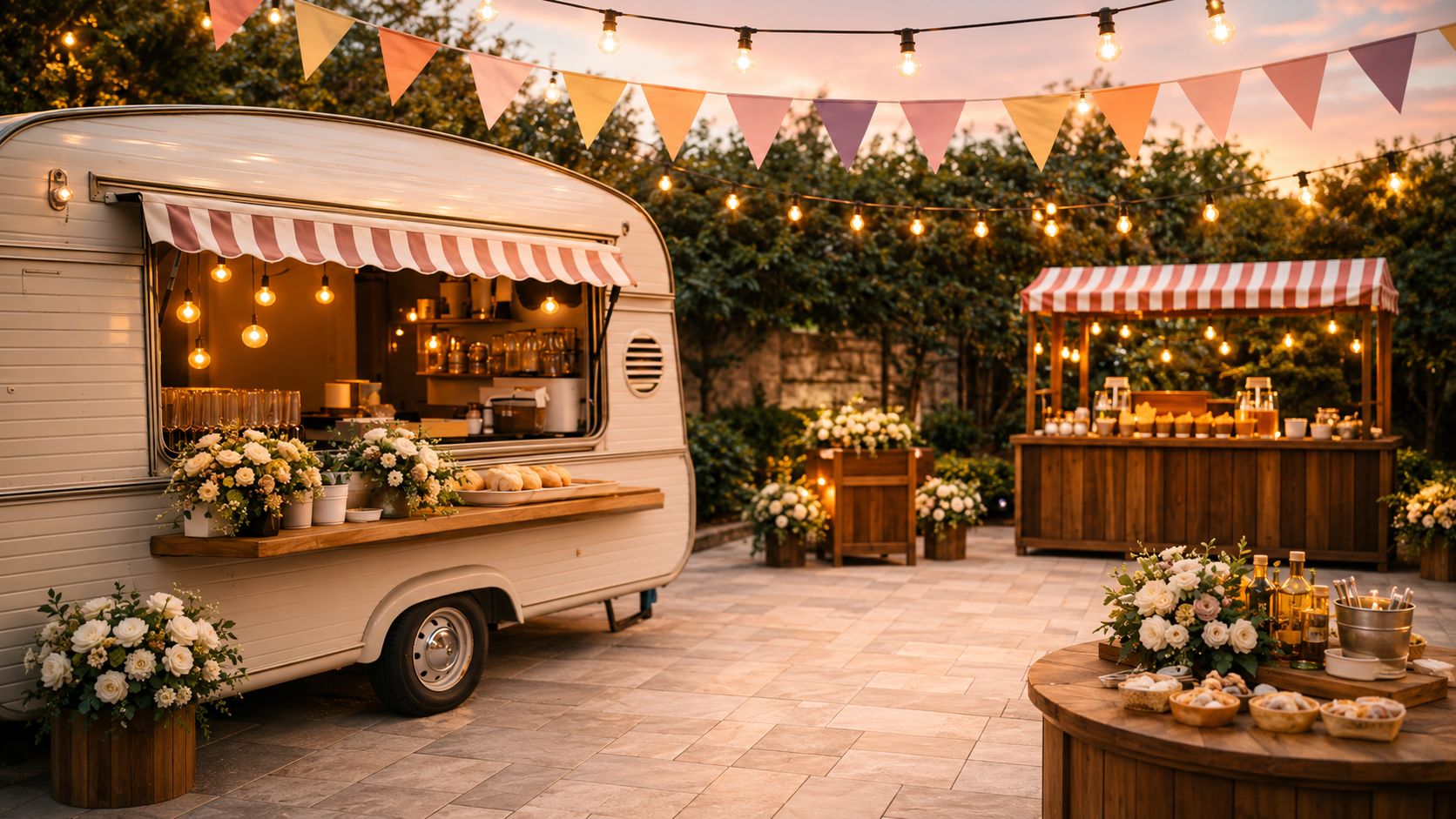
Street food trucks and mobile units are among the most cost-effective catering formats available and one of the best fits for outdoor and alternative venues. Converted vintage vans, horse boxes, and camper trailers positioned on-site serve high-quality, casual food — wood-fired pizza, slow-cooked barbecue, loaded tacos — at around £10–£25 per head, compared to £50–£150 for formal plated service. They're also a visual element that guests genuinely enjoy. Planning an outdoor wedding in 2026 increasingly means building the food and drink offer around these formats rather than retrofitting formal catering into an outdoor space.
Grazing tables — long farm tables laid with artisanal cheeses, cured meats, fresh bread, seasonal fruit, and honeycomb — suit the cocktail hour format brilliantly. They're visual showpieces, they remove the need for a full waiting staff team, and they photograph particularly well in outdoor and rustic settings.
Open-fire and live-fire cooking adds a genuinely dramatic element to woodland and farm venue receptions. Professional chefs roasting local, sustainably sourced meats over open flames provide both a sensory experience and an aroma that complements outdoor settings in a way that silver-service catering simply can't match.
Family-style sharing platters served in wooden bowls and cast-iron skillets passed between guests break down the formality of a seated dinner and reduce staffing overhead. For tipi, woodland, and farm venues where the atmosphere is naturally communal, this format feels far more natural than individual plated service.
💰 Budget Save: For outdoor and blank-canvas venues where you supply your own caterer, always get at least three quotes and be specific about the exact format (sharing platters versus plated, exact staffing levels, equipment they bring versus equipment you hire). The spread between caterers quoting for the same brief and guest count can easily be £1,000–£3,000.
Hidden Costs to Watch
The most common budget surprises for outdoor, woodland, and blank-canvas venue bookings:
- Weather contingency structures: If your chosen venue doesn't have a guaranteed indoor backup, factor in marquee or canopy hire — typically £800–£3,000 depending on size and quality level. Always ask explicitly what the venue's bad-weather Plan B looks like before signing.
- Generator hire: Rural and woodland venues often lack the electrical infrastructure for a full band or DJ. Generator hire typically runs £150–£500.
- Toilet hire: Outdoor venues without permanent facilities require luxury portable toilet units — budget £400–£1,200 depending on guest numbers and specification.
- Furniture and equipment: Blank-canvas venues rarely include chairs, tables, tableware, or linen. Hire costs for 80 guests typically add £700–£1,200 before catering.
- Transport logistics: Remote venues require guests to get home safely. If public transport isn't available, shuttle bus costs run £200–£600 depending on distance.
- Alcohol licensing: Some blank-canvas venues don't hold a premises licence for alcohol sales. A Temporary Events Notice (TEN) is the solution — a straightforward, low-cost process, but it must be arranged in advance.
⚠️ Watch Out: Always request a fully itemised quote — not just the headline hire fee. The venues that look cheapest on paper are sometimes the ones with the longest list of additional charges. The most genuinely affordable venues are transparent about the total cost from the first conversation.
At a Glance: UK Venue Types Compared
|
Venue Type |
Typical Hire Range |
Legal Status (E&W) |
Includes Infrastructure? |
Best For |
|---|---|---|---|---|
|
Register Office |
£62–£500 |
Fully licensed |
Yes |
Legal ceremony; pair with separate celebration |
|
Pub / Restaurant |
£0–£2,000 + min. spend |
Usually licensed |
Yes |
All-in simplicity, good food, low stress |
|
Village Hall |
£200–£1,000/day |
Usually not licensed |
No — hire equipment separately |
DIY couples with logistics support |
|
Tipi / Yurt |
£2,000–£6,000 |
Often licensed |
Usually yes (structure + bar) |
Festival feel, distinctive setting, flexible suppliers |
|
Woodland / Outdoor |
£1,500–£5,000 |
Varies — check carefully |
Partial |
Natural beauty, minimal decoration needed |
|
Lakeside / Farm |
£1,500–£6,000 |
Varies — check carefully |
Partial |
Dramatic setting, festival or communal format |
|
Scotland (Any Location) |
Minimal or flexible |
No building licence needed |
N/A — you choose the setting |
Maximum freedom, any landscape you love |
Frequently Asked Questions
What is the cheapest type of wedding venue in the UK?
A register office or council ceremony room is the lowest-cost legal option — the statutory ceremony in England and Wales costs as little as £146 in total. For a full celebration venue, village halls and community centres (£200–£1,000/day) are usually the cheapest to hire, though infrastructure and catering costs often close the gap with more inclusive options. Pub function rooms on a minimum spend basis tend to offer better all-in value once those additions are factored in. In Scotland, the cost can be minimal if you hold the ceremony at a private outdoor location with an authorized officiant.
Can you get married outdoors in the UK without a licensed venue?
In Scotland, yes — you can legally marry almost anywhere with an authorized officiant present, including beaches, forests, lochs, and private gardens. In England and Wales, the 2022 amendment allows outdoor ceremonies but only within the grounds of an already-licensed Approved Premises. Ceremonies in unlicensed public or private outdoor locations aren't legally binding under current law. Reform expected in 2027 may change this significantly, but until legislation passes, couples in England and Wales need either a licensed venue or a separate registry appointment.
Are tipi venues more expensive than barns?
Not necessarily, and the comparison is less straightforward than it first appears. Tipi venues typically include the structure, flooring, lighting, and bar setup in the hire fee, whereas barn venues frequently charge separately for furniture, staffing, and cleanup. A tipi venue at £4,000 all-in can offer better overall value than a barn at £3,000 hire that generates £2,500 in additions. Always compare total costs — not headline hire fees.
Is it cheaper to get married in Scotland than in England?
For outdoor and alternative weddings, usually yes — particularly when you factor in legal flexibility. Scotland's officiant-based system means you don't need to pay for an Approved Premises licence or compromise your venue choice to accommodate legal requirements. A ceremony on a loch shore, in a private woodland, or at a historic ruin with a humanist officiant is a fully legal marriage in Scotland — options that simply don't exist as legal ceremonies in England and Wales under current law.
What hidden costs should I look out for with outdoor venues?
The most common surprises are: weather contingency structures (marquees or canopies), generator hire for rural locations, portable toilet units for venues without permanent facilities, furniture and equipment hire for blank-canvas spaces, shuttle transport for remote venues, and Temporary Events Notices for venues without a premises alcohol licence. Always request an itemised quote and ask specifically what is and isn't included in the headline hire fee before signing anything.
Do I need an Approved Premises licence for my wedding venue in England?
Yes, if you want the ceremony itself to be legally binding. The licence is held by the venue, not the couple — confirm this when shortlisting, not after booking. Without it, your ceremony at that venue won't be legally recognised. The most common workaround is a short statutory ceremony at a register office (from £146) followed by a celebrant-led celebration at your chosen venue. The celebrant ceremony can be fully personal and meaningful; the legal element happens separately.
When is the cheapest time of year to book a wedding venue in the UK?
January, February, and November are typically the lowest-demand months. Midweek dates (Monday to Thursday) save further compared to weekends. Combining an off-peak month with a midweek date can reduce venue hire by 40–60% at the same venue. If your guest list is primarily close family rather than large social groups, a weekday winter wedding is well worth considering — and often produces a warmer, more intimate atmosphere than a peak summer Saturday.
What should I ask when viewing a wedding venue?
The most important questions: Does the venue hold an Approved Premises licence (for England and Wales)? What is and isn't included in the hire fee? Are there approved supplier lists with penalties for using external caterers? What is the weather backup if conditions change? Is there a corkage fee or minimum alcohol spend? What are the noise restrictions and when must music end? Is parking and transport adequate for your guest numbers? Asking these before you fall in love with the setting will prevent the most common planning surprises.
What is the most affordable region for wedding venues in the UK?
Wales typically offers the lowest average venue costs — overall wedding spend in Wales runs around 29% below the national average. Northern England and rural Scotland also offer strong value compared to London and the South East, where venue costs are often 10–20% above the national average. For the maximum combination of affordability and flexibility, Scotland's legal framework makes it the most practical option for couples planning outdoor ceremonies without a licensed venue.