Hindu and Sikh Wedding Outfits in the UK: Lehenga, Sherwani, Turban & Alterations
If you’re planning a Hindu or Sikh wedding in the UK, the outfit question soon turns into several smaller ones. Will the gurdwara accept the lehenga you’ve fallen for? Who ties the groom’s sehra and does it come off before the ceremony? And if the outfit is coming from India, will it arrive in time, and will there be tax to pay at the door?
 Rohan Kapoor
·
Updated November 2026
The short answer
Start with the ceremony venue, because some gurdwaras set written minimums for the bride’s outfit and the groom’s turban. Then work back from your date. Lehengas and sherwanis are sold in Southall and on Soho Road in Birmingham, and lehengas on Belgrave Road in Leicester, while one London-based bespoke studio asks brides for at least six months. Anything posted from abroad can carry VAT and duty and a made-to-measure order may not carry the usual right to cancel.
The words you’ll hear
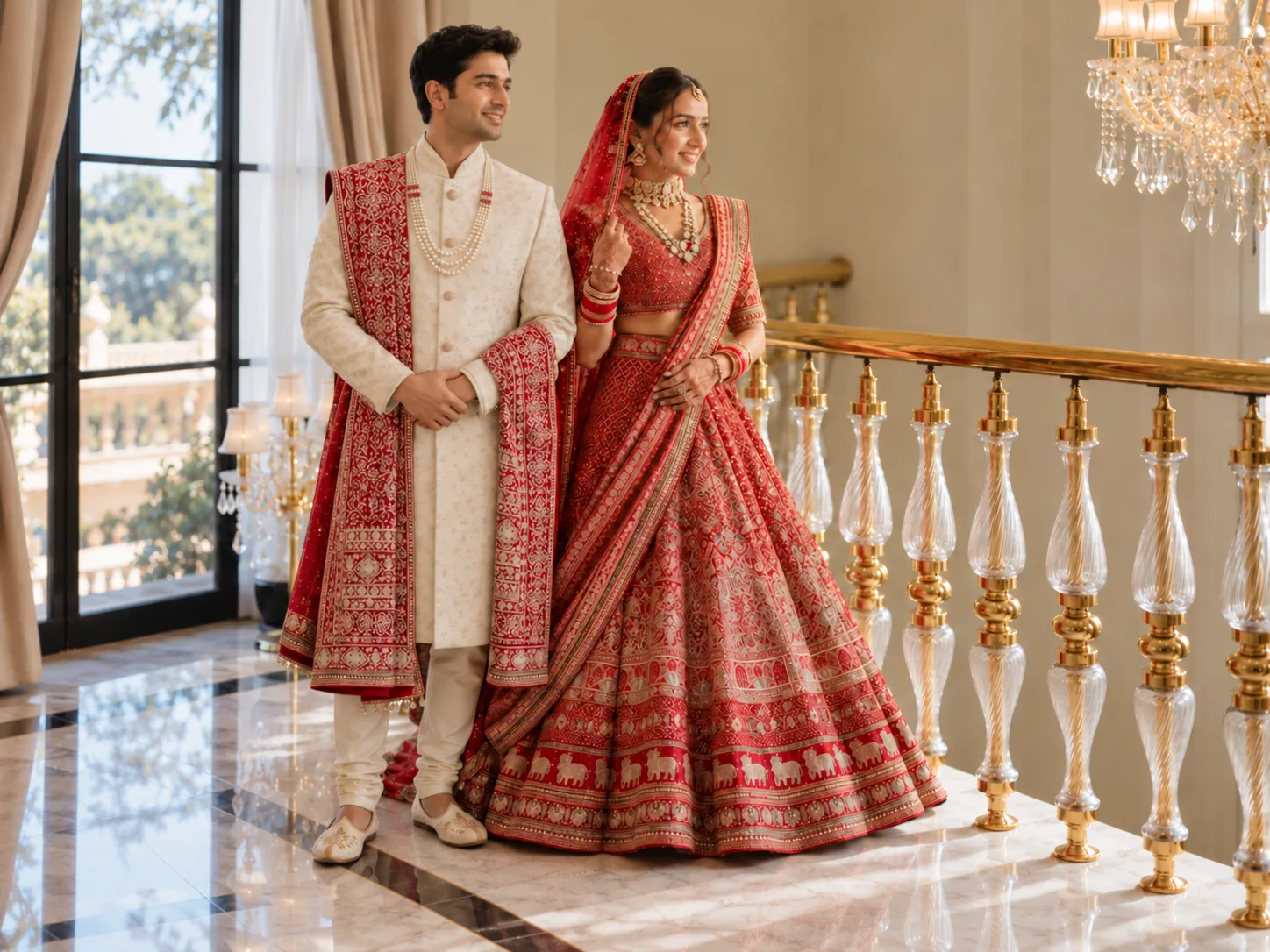
A 19th-century dictionary of Urdu and Hindi defines the lahaṅgā, the lehenga, as a skirt tied round the hips that reaches the feet or the ground. Merriam-Webster defines the sherwani as a long-sleeved, close-fitting, knee-length coat with a stand-up collar, worn by men of India and Pakistan. The same 19th-century dictionary gives pagṛī as a turban, and also as a mark of honour, respect and dignity. It defines the sehrā as a chaplet.
If one side of the family is Gujarati, you may hear about the gharchola. India’s register of geographical indications lists the Gharchola craft of Gujarat. A November 2024 news report of a Gujarat Chief Minister’s Office statement says gharcholas are traditionally worn on occasions such as weddings in Hindu and Jain communities, and were historically made in red, maroon, green and yellow.
What Punjabi and UK Sikh accounts record
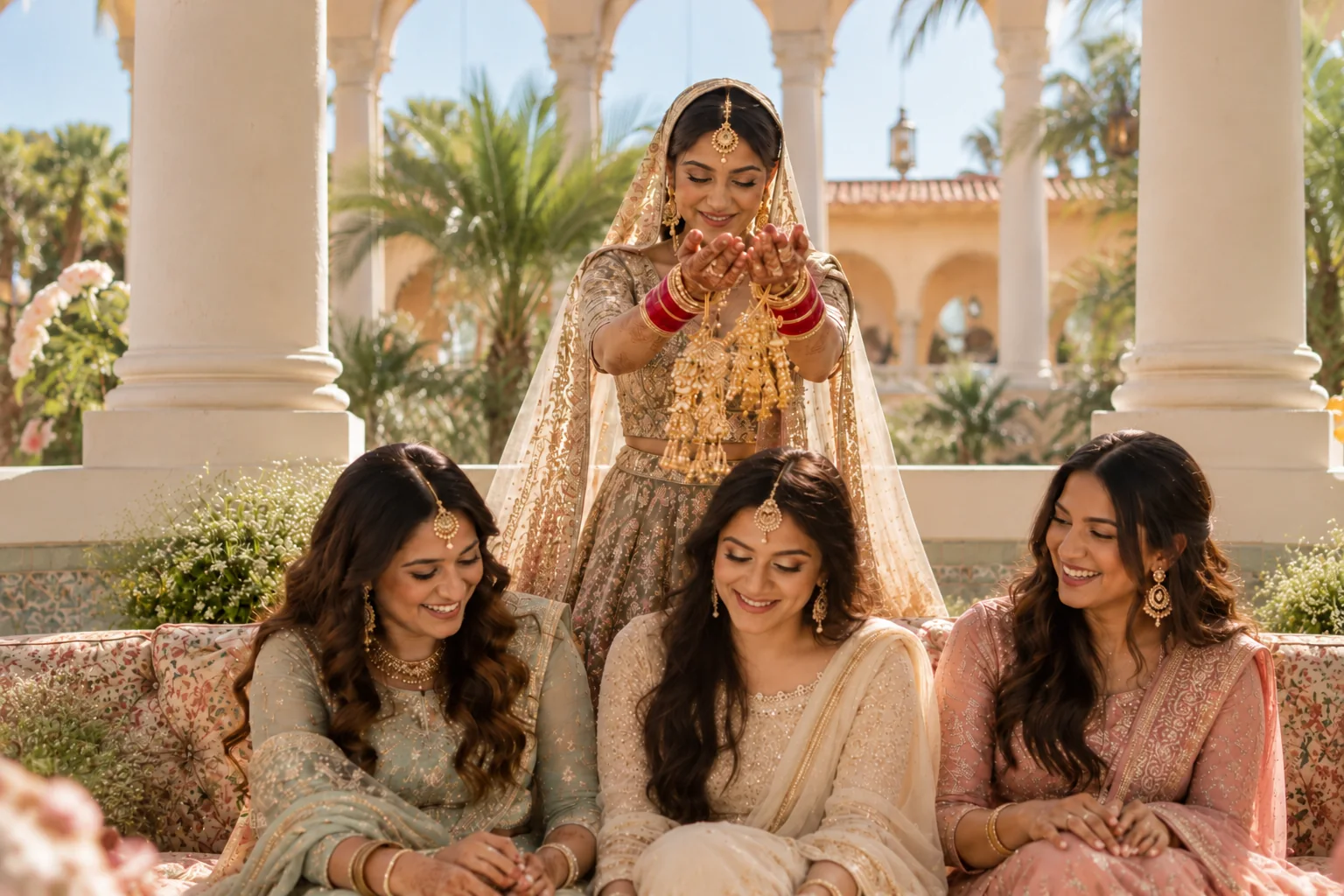
Each custom below is labelled with the account it comes from. A 2004 study of weddings in Punjab, India, which describes customs shared across the region’s communities, gives the maternal uncles of both bride and groom the role of providing the clothes worn on the wedding day. In that account the bride’s maternal uncle gives her red ivory bangles, the churha, which mark her as a married woman. He also ties a red thread, the gana, round her wrist. She arrives in the suit her maternal uncle gave her and leaves for her in-laws in a dress from the groom’s family. Her maternal aunt gives the kalira, trinkets or bells hung from her bangles, and a saying holds that the next unmarried girl they hit will be the next to marry.
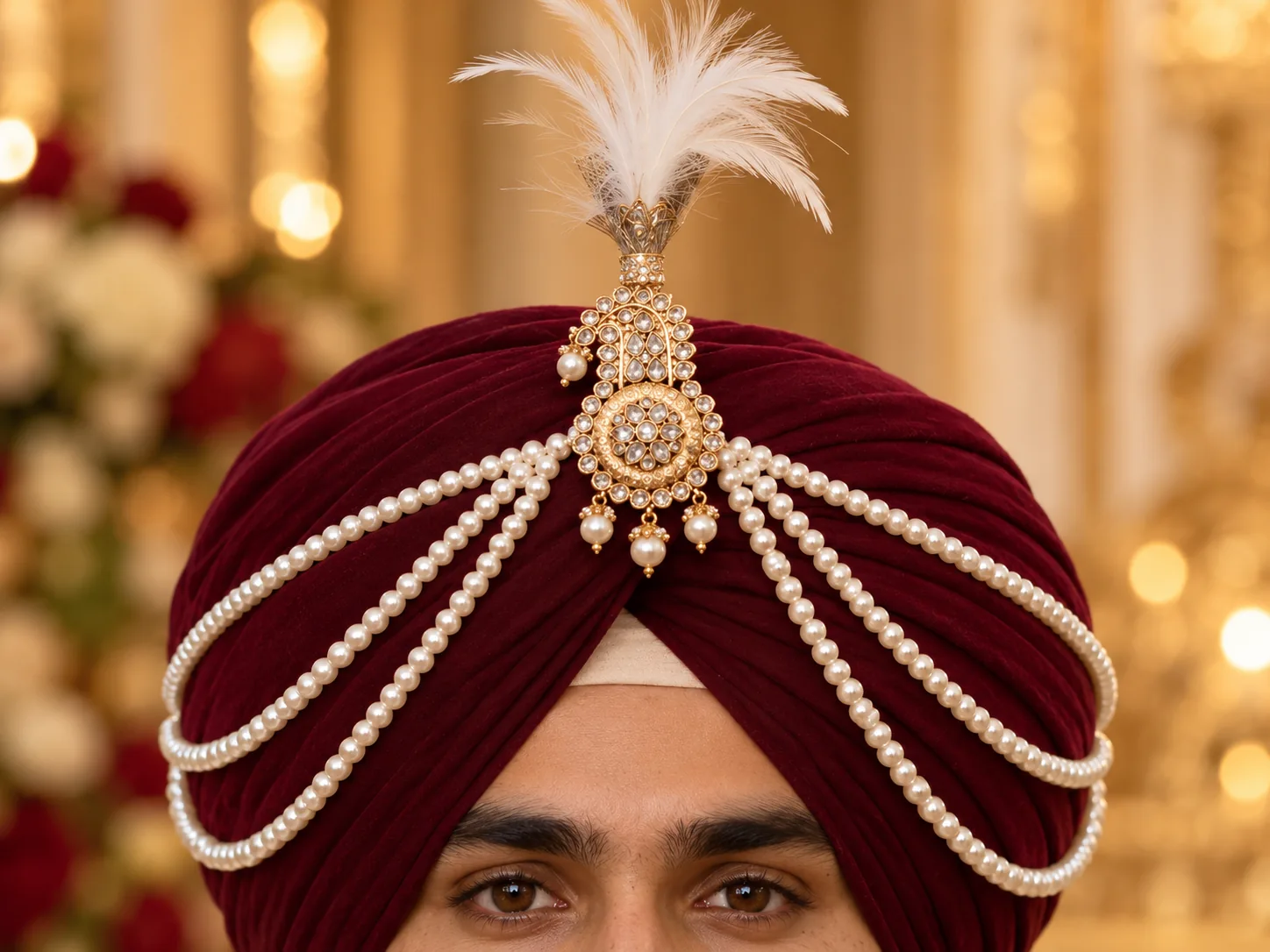
In the same Punjab account, the groom wears a red or pink turban and juti, shoes embroidered with gold thread. His sisters or his brothers’ wives attach a small plume, the kalgi, to the turban, and his sisters tie the sehra over it so that it covers his eyes until the wedding.
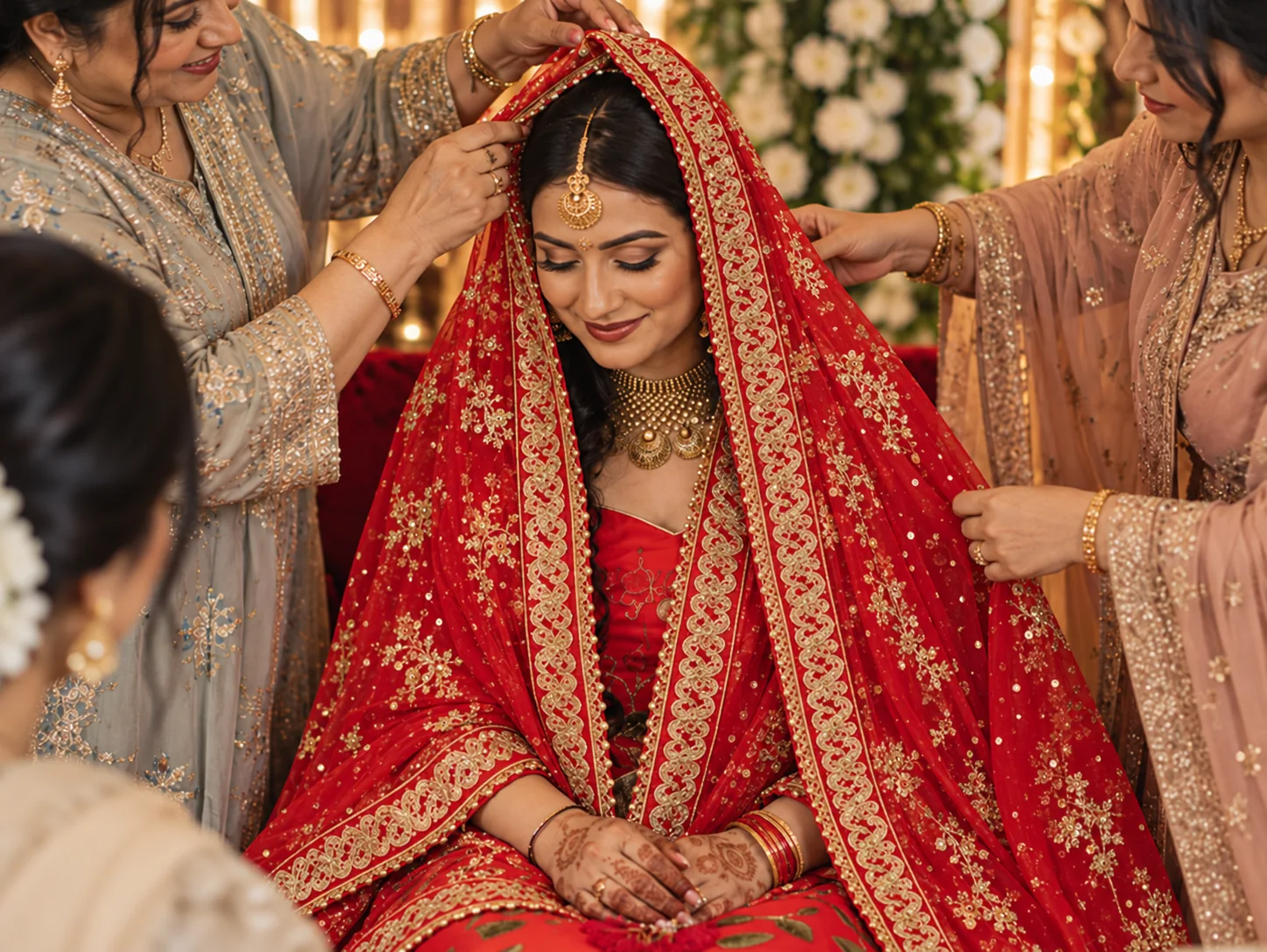
A 2016 study of Sikh weddings, focused on British Sikhs, lists choora for the bride and sehra bandi for the groom among pre-wedding customs that come from wider Punjabi and north Indian folk practice.18 It describes the chunni chadana, where the bride-to-be is dressed in a rich red garment.
At the sehra bandi, the groom’s sisters tie a fringe of flowers over his face (optional nowadays, the study notes) and the kalgi and kirpan are added. At the Anand Karaj, the bride’s father places in her hands the palla draped over the groom’s shoulder. Writing critically about rising wedding spending, the study also notes that close family on both sides now wear matching-colour turbans or head coverings to the ceremony. So if the groom’s side is planning turbans in one colour, the order and the fabric need agreeing early.
What a Hindu ceremony asks of your clothes
A study of weddings in England and Wales describes a Hindu ceremony in which the couple’s right hands are joined and their clothing is tied together (ganth bandhan) while prayers are said. Later the groom places a mangalsutra necklace on the bride and puts red sindoor powder along the parting of her hair. Both moments touch the outfit, so check that the groom’s look includes a stole or scarf that can be knotted, and that the bride’s dupatta leaves her hair parting reachable. The priest can tell you how your family’s ceremony will run.
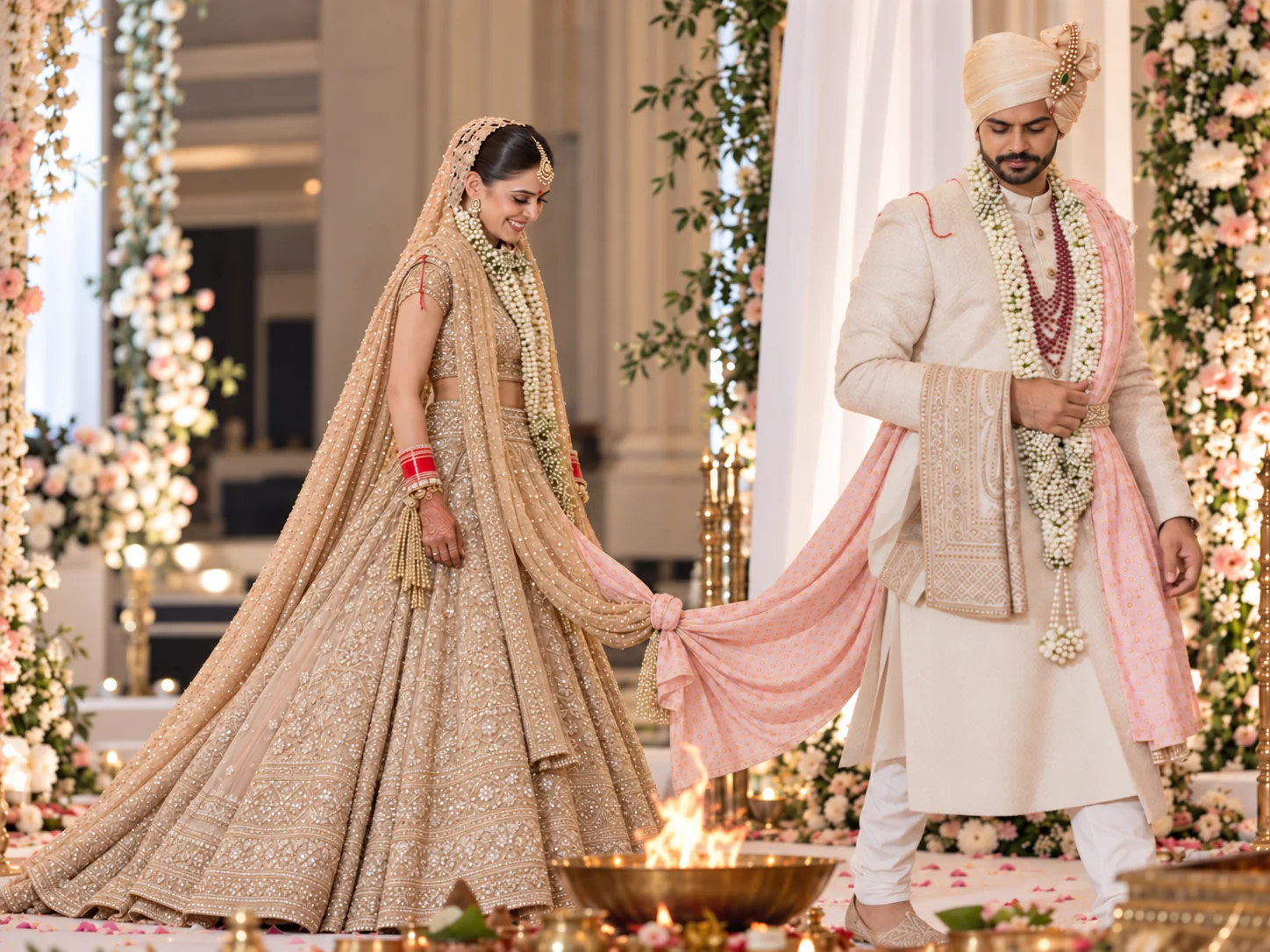
Check the ceremony venue’s dress rules first
For a Sikh wedding, the gurdwara’s own rules decide what works on the day and the three below publish theirs. Sri Guru Singh Sabha Southall says the bride and groom must wear modest clothing, with the midriff and chest covered and asks for outfits that are secure and practical to sit and move in. Its guidelines list what brides there have regretted: lehengas that are too heavy, tops that lift when the bride bows (matha tekna), skirts too tight or too layered to sit in and a dupatta or chunni that is too heavy. Guests there need their whole head covered, with chunnis and bandanas provided at the entrance.
Ramgarhia Board Leeds sets minimums for the bride: at least half sleeves, a covered midriff, a high neckline, and an outfit she can manage on her own. It recommends a single-piece suit. The groom must wear a dastaar (turban) with no excess material hanging from the back, front or top. Its order of ceremonies includes removing the kalgi, which it says the sisters traditionally do and which can be done in the diwan hall. Siri Guru Singh Sabha Croydon says no kalgi or sehra should be tied or hanging on the turban during the ceremony in front of the Guru Granth Sahib. Leeds also warns that its committee can cancel the Anand Karaj if couples or families don’t follow its terms.
If your ceremony is at a temple or another Hindu venue, ask for its dress expectations in writing before you choose the outfit.
Where to buy in the UK
Southall, Soho Road and Belgrave Road each have shops selling wedding wear. Manyavar and Mohey has a store at 42 The Broadway, Southall, London. When we checked its UK website on 19 October 2026, the first page of ready-to-wear lehengas ran from £205 to £1,025, and the first page of sherwanis from £295 to £775.4,21 In Birmingham, AMANS at 222 Soho Road listed lehengas at £294.99 and £394.99.5 Diya’s Direct, also on Soho Road, offers bridal lehengas, sarees, sherwanis and groom wear, with bespoke outfits by appointment. In Leicester, Shree at 65 Belgrave Road sells sarees, lehengas, salwar suits and bridalwear.
The pre-wedding events need outfits too. For a haldi, the first page of Manyavar’s UK men’s range of yellow and mustard kurta sets ran from £45 to £275 when we checked, and Fabilicious Fashion lists over 200 pieces under its haldi ceremony filter. Our guide Haldi Ceremony Planning for Hindu Weddings in the UK covers the ceremony itself. Add each outfit to Wedvisa’s budget calculator, which lets you set a total and allocate it by category, so the smaller events don’t eat into the bridal budget.
Ordering from India or a studio abroad
Some designers sell to UK couples but make the clothes in India. GISAW London designs in London and makes in India. It asks brides for a minimum of six months and says production takes 6–8 weeks once the design is confirmed. It offers up to three fittings, starting with a toile and posts toiles to brides abroad. Chirag Parmar Signature tailors groom wear in Bengaluru, has no UK showroom, and asks for an in-person fitting at its Bengaluru atelier for structured pieces such as wedding sherwanis; its London timetable puts delivery in weeks 4–6.
How the outfit reaches the UK changes the tax. If you arrive in Great Britain from outside the UK with it in your luggage, GOV.UK’s guidance gives a personal allowance of £390 for goods other than alcohol, tobacco and vaping products, or £270 if you arrive by private plane or boat. Go over it and you pay tax and duty on the whole value of the goods, including the part within the allowance. If the outfit is posted to Great Britain, VAT is charged on goods sent from outside the UK, except gifts worth £39 or less, and Customs Duty applies to goods worth more than £135. The courier or Royal Mail contacts you if anything is due before delivery. Fabilicious advertises duty-free shipping to the UK, and Chirag Parmar Signature says its courier delivery includes customs clearance. Neither line tells you who pays if a charge is due, so ask the seller in writing. GOV.UK has a separate page for arriving in Northern Ireland.
Bespoke orders and changing your mind
The Consumer Contracts Regulations 2013 give you a right to cancel an online or phone order within a cancellation period, without giving a reason. That right doesn’t apply to goods made to your specifications or clearly personalised. A lehenga cut to your measurements, or a sherwani with your initials embroidered inside, may fall into that category. Before paying a deposit, read the studio’s terms on changes and refunds and for a seller outside the UK, ask what its own refund terms say. GISAW, for example, takes full payment or a 50% deposit to start an order.
Fittings and alterations
Leave time for at least one fitting after the outfit arrives, wherever it was bought. MASSS Tailor on King Street in Southall makes and alters bridal lehengas and sarees, agrees a collection date with you at the start, and says it adjusts until the outfit fits. GISAW offers bridal clients a free round of amends, with changes outside the confirmed design charged.8 Book the final fitting close enough to the wedding to catch any changes in fit and wear the shoes and jewellery you’ll wear on the day so the hem is cut to the right length.
Planning your outfits, step by step
- Ask the ceremony venue for its dress rules before you shortlist anything, and share them with whoever is making the outfit.
- List every event that needs an outfit, from the haldi or mehndi to the reception, and who in the family needs one.
- Set a budget per outfit in Wedvisa’s budget calculator, including alterations, jewellery and delivery.
- Decide where each outfit comes from: off the rail in the UK, made to measure in the UK, or ordered from abroad.
- Get the timings in writing: production time, fitting dates, delivery date and who pays any VAT or duty.
- Agree the family pieces: who gives the bride’s ceremony outfit or bangles, who ties the sehra, and whether the groom’s side wants matching turbans.
- Book the fittings and bring the shoes and jewellery.
- Put the deadlines in Wedvisa’s planning timeline, which calculates booking deadlines from your wedding date.
A suggested timeline
This is a suggestion to adapt, built around the lead times above; your maker’s own dates come first.
|
When |
What to do |
|---|---|
|
6 months or more before |
Bespoke bridal order with a studio that asks for six months, like GISAW |
|
3–4 months before |
Order or buy ready-to-wear outfits; agree matching turbans |
|
2 months before |
Outfits from abroad should be in hand, with any tax paid |
|
4–6 weeks before |
First fitting and alterations |
|
1–2 weeks before |
Final fitting with shoes and jewellery; check the venue’s dress rules once more |
Questions to settle as a family
- Is anyone giving the bride’s ceremony outfit or her bangles, as the maternal uncle does in the Punjab account?
- Will the groom’s side wear matching turbans or head coverings, and who is ordering them?
- Who ties the sehra and who removes the kalgi before the ceremony if the gurdwara asks?
- Will the bride change outfits between the ceremony and the reception, and where will she change?
- Who is minding the outfits, jewellery and spare safety pins on the day?
Legal and practical points
- Customs: the £390 allowance and the posted-goods rules are on GOV.UK. Keep receipts with the outfit when you travel.
- Cancelling: goods made to your specifications or clearly personalised are excluded from the usual right to cancel under the Consumer Contracts Regulations 2013.
- Ceremony rules: a gurdwara’s dress rules are that gurdwara’s own conditions, and some reserve the right to cancel if they aren’t followed.
- Family variation: the customs above come from accounts of Punjab, British Sikh weddings, Hindu weddings in England and Wales and Gujarat; your families may do things differently.
Outfit checklist
Tick these off in Wedvisa’s wedding checklist.
- ☐ Ceremony venue’s dress rules in writing
- ☐ Outfit list by event and by person
- ☐ Budget per outfit, including alterations
- ☐ Maker’s production and delivery dates in writing
- ☐ Who pays VAT and duty on anything from abroad
- ☐ Refund and change terms read before the deposit
- ☐ Matching turbans or head coverings agreed and ordered
- ☐ First fitting booked
- ☐ Final fitting booked, with shoes and jewellery
- ☐ Head coverings for guests if the ceremony is at a gurdwara
At a glance
|
Moment |
Outfit decision |
Check with |
|---|---|---|
|
Haldi or mehndi |
Yellow or festive wear, which can be bought off the rail |
Your budget |
|
Gurdwara ceremony |
At some gurdwaras: covered midriff and chest, an outfit you can sit in, and no kalgi or sehra on the turban |
The gurdwara’s written rules |
|
Hindu ceremony |
A stole the groom can have knotted; a dupatta that leaves the bride’s hair parting reachable |
The priest and the venue |
|
Reception |
Change of outfit if planned |
The venue’s changing room |
|
From abroad |
Allowance or VAT and duty |
GOV.UK and the seller |
|
Bespoke order |
The usual right to cancel may not apply |
The maker’s written terms |