Igbo Traditional Wedding (Igba Nkwu) Planning in the UK
If one or both of your families are Igbo, you may be fitting an Igba Nkwu (the wine-carrying ceremony) into a plan with other events. The visits before it can differ from town to town, so agree with both families which ones happen and in what order. Book the legal ceremony separately, and brief your venue, MC and caterer on what the wine-carrying involves.
 Oluwole Adebayo
·
Updated November 2026
The short answer
In Nkwerre, in Imo State, the Igba Nkwu is the ceremony in which the bride publicly identifies her groom by presenting him with a cup of palm wine before kin and community; a 2025 study of Igbo weddings in Nigeria describes the same moment in some Igbo communities. The visits and meetings before it differ across the three places described below. Held in England or Wales, an Igba Nkwu does not by itself make a legal marriage, so the legal ceremony is planned as its own item. Notice for that ceremony must be given at least 29 days ahead.
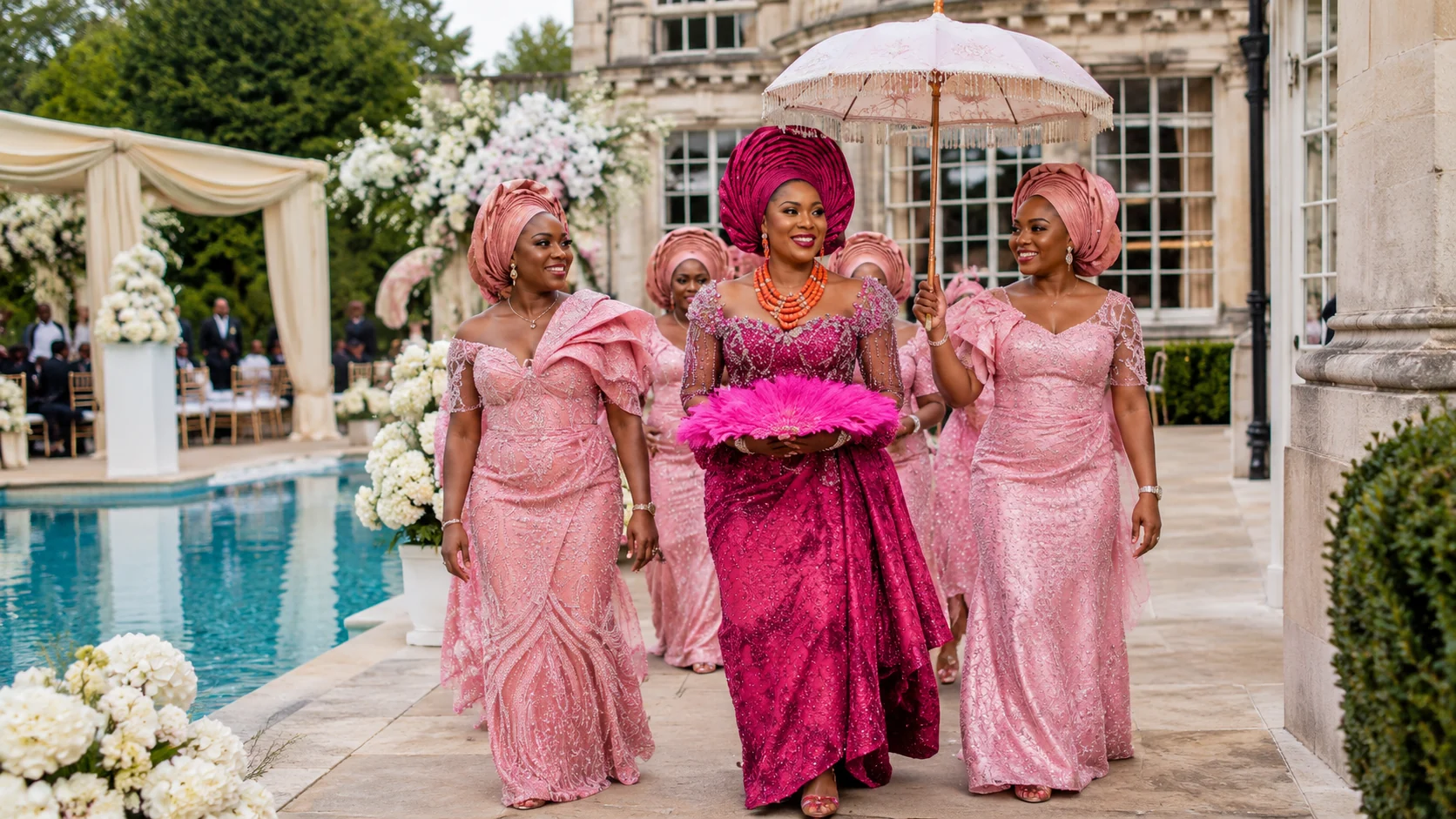
What the Igba Nkwu completes
In Nkwerre, in the Orlu zone of Imo State, the Igba Nkwu is described as the culmination of a longer marriage process. The 2025 study lists the negotiations before it as including Iku Aka (knocking on the door) and Ime Ego (payment of the bride price) in some Igbo communities. Each town keeps its own list, and your family’s town may follow another order or use other names.
The stages before the Igba Nkwu, town by town
|
Place |
What is described |
|---|---|
|
Nkwerre, Imo State |
Typically five stages: Iku Aka Nuzo (knocking on the door), Iga Di Abali Ano (the four days marriage visit), Iga Di Abali Asato (the eight days marriage visit), Nwaoka n’Ulo (final confirmations and bride price), then the Igba Nkwu. At Nwaoka n’Ulo both families publicly confirm that the couple consents to marry, and the bride’s father or a senior male relative hands her a cup of palm wine to identify her intended husband. |
|
Awgbu, Anambra State |
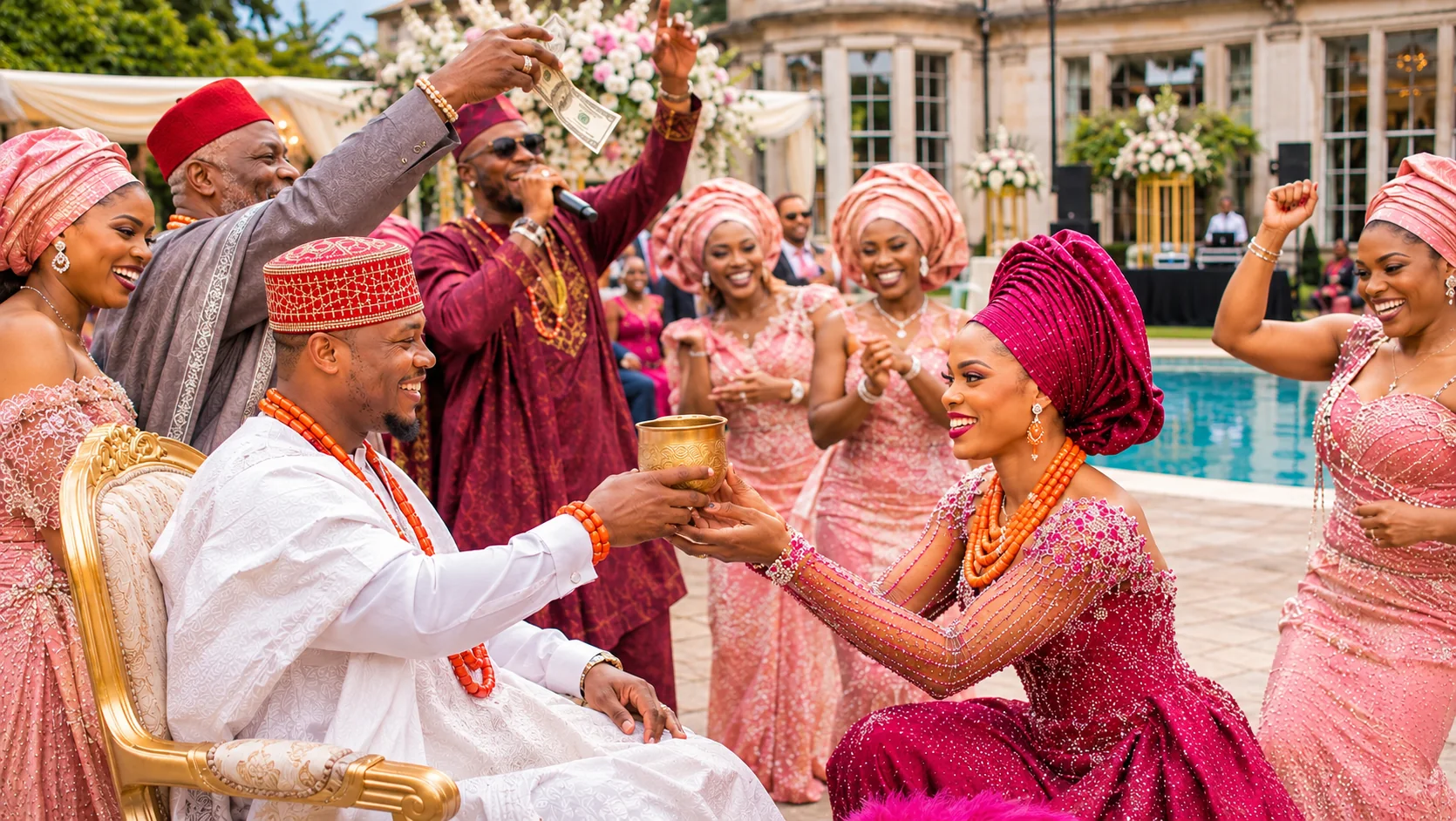
The bride-price negotiation is performed by ten elderly men, five from each side. After prayers with kola, the bride’s father or father figure gives her a drink in a cup to show them her would-be husband; she sips it and gives it to him, they return the cup with money from him and kneel for her father’s blessing, and she leaves before the negotiation starts. |
|
Anambra State (one study) |
A first introduction, when the groom, his father and one or two relatives visit the bride’s parents’ house, then a second, after which a date is set for paying the bride price. On that day the bride is given a glass of palm wine to sip and pass to the man; if she does not, that means she has rejected the suitor. The main ceremony is held in public in the bride’s compound, witnessed by selected members of both families, after the blessing of kola and the pouring of drinks. |
In all three accounts a drink in a cup also appears before the public ceremony, at a different point in each place: at Nwaoka n’Ulo in Nkwerre, at the bride-price meeting in Awgbu and on the bride-price day in the Anambra study. Which of these stages will your families hold, and where?
Who does what in the family
In Nkwerre, the groom’s delegation at the knocking visit is typically led by the eldest member present, who acts as the family’s spokesperson. At Nwaoka n’Ulo, extended-family rites are also performed: Ihe Umunna (rites involving the male lineage), Ihe Umunwanyi (rites for the women’s group) and Ihe Nne Nwa (rites involving the bride’s mother), after which a date is set for the Igba Nkwu. In Awgbu, the umunna are all the men of the kindred and the umuada are its married daughters, who receive a gift; the bride’s mother and father, or the people who fill those roles in her life, also have named parts.
For a UK plan:
- Who speaks for each family, and who briefs the MC?
- Which kindred groups need a seat, a gift or a role on the day?
The list and the gifts
In Nkwerre, gifts such as wrappers, drinks, food items, jewellery and livestock, often including a goat, are presented to the bride’s father as part of these rites. In Anambra State, the items are recorded as differing slightly from one locality to another, and the groom could instead give the money equivalent. In Awgbu, kola is described as among the most important items, used by the bride’s family to welcome their in-laws and in the prayers.
Item lists and amounts are for your two families to settle. If you use a list, who agrees it, who holds it, and will items be brought or money stand in for some?
On the day: the search, the music and what people wear
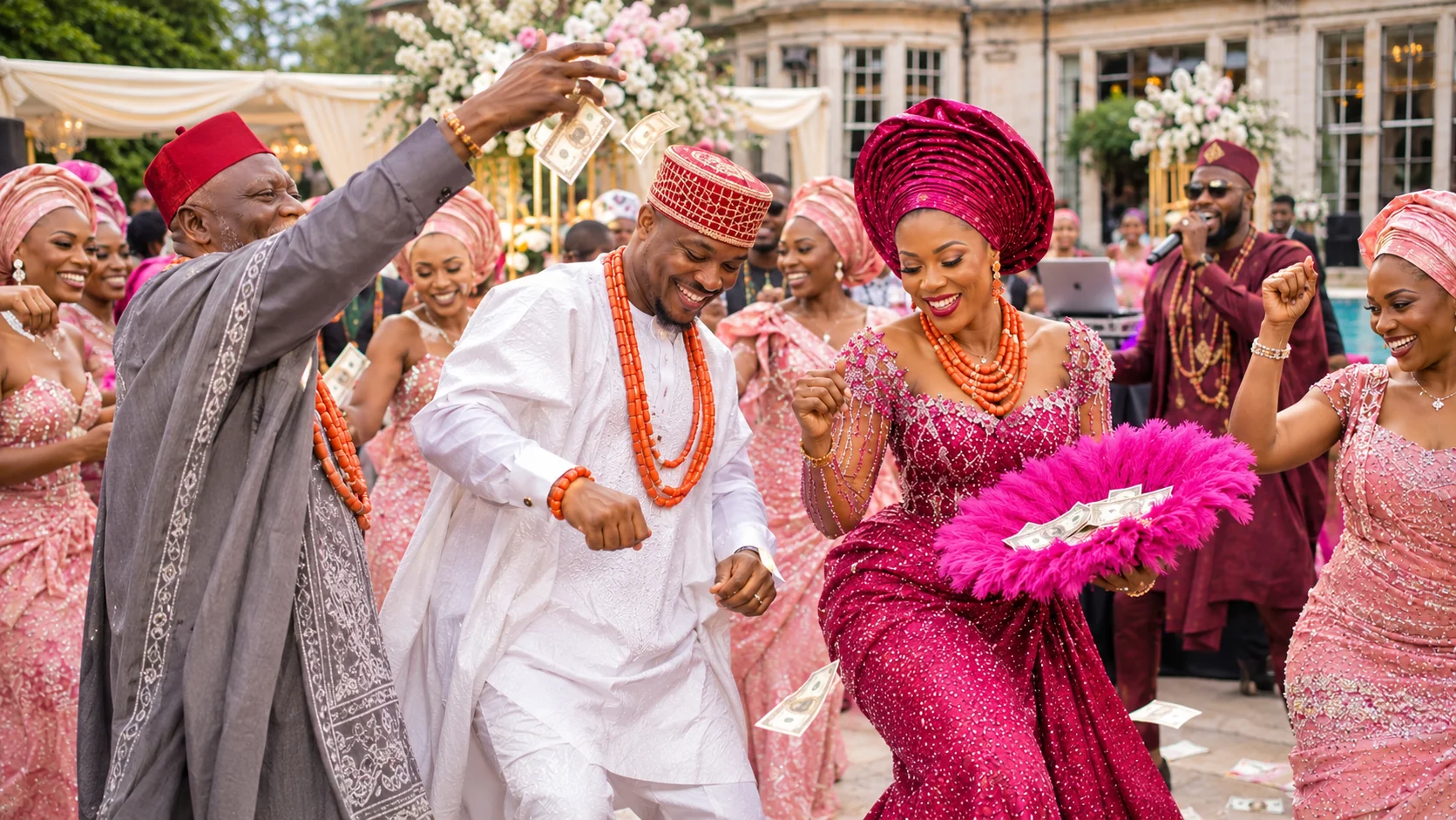
In Nkwerre, the bride carries a cup of palm wine and searches among the guests for her husband, often with her bridesmaids and female relatives, dancing while guests cheer and musicians play. She kneels to present the wine and, once he drinks, the crowd applauds. In Awgbu, the bride kneels before the man she has chosen to give him the drink her father gave her; he drinks in front of the guests and puts some cash in the cup, and both kneel for her father’s blessing.
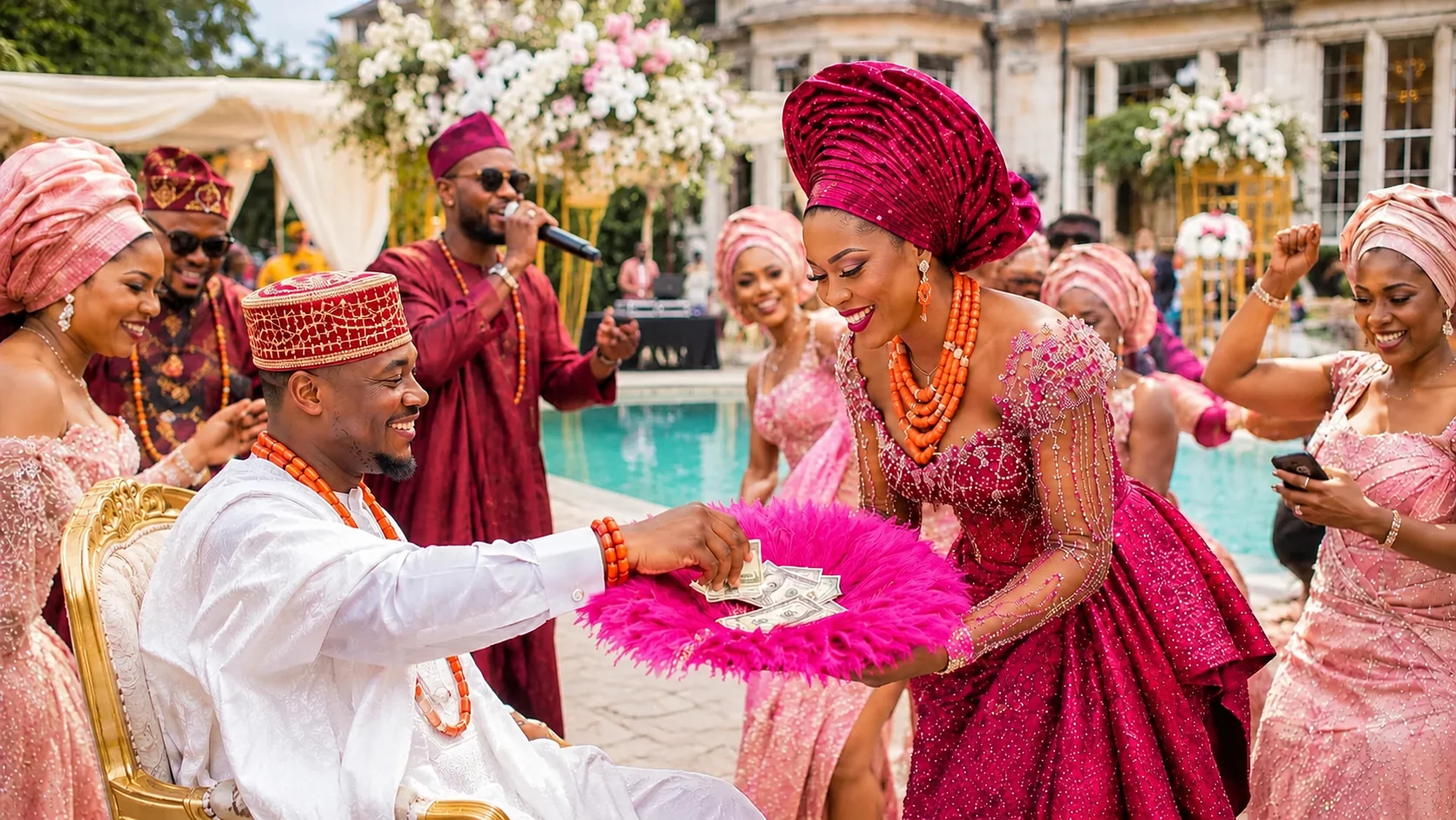
One musician in Nkwerre says traditional music still accompanies the key rituals, with recorded music after the formal parts. Live drummers for the formal parts and a DJ afterwards, or one team? Once your families agree the running order, Wedvisa’s Day Timeline is where to set the programme.
The 2025 study describes the bride in an ichafu (headscarf), coral beads and an embroidered blouse and wrapper, or George wrappers with headpieces, and the groom in an isiagu shirt. A bridal designer in Nkwerre says attire depends on the individuals, from heavy coral beads to more modern choices.
The legal ceremony in England and Wales
In Nkwerre, church weddings and civil marriages are generally regarded as complementary to the customary rites that culminate in the Igba Nkwu, not as substitutes. In England and Wales, an Igba Nkwu does not by itself make a legal marriage; the marriage is made by a ceremony that follows the legal formalities.
You must decide where the ceremony will take place before giving notice. Notice must be given at least 29 days before it, and the ceremony must take place within 12 months of notice. A civil ceremony can be held at a register office or any venue approved by the local council, with at least 2 witnesses; a religious wedding can take place at any registered religious building. A civil ceremony must not include anything religious, but a religious blessing can follow it, so whether any part of your rite counts as religious is a question for the registrar. A ceremony that does not follow these formalities may not result in a marriage the law recognises at all. In Scotland, National Records of Scotland says the registrar must have the notices at least 29 days before. In Northern Ireland, nidirect gives a minimum of 28 days.
The venue, drinks and timing
One London venue, The Willows in Hainault, says an Igba Nkwu needs open floor space for the bride to move through the crowd, and advises asking a venue directly whether it has hosted your tradition. Meridian Grand in London N18 says it is licensed for civil ceremonies, so the legal marriage can take place on site.
Questions for any venue:
- Is there floor space for the search?
- Whose home or which hall stands in for the compound described in the Anambra account?
- Does the venue supply the palm wine, or can you bring it?
- Can the MC work in Igbo and English, so guests who do not speak Igbo can follow the formal parts?
- Can you bring your own band or DJ, and what is the finish time?
- How is cash on the day handled, and is spraying money allowed?
For food brought into Great Britain from outside the EU, GOV.UK requires a plant health certificate for most fruit and vegetables, with exceptions such as peeled and processed nuts; kola nuts are not named there. For alcohol arriving in Great Britain from outside the UK, personal allowances apply, palm wine’s category is not stated, and going over an allowance means tax and duty on all of that category. A buffet needs allergen information for each item separately, in England, Northern Ireland and Wales. A hall whose licence does not cover your plans may need a Temporary Event Notice (fewer than 500 people, including staff) in England and Wales, applied for at least 10 clear working days before.
Family questions: where, who comes, who pays
One member of the Nkwerre diaspora, living in London for over twelve years, can now follow a cousin’s Igba Nkwu live through a sister’s video call.
- Which stages will be held at home, and which here?
- Who must be present in person, and who can join by video?
- If the Igba Nkwu and a white wedding fall in different countries, who delivers the photos and video of each, and by when?
- Who pays for which event?
Wedvisa’s Guest List Manager and Budget Calculator are where the guest lists and figures can go.
A suggested planning order
- Agree with both families which stages happen, in what order and where.
- Settle who speaks for each family and which kindred groups have a role.
- Decide the venue for the legal ceremony.
- Give notice at least 29 days ahead (England and Wales).
- Put the venue questions above to your venue and MC.
- Put the programme in the Day Timeline, the dates in the Planning Timeline and each step in the Wedding Checklist.
Questions about the Igba Nkwu in the UK
What is the Igba Nkwu ceremony?
It is commonly translated as the wine-carrying ceremony. In Nkwerre, the bride publicly identifies her groom by presenting him with a cup of palm wine.
What is the order of events for an Igbo traditional wedding?
There is no single order. Nkwerre typically has five stages ending in the Igba Nkwu, and one Anambra study describes a first and second introduction before the bride-price day, as the table above shows.
Does an Igba Nkwu in England or Wales count as a legal marriage?
No, not by itself. The legal ceremony is planned as its own item, as GOV.UK sets out.
Who pays for the Igbo traditional wedding?
That is for your families to agree, event by event. Wedvisa’s Budget Calculator is where the figures go.
At a glance
|
Decision |
Where it stands |
|---|---|
|
Stages before the day |
Differ by town: five in Nkwerre, two introductions in one Anambra study |
|
Legal ceremony |
Decide the venue, give notice at least 29 days ahead (England and Wales) |
|
Igba Nkwu |
Does not by itself make a legal marriage in England and Wales |
|
The list |
Items differ by locality in Anambra State |
|
First tool |
The Day Timeline |