Planning a Yoruba or Igbo Wedding in the UK: Where to Start
If you’re planning a wedding for families with Yoruba or Igbo roots in Nigeria, you may be fitting a traditional wedding (a Yoruba engagement or an Igbo Igba Nkwu), a legal ceremony and a reception into one plan. Fix the legal ceremony and its venue first, agree the family decisions next, then place the traditional wedding and reception around them.
 Oluwole Adebayo
·
Updated November 2026
The short answer
A Yoruba or Igbo wedding can involve several events. In Ibadan, in south-western Nigeria, one study found Yoruba weddings in civil, religious and traditional forms. A Yoruba engagement or an Igba Nkwu held in England or Wales does not by itself make a legal marriage, because the marriage is made by a ceremony that follows the legal formalities. In England and Wales you must give notice at least 29 days before that ceremony. So the legal ceremony goes first on your plan, with the traditional wedding and the reception fitted around it.
Which traditions this guide covers
Nigeria has an estimated 250 ethnic groups, and three of them are named as major: the Hausa-Fulani, the Yoruba and the Igbo. Two of the three are covered here, Yoruba and Igbo. Hausa-Fulani weddings, and those of Nigeria’s other groups, are not described.
Nigeria appears here as a place, and each tradition gets its own section. Each detail below says where it was recorded, or what kind of source it comes from. The Yoruba details come from Ibadan, the Lagos area and Abeokuta in south-western Nigeria, plus one study of Yoruba Christian couples in North West England. The Igbo details come from Nkwerre in Imo State, Awgbu and other communities in Anambra State, plus one study of Igbo weddings in Nigeria more widely. Your own family may do things differently, so where the detail runs out you’ll find a question to take to them instead.
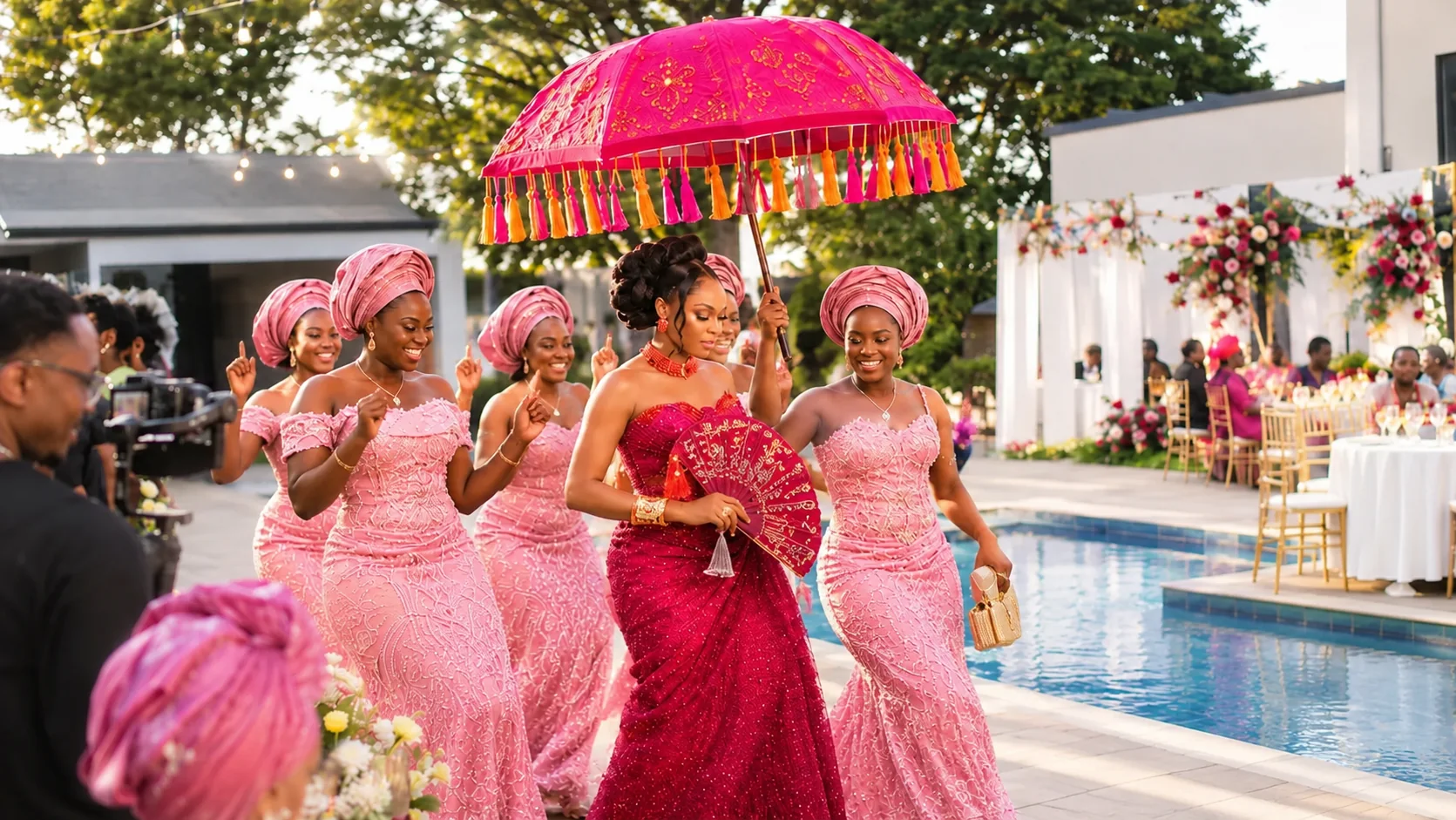
The legal sections cover England and Wales, with one line each for Scotland and Northern Ireland. Marriages held in Nigeria are not covered.
The events one date may have to hold
Picture the date both families have in mind. Before anyone books a hall, it helps to know which events that date has to hold, because the words for them blur.
In Ibadan, the religious weddings recorded were Muslim or Christian, with families of both kinds. The traditional wedding there included what is locally called the introduction and the engagement, when the two families and their extended families meet. The religious and civil weddings usually came after the traditional wedding. That is Ibadan’s order, not a rule for the UK.
In Nkwerre, Imo State, one study reports that church weddings and civil marriages are regarded as complementary to the customary rites rather than as substitutes for them. The legal position in England and Wales is further down.
The next two sections take the Yoruba and Igbo events one at a time.
Yoruba: the introduction, the engagement and the alagas
Two words come up first. In the Lagos area, the introduction, where members of both families are introduced, and the engagement, called the proper wedding there, have been described as a “twin” ceremony. Among Yoruba Christian couples in North West England, one study describes something earlier and separate, a declaration of marriage intent arranged by the groom’s family, at which they ask for the Idana. Idana is glossed in English as betrothal or engagement. So the introduction can be its own event or part of the engagement, and which it is for you is something your two families will know.
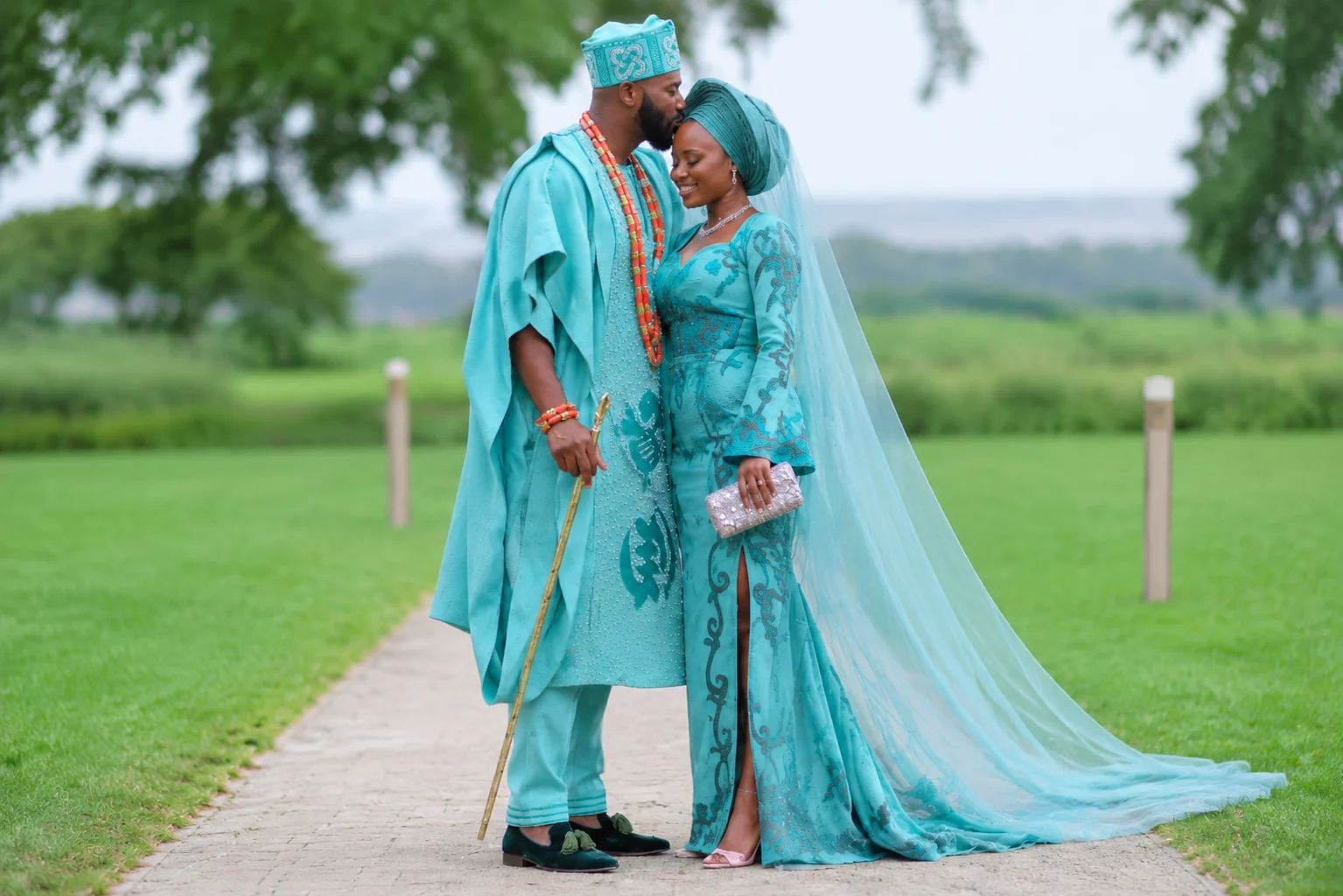
Then there are the alagas. In the Lagos area and in Ibadan, the Alaga Ijoko (“sitting chairman”) is the spokeswoman, or rarely a spokesman, for the bride’s family, and the Alaga Iduro (“standing chairman”) is the spokeswoman or spokesman for the groom’s family. The Lagos-area study adds that the two alagas are paid by the parents on either side and that professional alagas exist nowadays. The alaga is briefed on matters such as the list of goods expected.
In Ibadan, payment of bride price is among the traditional actions of the wedding. Amounts are for the two families to settle between themselves.
Practice can differ again by family and by religion, and your two families may do it their own way.
Igbo: the Igba Nkwu and what comes before it
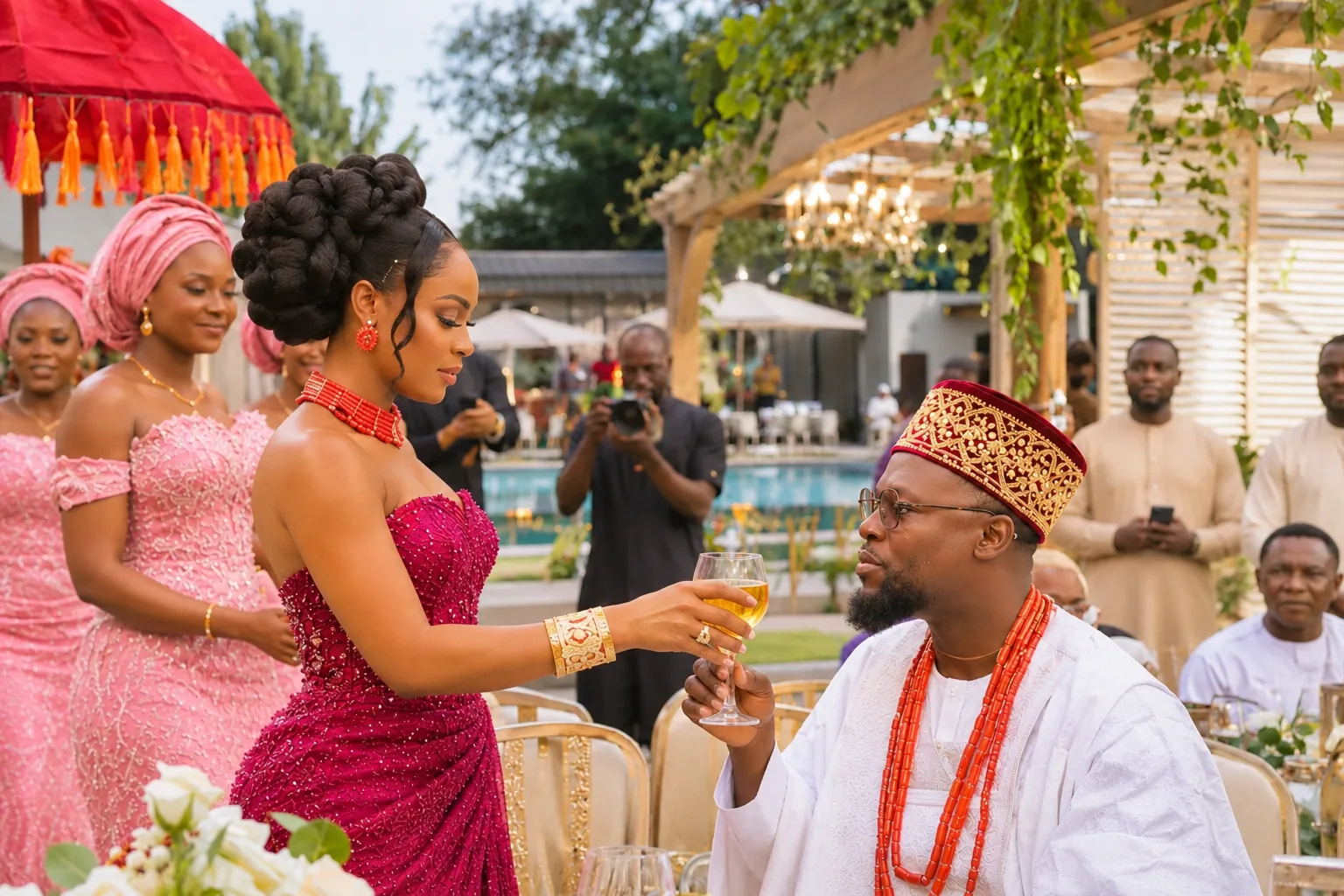
In a study from Nkwerre, Imo State, and in a 2025 study of Igbo weddings in Nigeria, Igba Nkwu is commonly translated as the wine-carrying ceremony, in which the bride finds her groom among the guests and presents him with a cup of palm wine before the assembled families. The 2025 study, drawing on earlier research, describes pre-marital negotiations before it, including Iku Aka (knocking on the door) and Ime Ego (payment of the bride price). The Nkwerre study names several stages leading up to the Igba Nkwu proper. Which stages does your family’s town follow, and under what names? Ask before you borrow a list from another town.
Place changes the details here. In Anambra State, one study found the items brought for the marriage differ slightly from one locality to another, and the groom could give the money equivalent of the items. Your elders are the people to ask what your town brings and whether money stands in for any of it.
Two kinship terms may come up. In Awgbu, Anambra State, the umunna are all the men of the kindred and the umuada are the married daughters of the kindred. If your family’s town uses both, it helps to ask early which of them, if any, the family expects to hear the plan.
The legal ceremony in England and Wales
Count back from the date you like. This is the part of the plan with fixed dates, so it sets the rest.
You must decide where the ceremony will be held before giving notice. You must give notice at least 29 days before the ceremony; notice on 1 May means the earliest date is 30 May. The ceremony must take place within 12 months of giving notice.
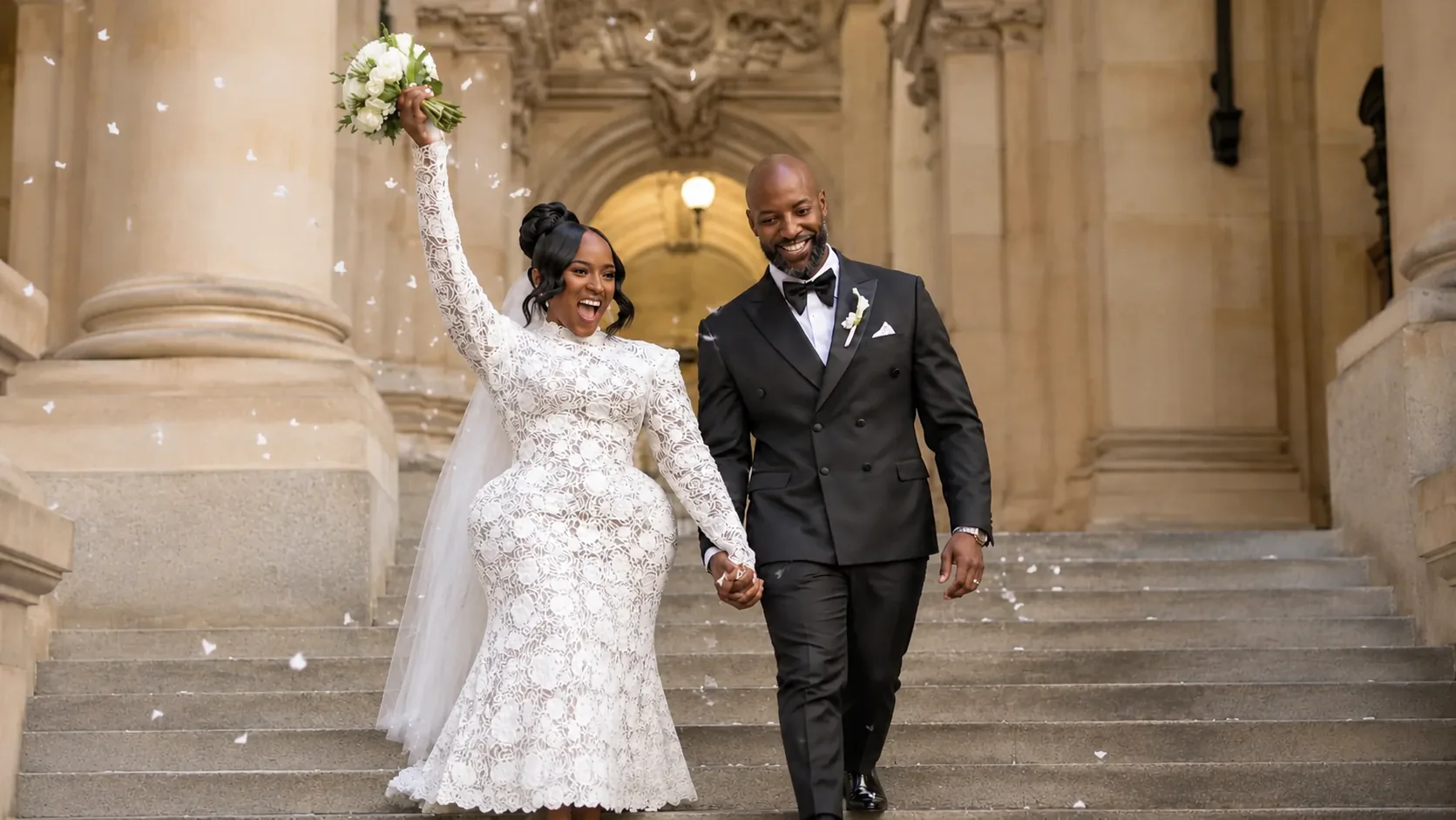
A religious wedding can take place at any registered religious building, with an authorised person (such as a religious minister) attending and signing the marriage schedule, or a registrar if the building has none. A civil ceremony can be held at a register office or any venue approved by the local council, with at least 2 witnesses. As shown on GOV.UK on 24 October 2026, the registrar’s cost is £62 at a register office and £114.50 at a registered religious building, and costs may differ at other approved premises. A civil ceremony must not include anything religious, but a religious blessing can follow it. Whether any part of your traditional rite counts as religious is a question for the registrar and the venue.
Under the law of England and Wales, a wedding ceremony can result in a valid marriage, a void marriage, or a non-qualifying ceremony that the law does not recognise as a marriage at all, and the parties to a non-qualifying ceremony cannot apply to court for financial provision if the relationship breaks down. A Yoruba engagement or an Igba Nkwu is therefore planned as one item and the legal ceremony as another.
Scotland and Northern Ireland have their own rules. In Scotland, the registrar must have the completed notices at least 29 days before the marriage, and National Records of Scotland suggests giving them 10 to 12 weeks ahead. In Northern Ireland, nidirect says notices should normally be with the registrar about eight weeks before the marriage, or 10 weeks if either of you has been married or in a civil partnership before. The minimum is 28 days.
One day or more, and the venue
In Ibadan, two patterns were common: either everything on one Saturday, with the traditional wedding early in the morning at the bride’s family house, then the registry, then the religious ceremony, then the reception, or the traditional wedding on Friday and the rest on Saturday. A UK venue sets its own rules.
In England and Wales, a civil ceremony on the same site as your reception needs a venue approved by the local council. So ask any hall you like whether it has that approval. One Herefordshire venue, Bredenbury Court Barns, lists “Yoruba Engagement” and “Igbo Igba Nkwu” among the traditions it has hosted and seats up to 180 for the ceremony in a space licensed for civil ceremonies.
If the traditional wedding, the legal ceremony and the reception share a day, Wedvisa’s day timeline is where to lay the hours out. Questions to put to any hall:
- How many guests does it seat for the ceremony, and how many for the meal?
- What time must everything finish, music included?
- Can you bring your own caterer?
- How will cash on the day be handled?
If the hall has no licence for what you plan, a Temporary Event Notice may cover it. In England and Wales it is needed for a licensable activity that the premises’ licence does not cover, for example a wedding reception at a community centre, and licensable activity includes selling alcohol, entertainment such as music or dancing, and hot food or drink between 11pm and 5am. The notice covers events of fewer than 500 people at any time, staff included, and must be applied for at least 10 clear working days before. If the caterer serves a buffet, allergen information must be given for each item separately, not for the buffet as a whole, in England, Northern Ireland and Wales. The caterer can give it to you dish by dish.
Family decisions, guests and money
A reference entry on Yoruba families, written partly about past practice, describes marriage as a union of two extended families, not only of the two spouses. Whether or not that matches your family, more people than the couple may have a view, so these questions are worth settling with both sides early:
- Who speaks for each family on the day?
- If your family uses a list of items, who agrees it and who holds it?
- Is the introduction its own event for your families, or part of the engagement?
- Who pays for which event?
- If one family follows Yoruba practice and the other Igbo, whose order of events leads, and how does each family get its place?
Once you know which events you are holding, Wedvisa’s free guest list manager and budget calculator are where to keep the guest list and the budget.
Aso ebi and the suppliers you book
In Ibadan, aso ebi is described as family celebration attire, and in Abeokuta as a group outfit; both are Yoruba accounts. If your families plan matching outfits, ask who chooses the colour, who pays for the fabric and, if guests will order their own, what the cut-off date is. Your supplier is the one to ask for that date and for the delivery time after it.
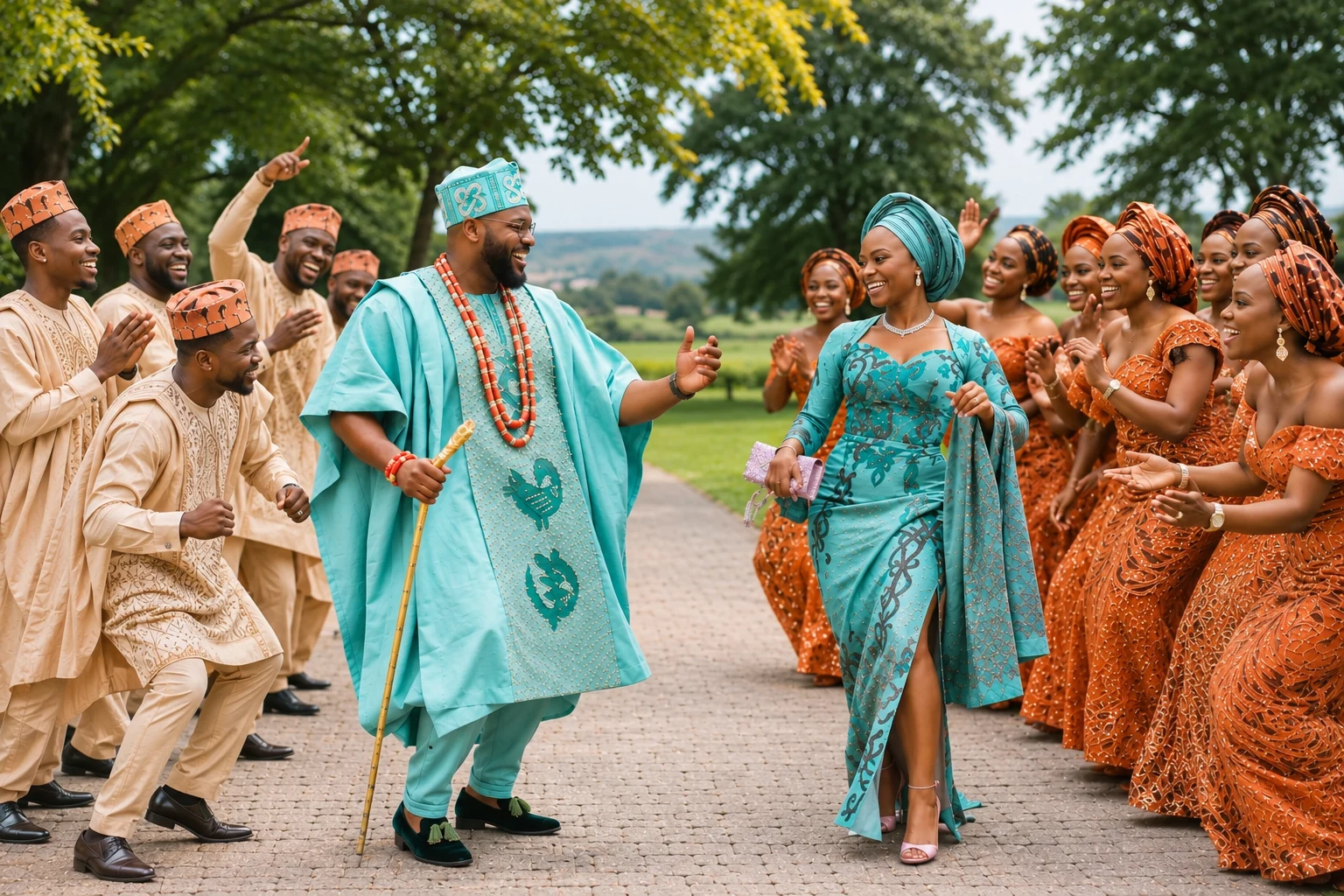
If you book an alaga (the Yoruba accounts above describe one speaking for each family), two questions are worth settling early: who briefs each side’s alaga, if both families have one, and whether each family’s list, if there is one, reaches the right person. The same goes for whoever runs the programme on the day. The alaga and that person can tell you what they need from you and by when.
A suggested planning order
This order works outwards from the legal ceremony. Adjust it to your own families.
- Choose the legal route: a register office, a council-approved venue or a registered religious building.
- Decide the venue for the legal ceremony, because it must be settled before notice.
- Give notice at least 29 days ahead, and hold the ceremony within 12 months of it.
- Agree the family questions: who speaks, whether a list is used and who pays.
- Decide whether the introduction, the engagement or Igba Nkwu, the legal ceremony and the reception take one day or several.
- Book the hall or halls, using the venue questions above.
- Count guests and set a budget line for each event.
- If your Yoruba side uses an alaga, book them; book the person who runs the programme and the caterer; and if your families plan aso ebi, set its cut-off date.
- Ask about licences and buffet allergens.
- Put every step on Wedvisa’s wedding checklist and planning timeline.
Open the planning timeline first and start from the legal ceremony date.
Questions about planning a Yoruba or Igbo wedding in the UK
Does the traditional wedding count as a legal marriage in England and Wales?
A Yoruba engagement or an Igba Nkwu held in England or Wales does not by itself make a legal marriage. The marriage is made by a ceremony that follows the legal formalities, so plan that ceremony as its own item.
Can we hold the traditional wedding and the legal ceremony on the same day?
It depends on the venue. A civil ceremony can be held at a register office or any venue approved by the local council, so ask whether your hall has that approval. One Herefordshire venue says its ceremony space is licensed for civil ceremonies and that it has hosted a “Yoruba Engagement” and an “Igbo Igba Nkwu”.
Is the introduction the same as the engagement?
It can be either. A Lagos-area study describes the two as a “twin” ceremony, while a study of Yoruba Christian couples in North West England describes a separate earlier declaration of marriage intent. If the two sides remember it differently, that’s the first thing to settle.
Who pays for the traditional wedding?
You and your families will need to agree that, event by event. One Lagos-area study says the two alagas are paid by the parents on either side, which covers that one cost only. Wedvisa’s free budget calculator is there when you’re ready to put figures down.
At a glance
|
Decision |
Where it stands |
|---|---|
|
Legal ceremony |
Decide the venue first, give notice at least 29 days ahead, hold it within 12 months (England and Wales) |
|
Traditional wedding |
A Yoruba engagement or an Igba Nkwu does not by itself make a legal marriage |
|
Yoruba introduction |
Twin ceremony with the engagement in one study, a separate earlier step in another |
|
Igbo items |
Differ slightly by locality in a study from Anambra State |
|
Who pays |
A question for the families; the budget calculator is where the figures go |
|
First tool |
The planning timeline, from the legal ceremony date |