Yoruba Traditional Wedding (Engagement) Planning in the UK
If you’re planning a Yoruba engagement in the UK, you’re planning a ceremony for two families, and in Lagos-area and Ibadan accounts each has an alaga to speak for it. In England and Wales it doesn’t make a legal marriage by itself. Fix the legal ceremony and its venue first, settle the family questions next, then book alagas, outfits and items around a day you’ve laid out.
 Oluwole Adebayo
·
Updated November 2026
The short answer
In Ibadan, the traditional wedding includes what is locally called the introduction and the engagement, when the couple’s families visit their extended families and perform traditional rites. In the Lagos area the two are described as a twin ceremony, while a North West England study’s review of Yoruba marriage describes the introduction as an earlier, separate meeting. A Yoruba engagement held in England or Wales does not by itself make a legal marriage. You must give notice at least 29 days before the legal ceremony.
What the engagement is, and where the introduction fits
Two terms need keeping apart. Idana is glossed in English as betrothal or engagement. A reference entry on Yoruba families, partly about past practice, lists Idana (the bond between the families formed by marriage) and Igbeyawo (the wife’s transfer to the husband’s lineage) as separate traditional steps, and the North West England study likewise separates formal betrothal (Idana) from the marriage ceremony (Igbeyawo).
The introduction can sit beside Idana in two ways. In the Lagos area, the introduction and the engagement, called the proper wedding there, are described as a twin ceremony directed throughout by the Alaga Ijoko, the spokeswoman for the bride’s side. In its review of Yoruba marriage, a study of Yoruba Christian couples in North West England describes something earlier and separate, a declaration of marriage intent (mo mi n moo) arranged by the groom’s family, at which they ask for the Idana. Your families will know which matches theirs, so ask both sides early whether the introduction is its own visit or part of the engagement day.
The alagas: who speaks for each family
In the Lagos area and in Ibadan, the Alaga Ijoko (“sitting chairman”) is the spokeswoman, or rarely a spokesman, for the bride’s family, and the Alaga Iduro (“standing chairman”) speaks for the groom’s family. In the Lagos area, the parents on either side pay them, and professional alagas exist who need not be relations. They act in concert with the bride’s and groom’s parents, and each is given a short brief, introduced to key people in the family and told which parts of the celebration must not be compromised, such as the list of goods expected and the time to be spent at the ceremony. In Lagos-area weddings where one family is not Yoruba, the Alaga Ijoko sometimes translates greetings into English.
In the UK, one London-based alaga service’s enquiry form offers “Introduction”, “Traditional Wedding” or “Both” as ceremony types, and asks for the date, venue and any cultural elements before it quotes. If you’re booking an alaga, these questions cover the brief:
- Which family do they speak for, and who briefs them?
- Which people in each family do they need to meet, and by when?
- Which parts of the day must not be compromised?
- Will they translate if one family is not Yoruba?
- What do they charge, and how far ahead do they book?
How the day can run
Three recorded weddings show how an engagement can run. All were in Nigeria.
In the Lagos area
In the two weddings recorded there, the day starts with the bride’s family seated at the venue, without the bride and her close friends. The groom’s family arrive singing and dancing, led by their Alaga Iduro, and are stopped and challenged by the Alaga Ijoko, while the groom stays out of sight until the Alaga Ijoko sends for him. In the same weddings, the bride picks the Bible or the Koran when asked to choose what she likes best from the gifts, and the ceremony closes after the couple are pronounced husband and wife, prayed for after exchanging rings, and the closing prayer. “Pronounced husband and wife” is the ceremony’s own wording; in England and Wales the legal marriage is separate. The Lagos-area account puts the ceremony at two to four hours.
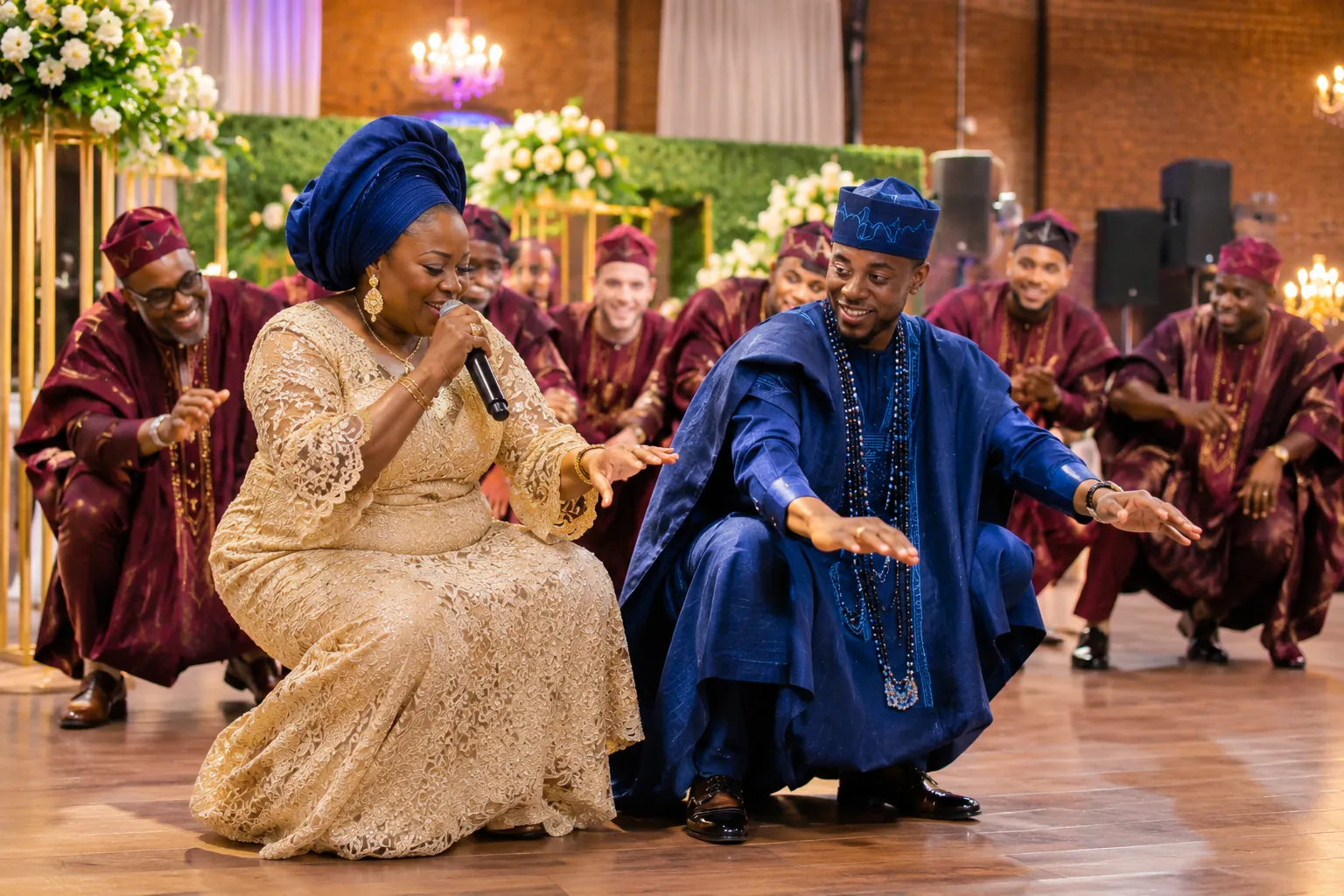
One wedding in Ibadan, March 2012
In one traditional wedding observed there, the groom’s family were led in by their Alaga Iduro, introduced, and knelt to greet the bride’s family. A proposal letter was presented by the Alaga Iduro and read out by a young woman from the bride’s family, and an acceptance letter was read. The groom then danced in with his friends and prostrated to his new in-laws twice with his friends and once alone.
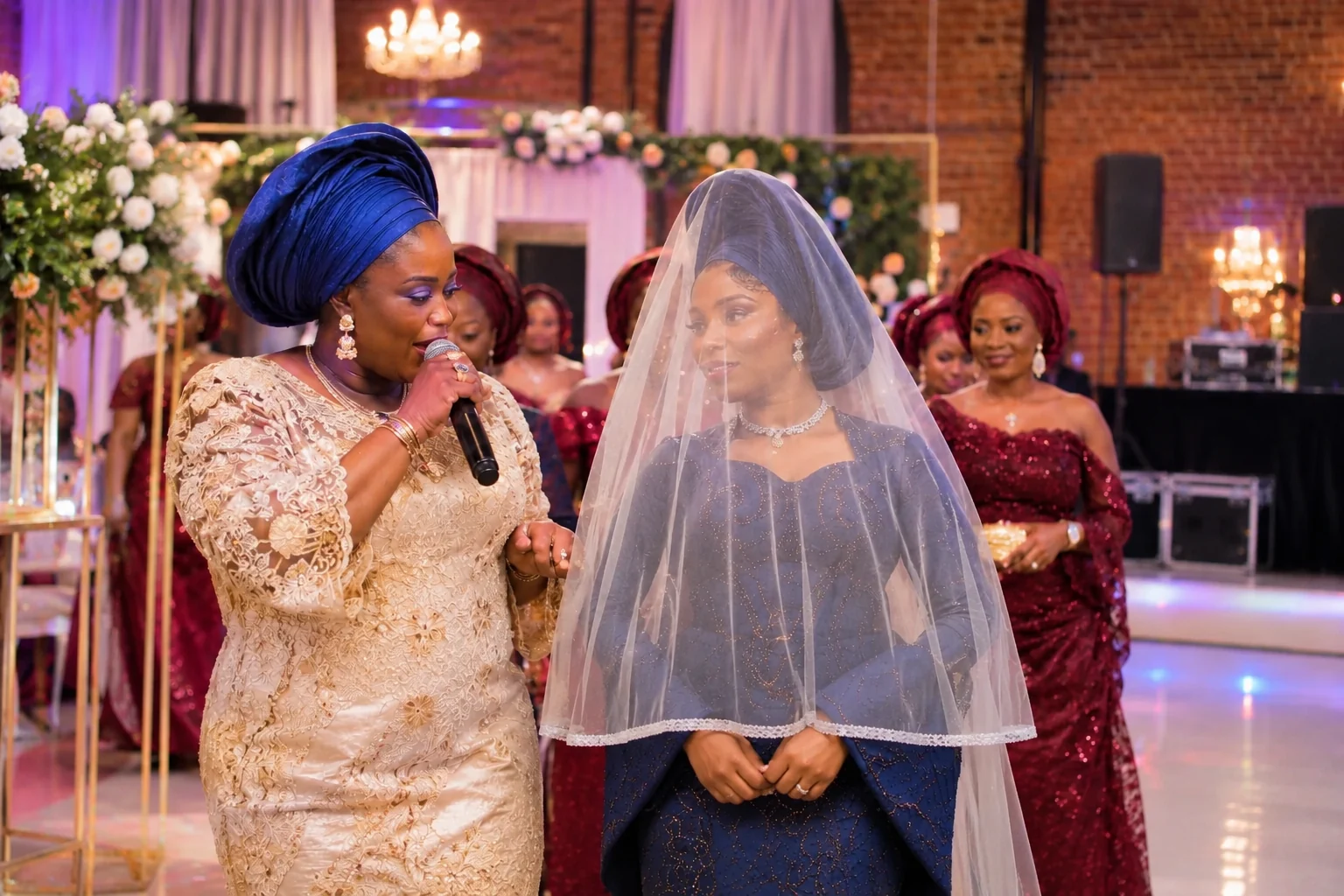
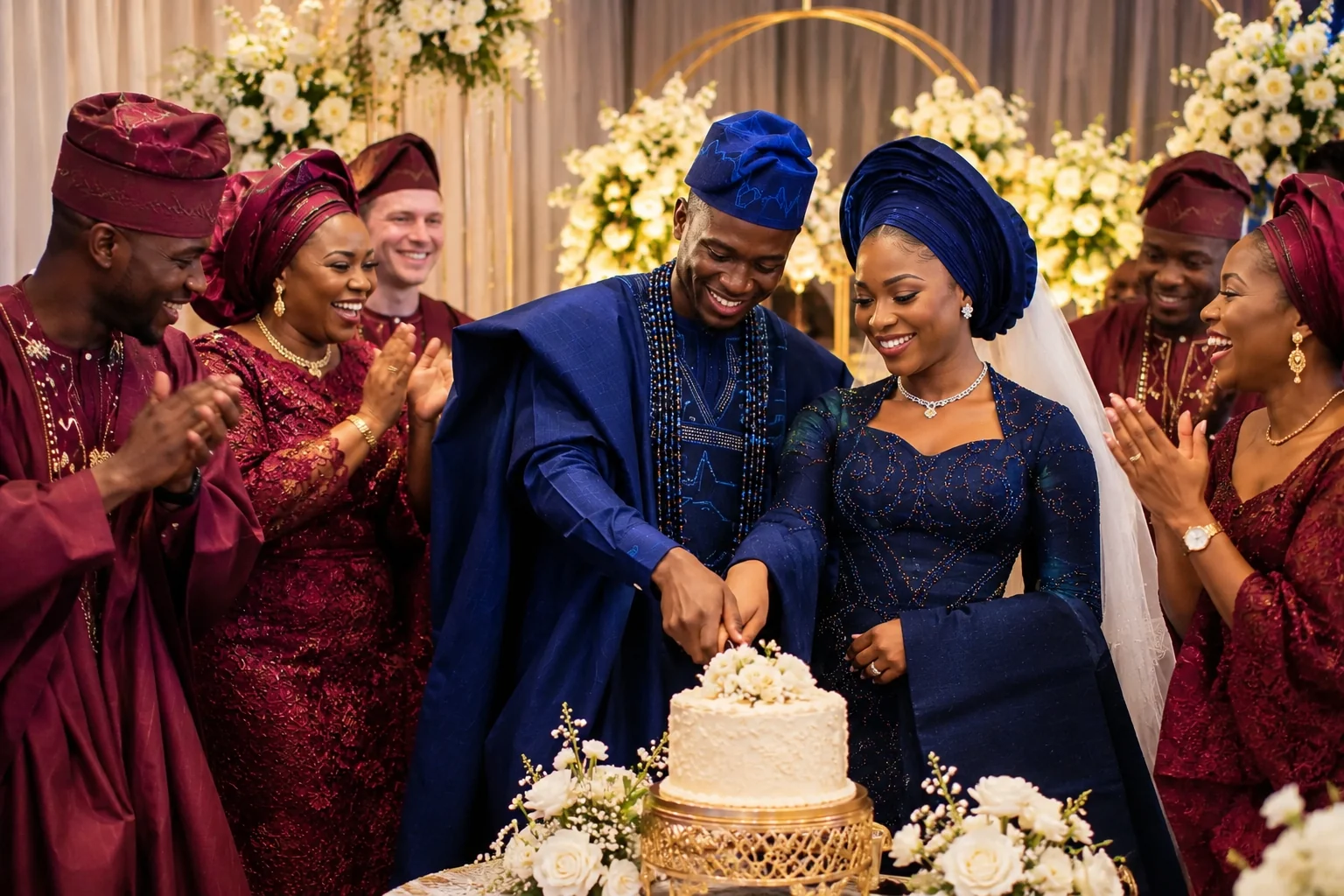
The bride entered veiled with her friends and knelt for prayers from her parents and then the groom’s parents; the groom unveiled her, she put his cap (fila) on his head, and she picked the Bible, with the engagement ring attached, from the gifts. Envelopes were handed over and an engagement cake was cut, and the day ended with prayers, eating, music and dancing. Ibadan research calls prostrating for the bride’s family a show of respect by the groom’s family. In Ibadan, what a wedding includes is described as depending on interests, class or status, dispositions, religion and location, and the patterns observed there as not sacrosanct and open to variation.
Wedvisa’s free day timeline is where to lay out your own hours, whether the engagement has the day to itself or shares it with the legal ceremony and a reception.
Items, bride price and who hosts
The reference entry describes marriage as a union of two extended families, not only of the two spouses, so more people than the couple may have a view. In the record of the Ibadan wedding, the engagement list brought by the groom’s family is noted as varying slightly from family to family and from one Yoruba state to another. Ibadan research describes the groom’s family presenting the eru iyawo (bridal load) as a symbol of value and a token of recognition of the bride’s worth. A Lagos-area list that the Ibadan account cites gives documented examples of materials: honey, kola nuts, bitter kola, salt and a Bible or Koran. In the Lagos area the items are expected to be used or provided, but cash can replace them if the older generation allows it, and a few families refuse to collect the cash.
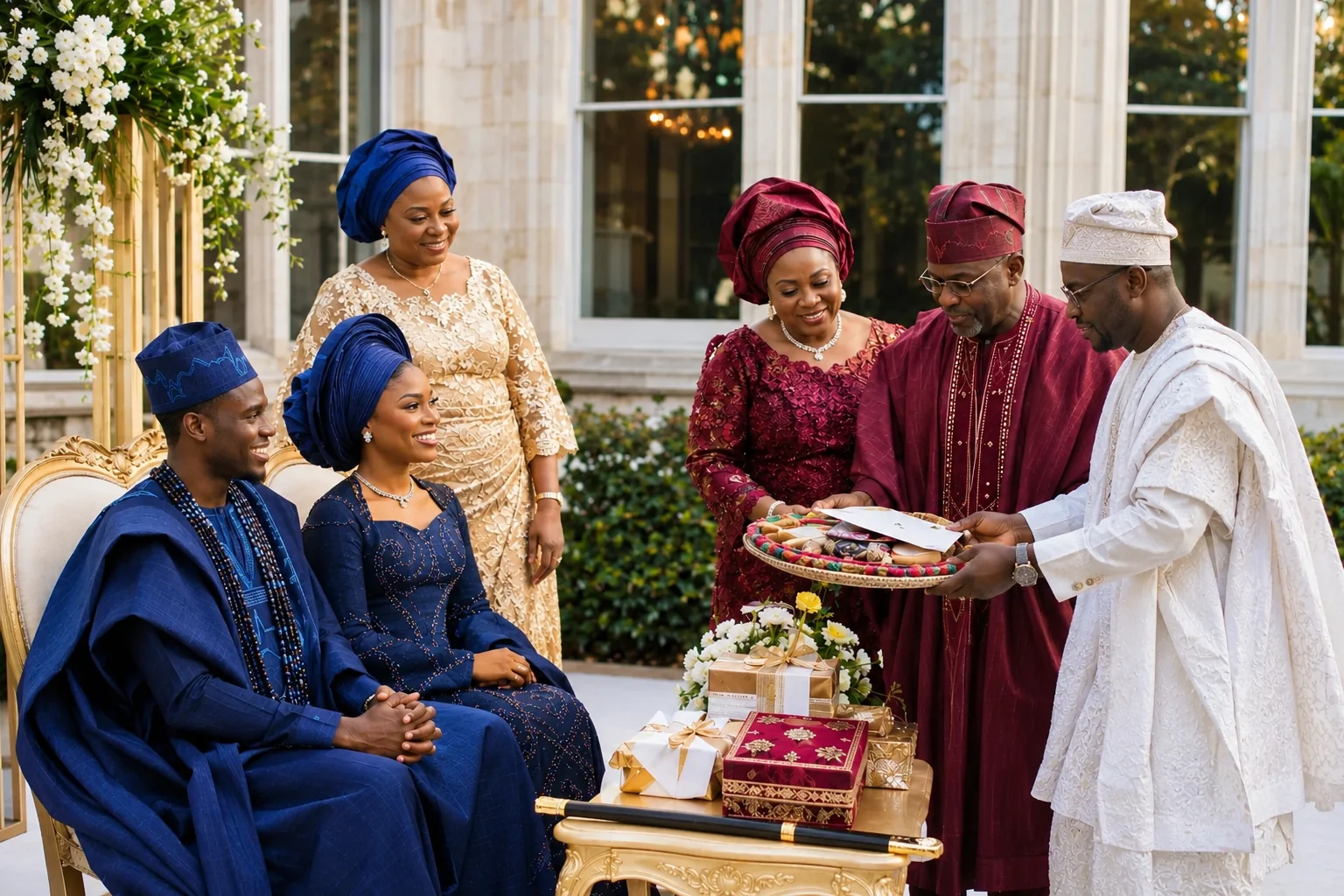
The same reference entry says the Idana ceremony centres on the payment of bride-wealth (owo ori, “money for the head”), which among the Yoruba has little to do with a price for the wife-to-be. In the one Ibadan wedding recorded in 2012, the bride’s family returned the envelope containing the bride price to the groom’s family. Amounts are for the two families to settle between themselves.
In the Lagos area, a wedding is generally hosted and sponsored by the bride’s family, at their house or another chosen venue, though the groom’s family sometimes helps pay; in the one Ibadan wedding observed in 2012, the bride’s family were the hosts. Questions worth settling with both sides:
- Who agrees the list of items, and who holds it?
- Who pays for which part: the venue, food, alagas, outfits and items?
- If one family is not Yoruba, whose order leads, and who explains it?
- Who stands in for a parent who has died?
Wedvisa’s free guest list manager and budget calculator hold the guest list and budget.
If anything is coming from Nigeria
If any item for the day is travelling from Nigeria in a suitcase, check it against the rules for Great Britain first. There are restrictions on bringing meat, dairy, fish and animal products, and fruit, vegetables, nuts and seeds, into Great Britain from abroad for your own use; Northern Ireland has different rules. From outside the EU you can bring up to 2kg of honey per person, and up to 20kg of fish per person in total, including dried, cooked, cured or smoked fish. From outside the EU, most fruit or vegetables need a plant health (phytosanitary) certificate, and the listed exceptions include processed and packaged plant products and peeled and processed nuts. For each fresh item on your list, check GOV.UK before you pack it.
What the families wear
In Ibadan, aso ebi is described as family celebration attire, and in Abeokuta as a group outfit. The Abeokuta account lists women’s attire as iro (wrapper), buba (blouse), gele (head-tie) and ipele (shawl), and men’s as sokoto (trousers), buba (shirt), agbada (a large embroidered gown) and fila (cap).
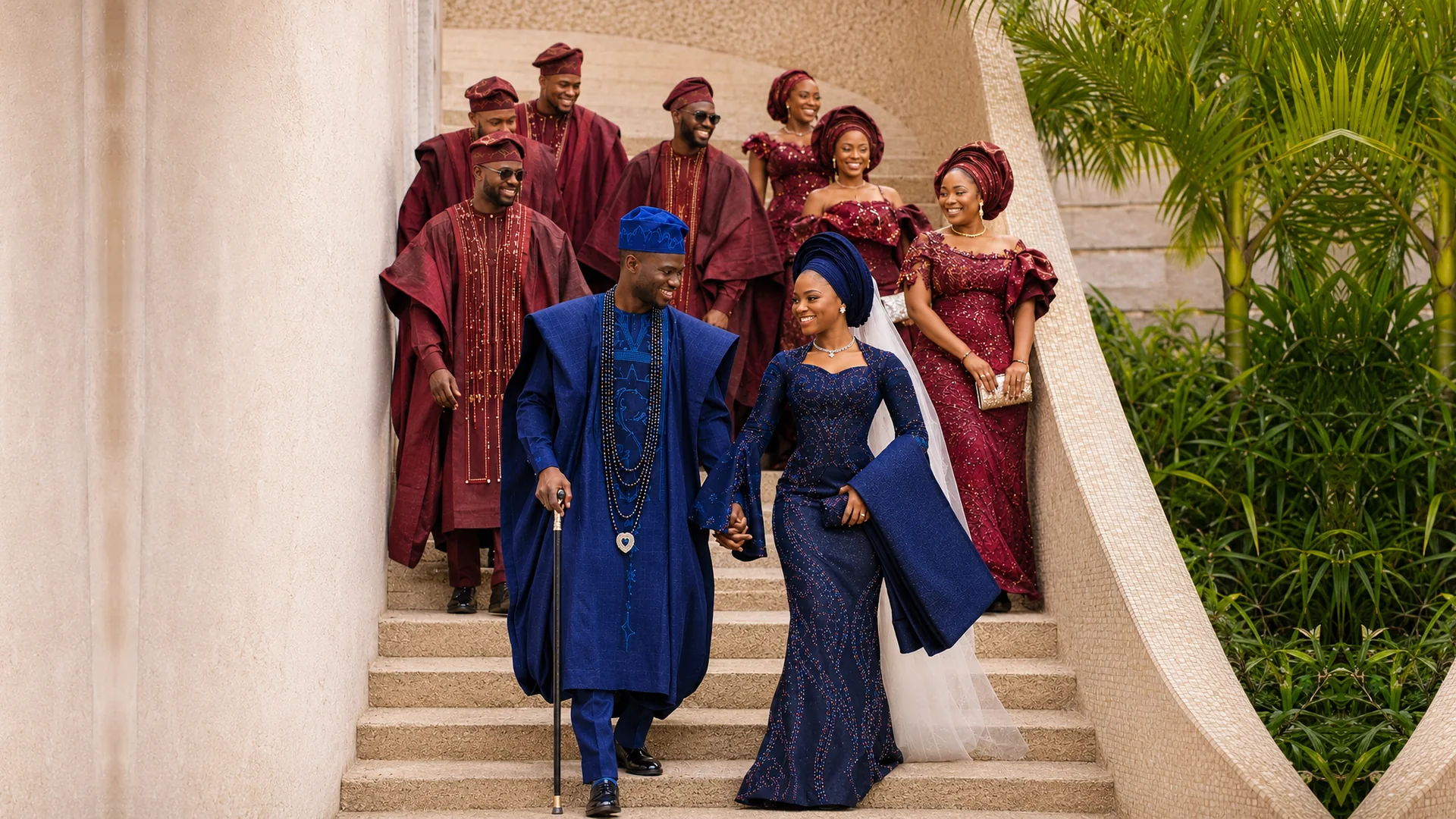
If your families plan matching outfits, ask:
- Who chooses the colour and pays for the fabric?
- If guests order their own, what is the supplier’s cut-off date and delivery time?
- Who ties the gele?
- What should the groom’s side wear for the entrance?
Fitting the engagement around the legal ceremony
The date hangs on the legal ceremony. In England and Wales you must decide where it will be held before giving notice. Notice goes in at least 29 days before, and the ceremony must take place within 12 months of it. A civil ceremony can be held at a register office or at any venue approved by the local council, with at least 2 witnesses, so if you want it in the engagement’s hall, ask whether the hall holds that approval. A civil ceremony must not include anything religious, but a religious blessing can follow it. Whether any part of your engagement counts as religious, such as prayers, kneeling or the Bible or Koran choice, is for your registrar and venue to say, so ask which parts belong in which ceremony.
If the hall’s licence does not cover what you plan, a Temporary Event Notice may. In England and Wales it is needed for a licensable activity the premises’ licence does not cover, covers fewer than 500 people at any time, staff included, and must be applied for at least 10 clear working days before. If a caterer serves a buffet, allergen information must be given for each item separately, not for the buffet as a whole, in England, Northern Ireland and Wales. Other questions for any hall:
- What time must everything finish, music included?
- Can we bring our own caterer?
- How will cash on the day be handled?
- Is there a room for outfit changes?
A planning order for the engagement
- Choose the legal ceremony and its venue, because the venue must be decided before notice.
- Give notice at least 29 days ahead.
- Agree the family questions: introduction apart or together, hosting, the list, who pays.
- Book an alaga for each side, with the brief above.
- Order outfits and fix the supplier’s cut-off date.
- Check any food coming from Nigeria against GOV.UK.
- Ask each hall about its licence, finish time and caterer.
- Lay out the engagement, then the legal ceremony and reception, on Wedvisa’s day timeline.
- Tick it all off on the wedding checklist.
Questions about a Yoruba engagement in the UK
What is the difference between the introduction and the engagement?
In the Lagos area they are described as a twin ceremony, while a North West England study’s review of Yoruba marriage describes the introduction as an earlier, separate meeting.
What are the items for a Yoruba engagement?
The list varies slightly from family to family and from one Yoruba state to another. In the Lagos area, cash can replace items if the older generation allows it, and a few families refuse the cash.
Who pays for what at a Yoruba engagement?
In the Lagos area the bride’s family generally hosts and sponsors, and the groom’s family sometimes helps pay.
Will the groom and his family be expected to prostrate?
In one Ibadan wedding in 2012, the groom prostrated to his in-laws three times in all, and Ibadan research calls it a show of respect. Ask both families what they intend.
Does the engagement make us legally married in England or Wales?
Not by itself, in England or Wales.
At a glance
|
Decision |
Where it stands |
|---|---|
|
Legal ceremony |
Decide the venue first, give notice at least 29 days ahead, hold it within 12 months (England and Wales) |
|
Engagement |
Does not by itself make a legal marriage in England or Wales |
|
Introduction |
A twin ceremony with the engagement in the Lagos area; an earlier, separate meeting in a North West England study’s review of Yoruba marriage |
|
Alagas |
One per family (Lagos area, Ibadan); the parents pay (Lagos area) |
|
Items |
Vary by family and Yoruba state |
|
Who pays |
A question for the families; the budget calculator holds the figures |
|
First tool |
The day timeline |