Wedding Invitations UK: Complete Guide
Wedding invitations are surprisingly very tricky and complicated. Follow this guide to make sure your guests (especially your elders) are happy with the invitations they get.
Wedding invitations do more than announce a date. They set the tone for the whole day, tell guests exactly what's expected of them, and — if you get the wording wrong for a divorced parent or a religious ceremony — they can cause more family friction than almost any other part of planning. In the UK, invitations also follow etiquette rules that are more precise than most couples expect: specific phrasing for civil versus religious ceremonies, strict conventions for how divorced or remarried parents are listed, and an unwritten but widely followed rule about day and evening guest tiers.
This guide covers everything you need: when to send save-the-dates and formal invitations, exactly how to word them for every family situation, the day-versus-evening split that shapes two-thirds of UK weddings, and whether paper, digital, or a hybrid of the two makes sense for you.
When to Send Save-the-Dates and Invitations
Save-the-dates exist to protect your guests' calendars before your venue, catering, and full schedule are locked in. Formal invitations follow later, once every detail is confirmed, and carry a hard RSVP deadline that your caterer and venue will hold you to.
|
Stage |
Local UK wedding |
Destination / holiday-period wedding |
|---|---|---|
|
Save-the-date dispatch |
4–6 months before |
6–10 months before |
|
Formal invitation dispatch |
6–8 weeks before (up to 8–10 weeks) |
10–12 weeks before |
|
RSVP deadline |
3–4 weeks before |
4–6 weeks before |
|
Chase non-responders |
2–3 weeks before |
3–4 weeks before |
A couple of things worth flagging. First, a save-the-date is not a substitute for the invitation — keep it simple, with just your names, the date, and the location, rather than trying to squeeze in host lines or registry details. Second, if your date falls near Christmas, New Year, or a bank holiday weekend, push toward the longer end of every window above, since you're competing with guests' existing holiday plans and travel bookings.
The Six Parts of a Formal UK Invitation
Traditional British wedding invitation wording follows a set structure that's stayed remarkably consistent, even as more couples move toward informal or digital formats. A formal suite is built from six elements: the host line, the inviting line, the couple's names, the date and time, the venue, and the reception/RSVP details.
The Host Line and Who's "Inviting"
The host line names whoever is organising — and traditionally, financially backing — the wedding. Historically, this was the bride's parents alone, which is why, on a fully traditional invitation, the bride's own surname is left off her name: it's already established by the line above naming her parents. Where both families are hosting jointly, or the couple is hosting themselves, the structure adjusts to reflect that.
Choosing the Right Inviting Phrase
This is one of the most commonly misused conventions on UK invitations, and it's determined entirely by venue type, not formality:
-
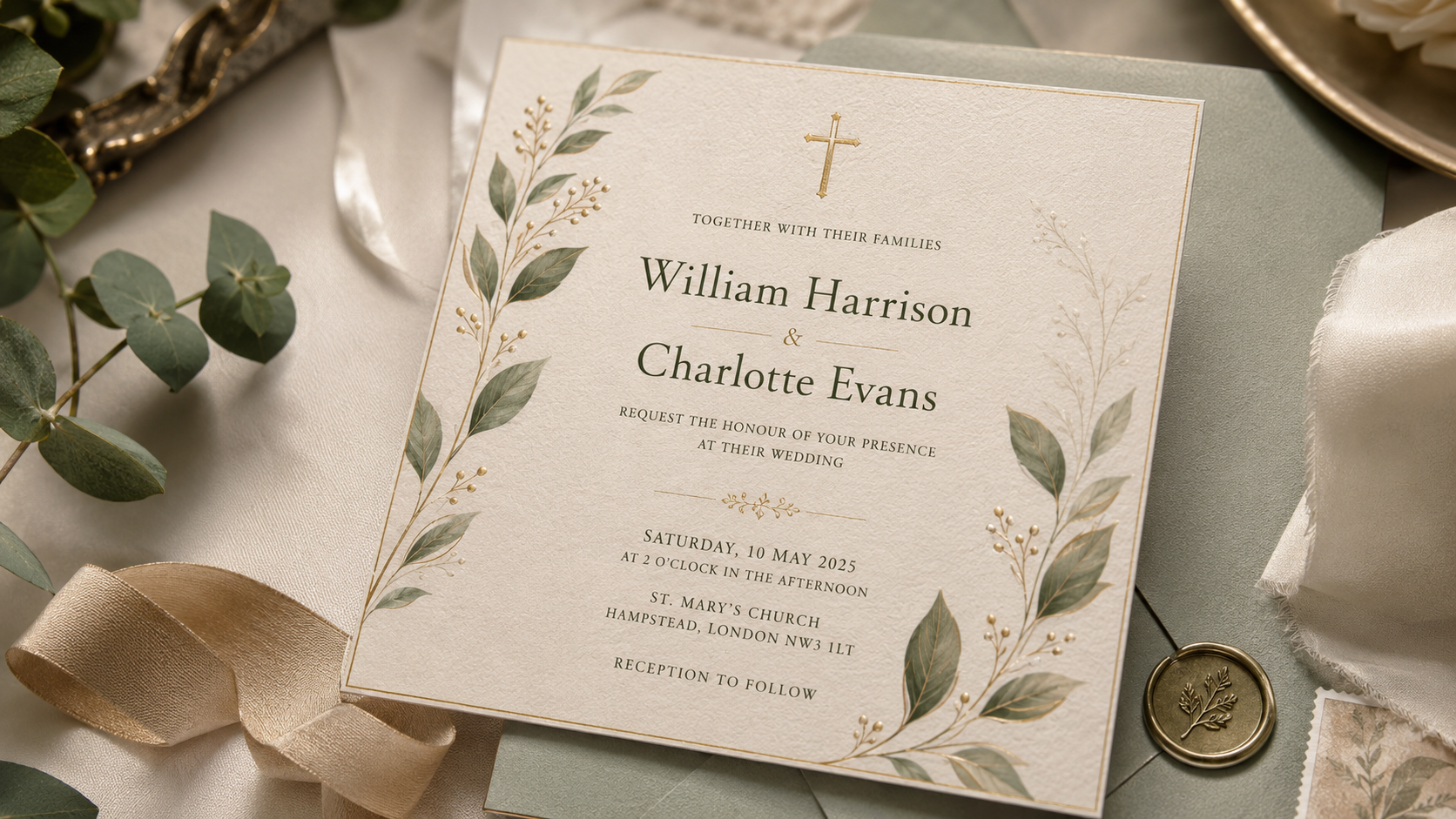
"Request the honour of your presence" (British spelling, "honour" with the "u") — used only for religious ceremonies in a church, chapel, synagogue, or temple.
-
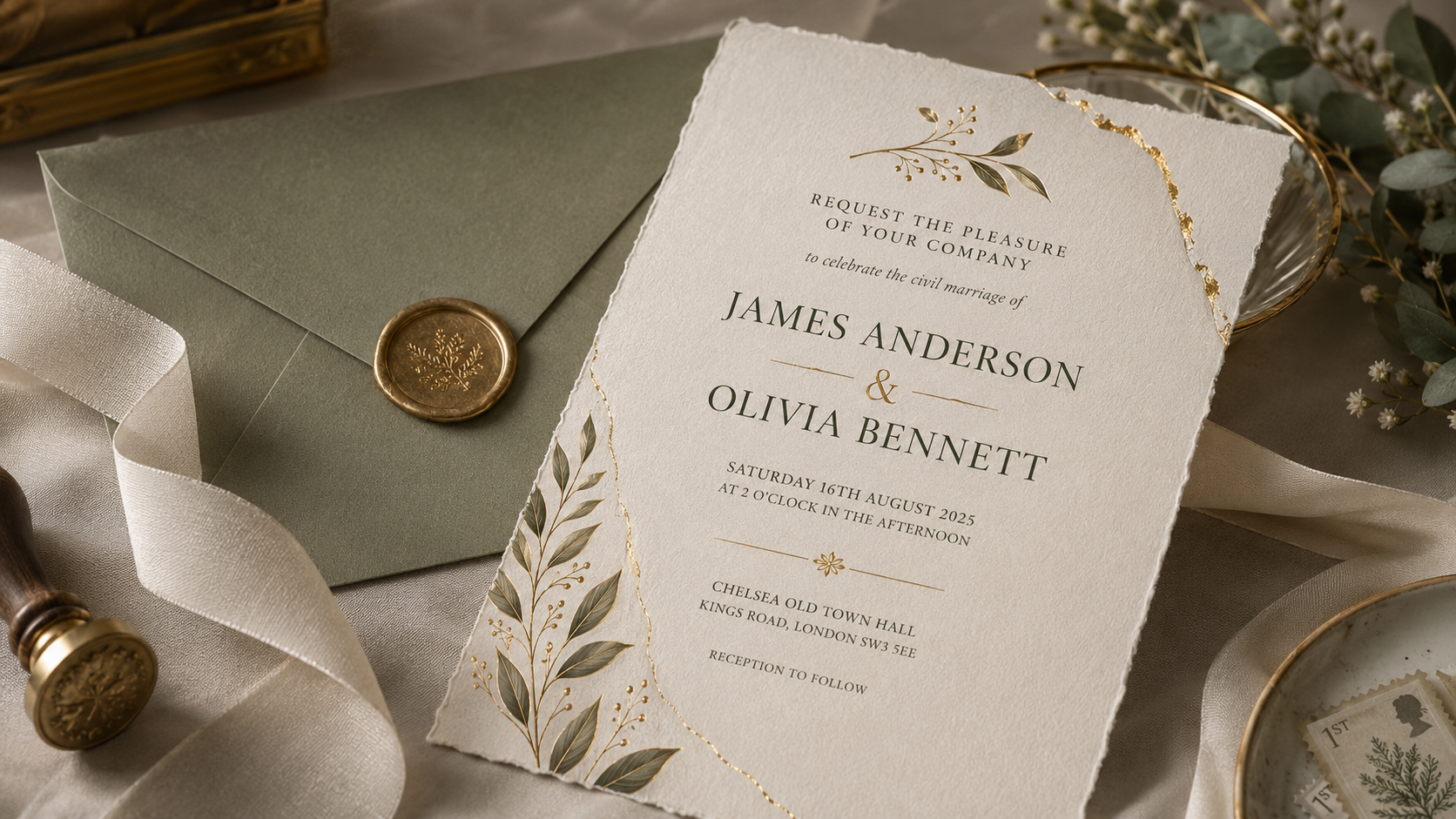
"Request the pleasure of your company" — used for civil ceremonies: registry offices, hotels, country houses, and any other non-religious venue.
Get this one backwards and it reads as a small but noticeable error to anyone familiar with the convention.
Formatting Rules That Signal Formality
A handful of typographic rules separate a properly formal British invitation from an informal one:
- The whole thing is written as a single sentence, broken across lines — no trailing commas or full stops at line-ends.
- Capitals are reserved for proper nouns, days, months, and the first letter of the year; line starts aren't capitalised unless a proper noun demands it.
- Abbreviations are avoided throughout. Street names are spelled out in full ("Road," not "Rd"), and so are numbers — dates, times, and years are written as words: "Saturday, the twenty-fifth of June, two thousand and twenty-six, at three o'clock in the afternoon."
- On heterosexual invitations, the woman's name traditionally comes before the man's. For same-sex couples, order comes down to personal preference or alphabetical sequence.
- Pre-wedding names are used throughout the invitation — new surnames only appear later, on thank-you notes sent after the wedding.
Wording for Divorced, Remarried, and Blended Families
This is where most couples get stuck, and it's worth getting right, because the wording carries real social meaning. The key rule: the word "and" signals marriage. Two names joined by "and" on the same line tells every guest reading the invitation that those two people are currently married to each other. That means divorced parents should never share a line joined by "and" — even if they're on excellent terms and co-hosting together. Each gets a separate line.
A few structural conventions to know:
- In most co-hosting scenarios, the mother's name is listed first, unless she prefers otherwise or isn't contributing financially.
- Where parents now have different surnames, include the couple's full names on the invitation to avoid any ambiguity about whose children they are.
- Step-parents share a line with their current spouse — so a remarried parent and their new spouse appear together, joined by "and," while the other birth parent (and their spouse, if remarried) sits on a separate line.
- When a family situation is too complex to lay out cleanly, "Together with their families" is a widely accepted, elegant fallback that avoids listing everyone individually.
|
Family situation |
Host line example |
Rationale |
|---|---|---|
|
Bride's parents hosting (traditional) |
Mr and Mrs James Edward Thompson |
Bride's surname is implied by the parent line above, so it's omitted |
|
Both sets of married parents hosting |
Mr and Mrs James Edward Thompson and Mr and Mrs William Henry Clarke |
Each married couple joined by "and," the two couples on separate segments |
|
Couple hosting themselves |
Miss Charlotte Emily Thompson and Mr Henry William Clarke |
Full formal names and titles used |
|
Divorced parents co-hosting (not remarried) |
Ms Sarah Mitchell / Mr Robert Mitchell |
Mother listed first; separate lines, no "and" |
|
Divorced and remarried parents co-hosting |
Mrs Sarah and Mr David Thornton / Mr Robert and Mrs Caroline Mitchell |
Step-parents share a line with their current spouse; the two family units sit on separate lines |
|
Same-sex couple hosting |
Miss Juliet Capulet and Miss Katherine Montague |
Order by preference or alphabetically |
Day Guests vs Evening Guests: How the UK Two-Tier System Works
Roughly two-thirds of UK weddings run a two-tier guest list, sending entirely separate invitations to day guests and evening-only guests. Day guests attend the ceremony, the drinks reception, the wedding breakfast, and the speeches. Evening guests join later — typically from 7:00–7:30pm — for the party, food, and dancing.
If you're inviting people to the evening only, the wording matters more than you'd think. Avoid anything that reads as diminishing — "just the evening" or "evening invite only" can leave guests feeling like an afterthought. Frame it instead as its own celebration: an invitation to the evening reception, with its own food, music, and dancing, not a lesser version of the day.
|
Day invitation |
Evening invitation |
|
|---|---|---|
|
Ceremony details |
Included in full |
Omitted entirely |
|
Start time |
Early-to-mid afternoon (e.g. 1–3pm) |
Evening (typically 7–7:30pm) |
|
Catering |
Wedding breakfast / formal meal |
Late-night food, buffet, or evening bites |
|
Focus of wording |
Ceremony and wedding breakfast |
Reception, drinks, and party |
|
Departure ("carriages") |
Sometimes noted on the details card |
Usually stated prominently |
Paper, Digital, or Hybrid: Which Should You Choose?
There's no single "correct" answer here anymore — modern UK etiquette has shifted from judging the medium to judging the execution. A well-designed digital suite is now broadly accepted; a poorly designed paper one isn't automatically more prestigious just because it's printed.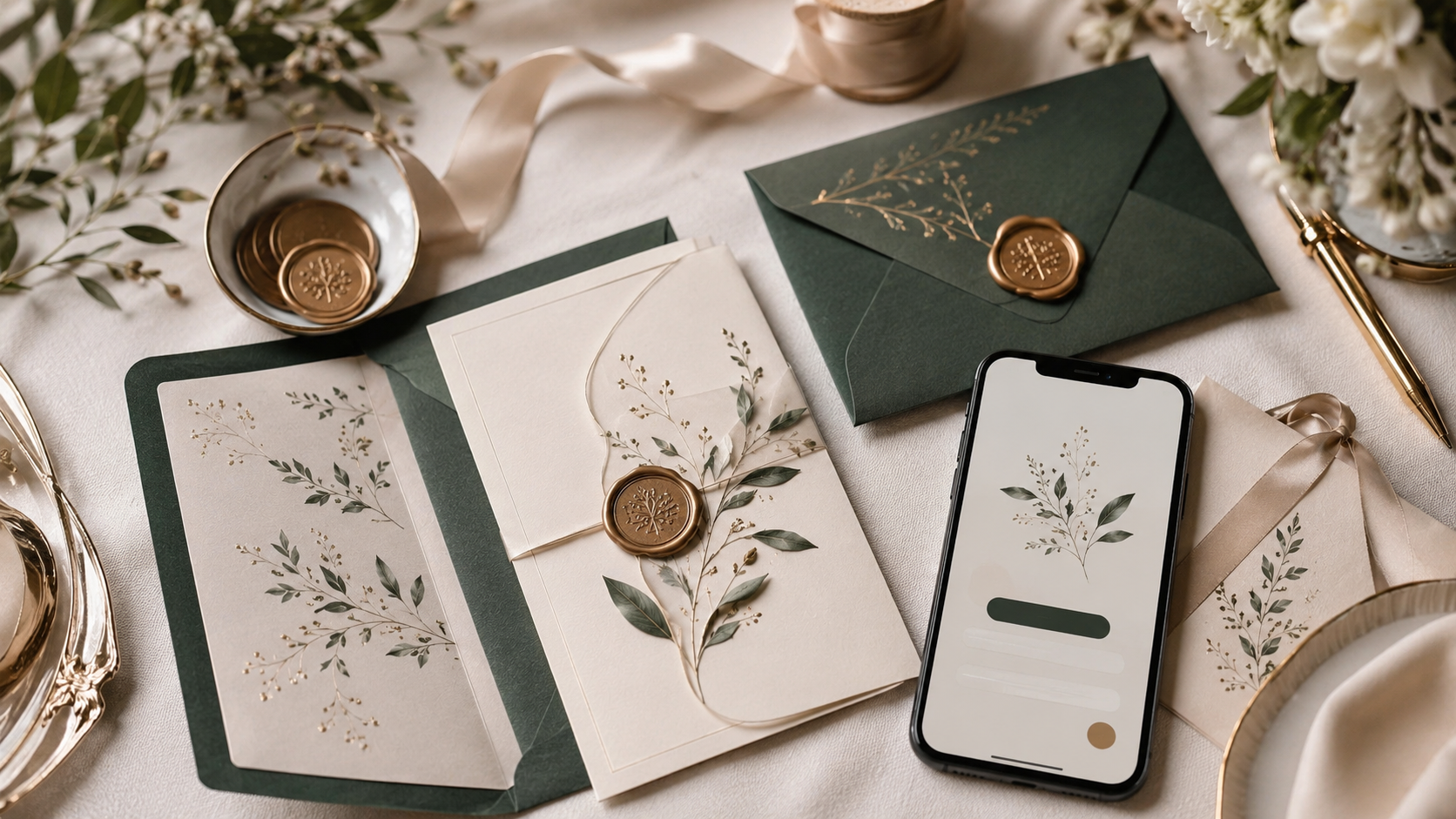
Paper remains the standard for formal, black-tie, or traditional religious weddings. Cotton cardstock, letterpress, foil stamping, and wax seals communicate formality in a way digital simply can't, and paper gives older or less tech-comfortable guests something tangible to work with — and something you'll actually keep.
Digital invitations remove most of the friction of paper: no printing, calligraphy, assembly, or postage, which typically saves 70–95% compared to a paper suite. They also connect directly to digital RSVP forms, so dietary requirements, song requests, and headcounts land automatically instead of arriving as scattered texts and voicemails — and if a venue detail or map changes, you can update it instantly rather than reprinting.
Hybrid is the middle path a lot of couples land on: digital invitations for the bulk of the guest list, with a small run of 5–15 formal printed suites reserved for parents, grandparents, and personal keepsakes.
|
Paper |
Digital |
Hybrid |
|
|---|---|---|---|
|
Typical cost |
£300–£1,500+ depending on finish |
Minimal — 70–95% cheaper than paper |
Moderate (small print run + digital platform fee) |
|
Tracking |
Manual, subject to postal delays |
Real-time RSVP data, instant updates |
Combined: physical for elders, digital for the rest |
|
Formality |
Highest — tactile finishes unmatched by digital |
Depends on design quality |
High formal impression for key recipients |
|
Best for |
Traditional, formal, or religious weddings |
Modern, budget-conscious, or fast-moving timelines |
Couples who want both tradition and efficiency |
For a broader sense of where invitations sit within the total cost of a UK wedding, industry data puts average stationery spend at around £378 — a small slice next to venue and catering, but one that's easy to underestimate once save-the-dates, invitations, order-of-service cards, and thank-you notes are all added up.
Addressing Envelopes and Avoiding Guest List Confusion
A surprising amount of RSVP confusion comes down to ambiguous addressing, not bad wording. A few conventions prevent it:
- Inviting a whole household: address it to "The Hassan-Okafor Family."
- Excluding children: name the adult guests explicitly ("Mr Marcus Vance and Ms Clara Jones") rather than using a household title — leaving children's names off signals adult-only attendance without needing to spell it out.
- Plus-ones: if you know the partner's name, use it ("Ms Aiyana Hassan and Mr David Miller"). Reserve "and Guest" for situations where the plus-one's identity genuinely isn't confirmed yet.
Whether your RSVP card is paper or digital, it should capture more than a yes or no: attendance status for day and evening separately if you're running a two-tier list, dietary requirements (allergies, vegetarian, vegan, religious dietary needs), and any transport or accommodation numbers you need for shuttles or room blocks. For guests who haven't responded, a reminder 2–3 weeks before your RSVP deadline — automated if you're digital, personal if you're not — is standard practice before you lock final numbers with your caterer.
Frequently Asked Questions
How far in advance should I send UK wedding invitations?
Formal invitations typically go out 6–8 weeks before the wedding (up to 8–10 weeks), following save-the-dates sent 4–6 months out. For destination weddings, push both further back — invitations 10–12 weeks ahead, save-the-dates 6–10 months ahead — to give guests enough time to arrange travel.
What's the correct wording for a civil versus a religious ceremony?
"Request the honour of your presence" is reserved for religious ceremonies in a church, chapel, synagogue, or temple. "Request the pleasure of your company" is used for civil ceremonies at registry offices, hotels, or any secular venue.
How do I word an invitation when my parents are divorced?
List each parent on a separate line with no connecting "and" — that word specifically signals marriage between two people, so divorced parents should never share a line joined by it, even if they're cordial and co-hosting together. If a step-parent is involved, they share a line with their current spouse.
Do I need separate invitations for day and evening guests?
Not strictly, but around two-thirds of UK weddings do split them, since day and evening guests need different information — ceremony details for day guests, arrival time and catering format for evening-only guests. If you're combining them onto one invitation, be clear about which sections apply to which guests.
Are digital wedding invitations acceptable in the UK?
Yes — modern etiquette has moved past the paper-versus-digital debate and now focuses on design quality and personalisation rather than the medium itself. Many couples run a hybrid approach: digital for most guests, paper for parents, grandparents, and keepsakes.
How do I invite a household without accidentally including children?
Name the adult guests explicitly by name rather than addressing the envelope to "The Smith Family." Leaving children's names off the invitation is the standard, polite way to signal an adult-only guest list without stating it outright.