Wedding Invitation Wording Examples: A Complete UK Guide for Every Situation
Learn how to properly word your wedding invitations in the UK from this detailed guide.
Staring at a blank invitation template is harder than it should be. You know roughly what needs to go on it — who's getting married, when, where — but the second you try to actually write it, questions pile up. Do you list your parents? Which phrase do you use for a register office wedding versus a church one? What do you even say if your parents are divorced, or if you're paying for the whole thing yourselves and don't want a host line at all?
This invitation guide gives you real, ready-to-adapt wording for every common UK scenario — formal and casual, religious and civil, traditional family structures and blended ones — so you can find the example closest to your situation and edit in your own names and details.
Match Your Wording to Your Wedding's Formality First
Before picking an example, decide how formal your day actually is. Wording should match the formality of your wedding — a black-tie, letterpress invitation calls for traditional third-person wording, while a relaxed barn or garden wedding usually sits better with a warmer, first-person tone. There's no rule that says you have to pick one over the other; plenty of couples run a formal ceremony with genuinely casual wording, because the wording is really about your personalities and the vibe you want to set, not a strict reflection of venue type.
Formal Wording Examples by Host
Bride's Parents Hosting (Religious Ceremony)
Mr and Mrs Andrew Whitfield request the pleasure of your company at the marriage of their daughter Charlotte Elizabeth to Mr Daniel James Reeves on Saturday, the twelfth of September two thousand and twenty-six at half past two in the afternoon at St Mary's Church, Cranleigh, followed by a reception at Wintergreen Barn.
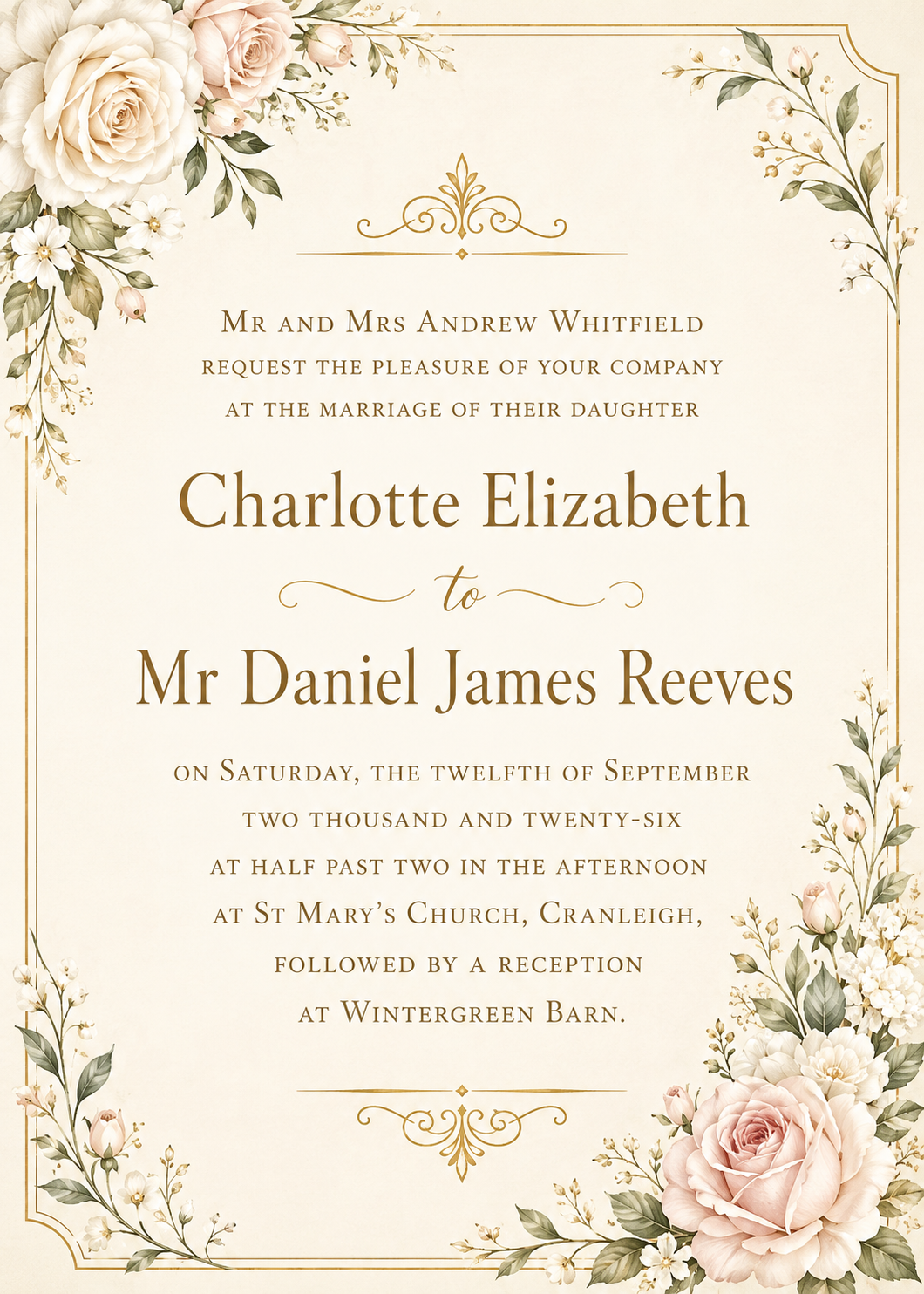
Use "request the honour of your presence" instead of "request the pleasure of your company" if the ceremony is being held in a church, chapel, synagogue, or temple — the "honour" phrasing is reserved specifically for religious venues.
Both Sets of Parents Hosting Jointly (Civil Ceremony)
Mr and Mrs Andrew Whitfield and Mr and Mrs Peter Reeves request the pleasure of your company at the marriage of their children Charlotte Elizabeth Whitfield and Daniel James Reeves on Saturday, the twelfth of September two thousand and twenty-six at half past two in the afternoon at The Old Rectory, Petworth
Couple Hosting Themselves
Charlotte Elizabeth Whitfield and Daniel James Reeves request the pleasure of your company at their marriage on Saturday, the twelfth of September two thousand and twenty-six at half past two in the afternoon at The Old Rectory, Petworth followed by dinner and dancing
When the couple is hosting, the host line and the couple's name line are effectively the same — there's no separate parent line above.
Wording for Divorced, Remarried, and Blended Families
Divorced Parents, Not Remarried, Co-Hosting
Ms Helen Whitfield Mr Andrew Whitfield request the pleasure of your company at the marriage of their daughter Charlotte Elizabeth to Mr Daniel James Reeves
Notice there's no "and" between the two parent names — each sits on its own line. As Paperlust's divorced-parents wording guide explains, that missing "and" is deliberate: joining two names with "and" signals a current marriage, so divorced co-hosts are always kept on separate lines.
Divorced Parents, One or Both Remarried
Mrs Helen and Mr Robert Ashby Mr Andrew and Mrs Louise Whitfield request the pleasure of your company at the marriage of their daughter Charlotte Elizabeth to Mr Daniel James Reeves
Each remarried parent is joined to their current spouse with "and," but the two family units still sit on separate lines with no connecting word between them.
Fallback for Complicated Family Situations
Together with their families, Charlotte Elizabeth Whitfield and Daniel James Reeves request the pleasure of your company at their marriage
This is a genuinely useful option if listing every parent and step-parent individually starts to feel cluttered or risks leaving someone out. It's a widely used, neutral way to acknowledge every parent's involvement without the line-by-line complexity.
Casual and Modern Wording Examples
Casual wording drops the third-person host line almost entirely and speaks directly to the guest in first person. It's a natural fit for a relaxed venue, a smaller guest list, or a couple who just don't want their invitation to sound like a legal document.
We're getting married! Join Charlotte & Daniel as they tie the knot
Saturday, 12th September 2026, 2:30 pm
Wintergreen Barn, Surrey
Dinner, drinks and dancing to follow
RSVP by 15th August
Casual wording can drop the hosting line entirely if the couple is self-hosting, and numerals are perfectly acceptable for the date and time rather than spelling everything out — the formality rules that govern traditional invitations simply don't apply here.
A slightly warmer variant, still casual but a touch more personal:
Charlotte & Daniel would love for you to join them as they say "I do"
Saturday the 12th of September, 2026 at half past two
Wintergreen Barn, Surrey
Casual attire, big smiles, and dancing shoes encouraged
Evening-Only Invitation Wording
Evening invitations should read as an invitation to a genuine celebration in their own right, not a diminished version of the day. Skip anything that sounds like "evening guests only" — frame it as an invitation to the reception itself.
Mr and Mrs Andrew Whitfield request the pleasure of your company at the evening celebration of the marriage of Charlotte Elizabeth and Daniel James Reeves on Saturday, the twelfth of September at seven o'clock in the evening at Wintergreen Barn Carriages at midnight
Ceremony details are left off entirely — evening guests only need the arrival time, venue, and departure time, plus anything relevant about catering (buffet, late-night snacks) or dress code.
RSVP Card Wording Examples
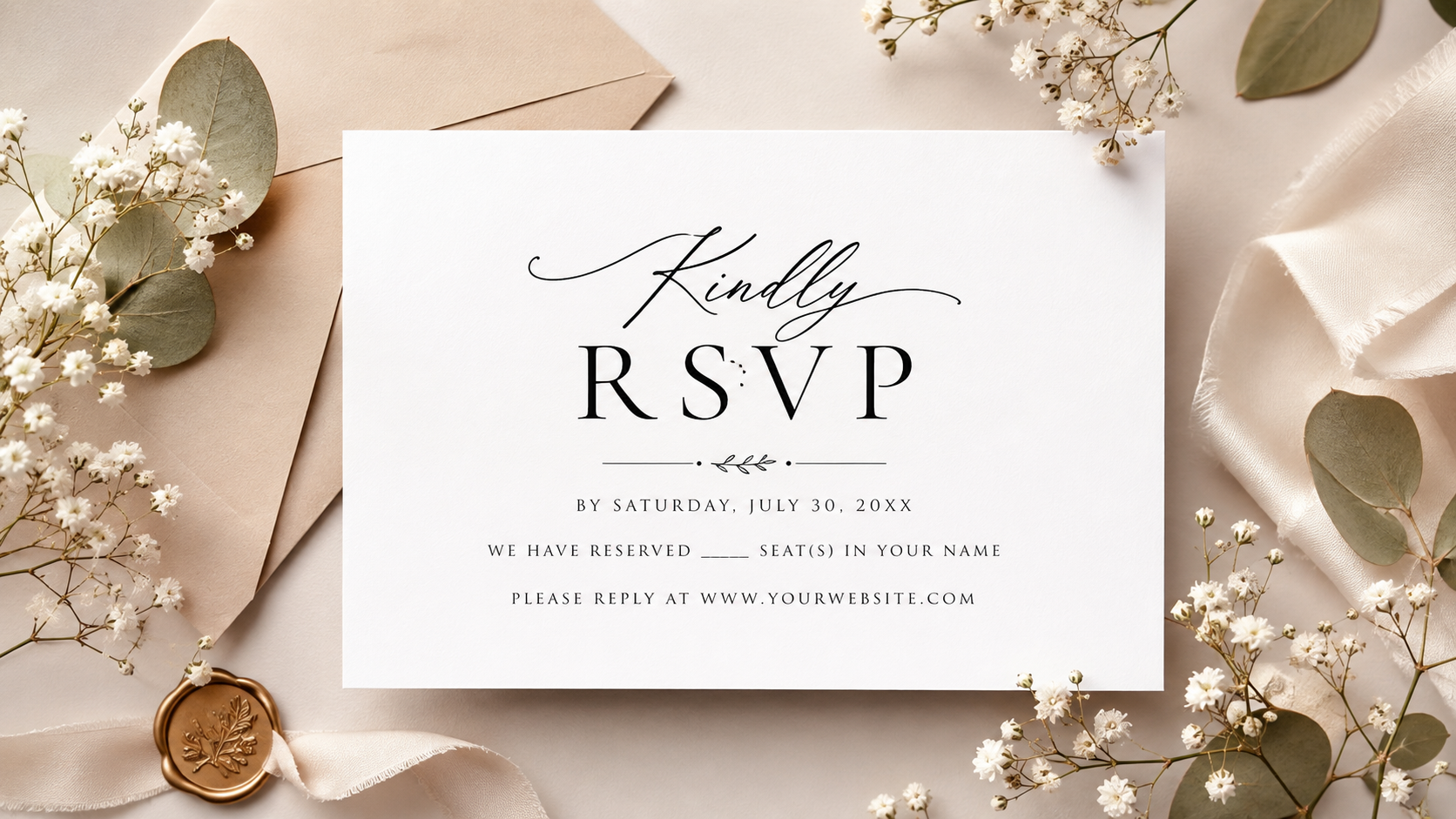
Formal RSVP wording should mirror the formality level of your main invitation — if your invitation says "honour," your RSVP card should say "favour," not "pleasure":
The favour of a reply is requested by the first of August M_______________________________ will _______ attend
A simpler, modern version:
Kindly respond by 1st August
☐ Joyfully accepts
☐ Regretfully declines
Number attending: _______
Dietary requirements: _______________________
Details and Dress Code Wording
Dress code, when included, usually sits below the venue and reception details, not on the main invitation card itself if you're using a separate details insert:
Dress code: Black tie
Wintergreen Barn is a 10-minute taxi ride from Cranleigh station
Accommodation options and a link to our wedding website can be found at [yourwebsite.com]
Frequently Asked Questions
What's the difference between "request the honour of your presence" and "request the pleasure of your company"?
"Honour" (with the British spelling) is used exclusively for religious ceremonies held in a church, chapel, synagogue, or temple. "Pleasure of your company" is used for civil ceremonies — register offices, hotels, or any secular venue.
How do I word a wedding invitation when my parents are divorced?
List each parent on a separate line without joining them with "and," since that word specifically signals a current marriage. If a parent has remarried, they share a line with their current spouse, joined by "and" — but the two family units still sit on separate lines.
Can I skip the host line entirely?
Yes. "Together with their families" is a widely used fallback that avoids listing every parent individually, and many self-hosting couples skip a formal host line altogether, going straight into their own names.
Is casual wedding invitation wording acceptable for a formal venue?
Yes — formality of wording and formality of venue don't have to match. Plenty of couples hold a traditional ceremony but choose warmer, first-person wording because it better reflects who they are.
What should an RSVP card say?
At minimum: a reply-by date, space to confirm attendance, and a line for dietary requirements. Formal RSVP cards should mirror the language of the invitation — "the favour of a reply is requested" pairs with "honour," while "kindly respond" works for less formal wording.