Haldi Ceremony Planning for Hindu Weddings in the UK
If someone in the family has already bought the turmeric and the next question is whether the haldi happens at home or in a hall, start with a smaller one: which haldi does your family do? In the accounts below, from Punjab, a Swaminarayan Hindu organisation and Bastar, the haldi differs in the day, the paste and who receives it,1,2,3 and each answer changes the space you need.
The short answer
A haldi is a pre-wedding ceremony in which turmeric paste is put on the bride, the groom or both. Find out from the elders which version your family follows, then book a space that can take turmeric on the floor and gives the couple somewhere to wash and change. Buy the turmeric from a UK supermarket, where spices fall under food standards law, raise any skin allergies with a GP or pharmacist early, and keep the haldi off the wedding morning if the dates allow.

What is a haldi?
Haldi is the Hindi and Urdu word for turmeric. In a 19th-century dictionary of the two languages, haldī chaṛhānā is the name of a marriage ceremony in which the bride and bridegroom are anointed with turmeric.
Other names belong to particular communities. In its account of the Hindu wedding ceremony, BAPS Swaminarayan Sanstha, a Hindu organisation, names the turmeric rite pithi cholvi in Gujarati and haridralepan in Sanskrit. In South Africa, a dictionary of the Indian community’s English, quoted in a 2022 thesis, records pithi as a pre-wedding turmeric ceremony held mainly in Gujarati homes. In Punjab, India, where one study records these customs across the region’s religious communities, the days of seclusion and preparation before a wedding are called maiyan, and the turmeric paste is called vatna.
Which version does your family do?
The three accounts in the table come from different places and record different customs.
|
Punjab, India (2004 study; shared across communities) |
BAPS (Swaminarayan Hindu) |
Bastar, east-central India (2011 study) |
|
|---|---|---|---|
|
Name |
Maiyan for the days of seclusion and preparation; vatna for the paste |
Pithi cholvi in Gujarati; haridralepan in Sanskrit |
Haldi tel, the turmeric-oil |
|
When |
During maiyan, the three to ten days before the wedding, depending on local custom |
The day before the marriage |
One day of rubbing upwards and another day downwards, in a wedding ritual that can last up to a week |
|
Paste |
Mustard oil, barley flour and turmeric mixed with fresh curd |
A creamy paste of turmeric and oil |
Turmeric-oil, with holy oil (dev tel) |
|
Who receives it |
The bride and the groom, each in their own home |
The bride |
The bride and the groom |
|
Who applies it |
Female relatives |
Not stated in its account |
Relatives |
The Punjab study covers customs shared across the region’s social and religious communities, and it notes that local practice varies. It describes the bride and the groom each sitting at home on a small wooden platform, under a canopy or an embroidered phulkari, while female relatives put the paste on. The bride’s sisters and female friends usually rub her arms, feet and face while singing, and at the groom’s house his sisters and his brother’s wives entertain him with naughty commentary. In both houses the maternal uncle lifts the bride or the groom from the platform. In some families, maiyan starts when a red thread, the mauli, is tied around each of their wrists and during those days the couple wear simpler, quieter clothes than usual.
The Bastar study describes the wedding there as a Hindu ritual, mostly joyous, with dancing, laughing and horseplay with coloured water and mud. It also has a serious religious side, in which the bride and groom are anointed with holy oil and turmeric to make them auspicious and pure.
Customs differ by family, region and generation, and families in the UK may adapt them in their own way. If your two families come from different traditions, the table is a quick way to spot where your plans will differ before anyone books anything.
What to settle with the family first
The answers to these questions decide the guest list, the space and the timing, so they come before any booking.
- One haldi or two? The Punjab account has a separate one in each family’s home. If you’re thinking of one joint haldi for both sides, agree whose customs lead and in what order.
- Who puts the paste on? Sisters and friends, aunts, or everyone who comes, and whether any relative has a set role, such as lifting the couple from the seat.
- Who’s invited? A haldi can be close family or a bigger party, so keep a separate count for it. Wedvisa’s guest list manager records each guest’s side (bride’s, groom’s or mutual), RSVP and dietary needs.
- Which songs? Whether the elders want particular songs, and who will lead them.
- Who hosts and who pays? Each family for its own haldi, or one budget for a joint event.
- Same day as the mehndi? That changes the timing, which is covered below. The henna evening has its own guide, Indian Wedding Mehndi Night in the UK: A Planning Guide for Hindu and Sikh Families.
Home, hall or venue?
Holding it at home stays closest to the Punjab account, where each family anoints its own child in its own house. One London decorator, 1SW Events, shows a haldi ceremony at a client’s residence in its portfolio, and offers marquees for mehndi gatherings, from small home events to large ones.

If you’d rather hire a space, these four UK venues name the haldi on their own pages (checked 16 October 2026).
|
Venue |
What it says about the haldi |
Space, hours and catering |
|---|---|---|
|
The Willows, Premier Suite, Hainault, London |
Lists a haldi ceremony among the suite’s best uses |
Up to 120 guests and a private balcony; in-house catering, or dry hire with your own caterer |
|
Pinewood Hotel, near Slough, Buckinghamshire |
Lists the haldi among the ceremonies it has welcomed |
Symak suite for up to 150 guests and 4 acres of lawn; dry-hire package for the wedding day: 9am to midnight, cleared by 1am; external caterers welcome; changing rooms 7am to 7pm on the wedding day |
|
Netley Hall, near Shrewsbury, Shropshire |
Lists mehndi and haldi gatherings among the events the estate hosts |
On exclusive hire, decor can stay in place from one event to the next; your chosen specialist caterers are welcome; up to 20 rooms on site |
|
Cavendish Banqueting Hall, Colindale, London |
Says the hall can host a haldi |
Licensed until midnight, with council approval needed to run later |
None of the four pages sets out rules on turmeric paste, floor protection or cleaning charges. One Cornwall event-hire firm’s terms list turmeric among foods that can stain its hired crockery. So it’s worth getting these answers from the venue in writing:
- whether turmeric paste is allowed in the room, on a terrace or lawn, or only outdoors
- what floor and furniture covers they want, and whether they supply them
- whether there’s a cleaning or damage charge, and how much
- where the couple can wash and change, and from what time
- how early you can get in to set up, and when the room must be clear
- whether the decor can stay up if a mehndi follows the same evening
If the haldi is planned for a lawn, keep an indoor or covered fallback booked.
Turmeric, skin and food
The turmeric itself needs a little care. UK Health Security Agency guidance says spices bought from a UK supermarket are covered by food standards law, while spices brought from abroad can contain lead. It adds that lead chromate can be added to turmeric to brighten its golden colour. Buying the turmeric for the paste from a UK supermarket keeps it within those rules, even if a relative offers a packet from a recent trip. It doesn’t guarantee every packet.
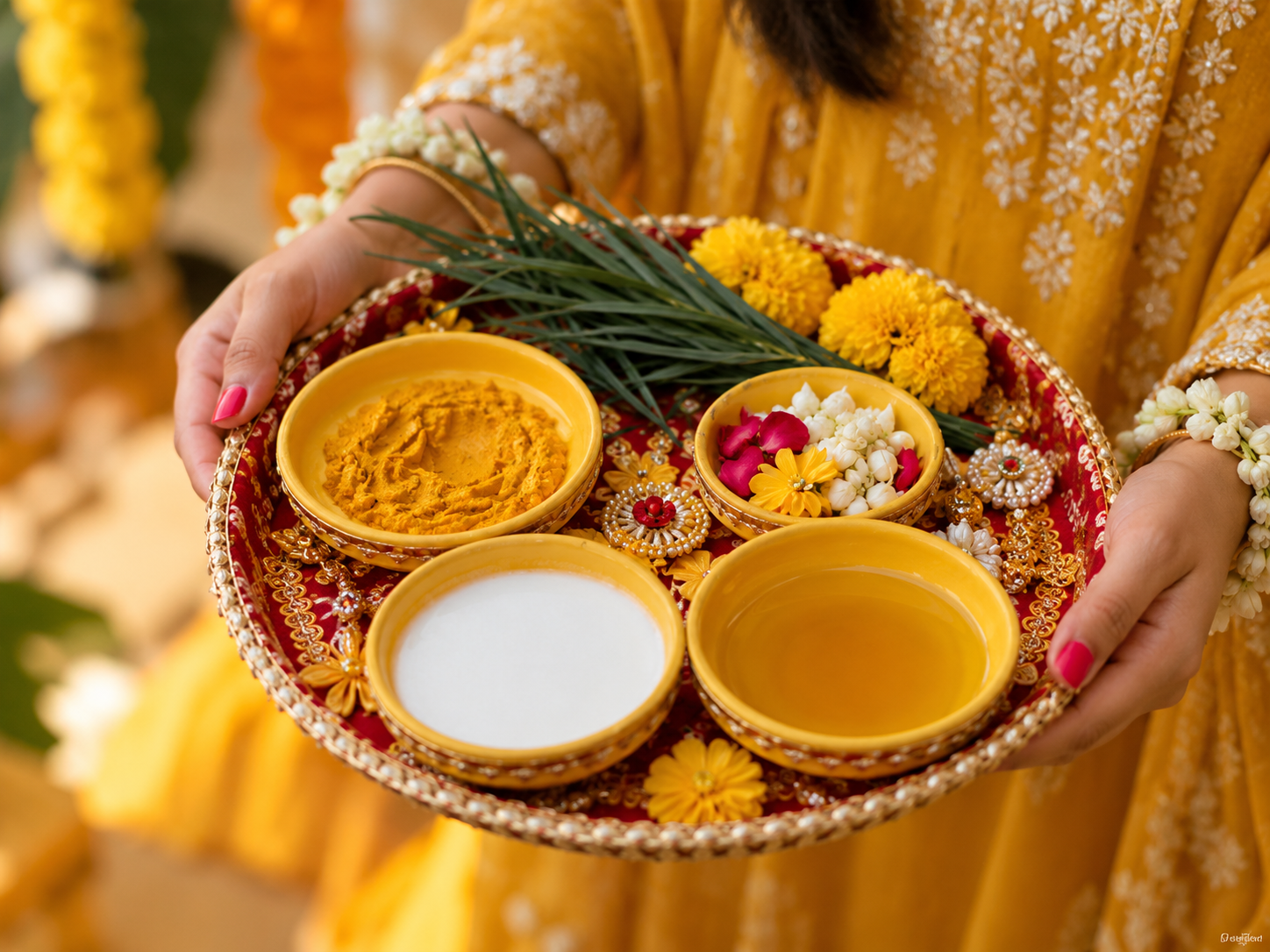
Then there’s the skin it goes on. The NHS describes patch testing as part of diagnosing contact dermatitis, and as the best way to test for a reaction to allergens, with tiny amounts of known allergens put on the skin and checked after 2 days. It’s a clinical test, so it isn’t something to try with the paste at home. If the bride or groom has eczema or a known allergy, take the list of paste ingredients (turmeric, oil, flour, curd or whatever your family uses) to a GP or pharmacist well before the day.
If a caterer serves food at the haldi, it has to manage food allergies, which includes giving accurate allergen information. The guest list manager’s dietary field covers choices such as vegetarian, halal and gluten-free; note any allergies separately and give the caterer both.
Decor for the haldi
Three UK decorators publish haldi work (checked 16 October 2026); their pages give no haldi price.
- Yas Event Decor has a haldi decor page and covers Essex and East, North, West and South London.
- 1SW Events, in London, offers bespoke decor for pre-wedding events, the haldi among them.
- Aster Events, in Cardiff, offers a second-day mehndi or haldi setup as an add-on to its wedding decor, and quotes the full programme itemised within 24 hours of an enquiry. Its £3,495 wedding package, for up to 175 guests, doesn’t list a haldi.
When you ask for a quote, mention the details your family’s version needs. If it uses a low wooden seat and a canopy or phulkari, as in the Punjab study, ask whether the decorator can supply them, and who brings the floor covers.
What to wear
Yellow links back to the word itself, since the same 19th-century dictionary gives haldiyā as turmeric-coloured, or yellow. Retailers selling to UK buyers list clothes for the haldi, and yellow appears among them: Manyavar’s UK storefront has a mustard-yellow patterned kurta in its men’s haldi collection, Diya Online lists a men’s haldi yellow kurta pyjama set (sold out when checked), and Fabilicious Fashion has a collection called Haldi Ceremony.
The accounts above set no haldi colour and say nothing about guests’ clothes, so go by the invitation or ask the hosts. Whatever the colour, wear something you won’t mind getting paste on, and bring a change of clothes. For a haldi between October and March, a layer for the walk between rooms helps.
Running the haldi morning
In the Punjab study, bathing is sometimes tied to the vatna and many families there give the bride or groom several baths in the days before the wedding. If the dates allow, holding the haldi on an earlier day leaves the couple time to wash, rest and change. If the haldi and the mehndi fall on the same day, ask whether the decor can stay up between them, as Netley Hall offers on exclusive hire. If they’re on separate days, Aster offers a second-day haldi setup as an add-on, quoted separately.

A suggested order for a morning haldi in a hired room, with a mehndi that evening:
|
Time |
What happens |
|---|---|
|
9am |
Access; decorator sets up; floor covers down |
|
10.30am |
Close family arrive |
|
11am |
Paste mixed and put on, with songs |
|
12.30pm |
Couple washes and changes |
|
1pm |
Lunch |
|
3pm |
Room turned round for the mehndi, or cleared |
Pinewood, for example, publishes wedding-day hours (dry hire from 9am, changing rooms until 7pm), so ask what hours apply on a haldi day. Build your own version hour by hour in Wedvisa’s day timeline, which you can share with your photographer and venue once you’ve signed up.
A countdown
The dates are a starting point. The planning timeline works out booking deadlines from your wedding date, and the budget calculator lets you set a total and allocate it by category.
|
When |
What |
|---|---|
|
3–4 months before |
Agree the version with both families; start the haldi guest list; send venue enquiries |
|
2–3 months before |
Book the venue or decorator; get the turmeric, floor and cleaning terms in writing |
|
4–6 weeks before |
Choose outfits; take any skin questions to a GP or pharmacist; give the caterer numbers and dietary needs |
|
1 week before |
Buy the paste ingredients, including turmeric from a UK supermarket; confirm the running order |
|
The day before |
Pack towels, old sheets and a change of clothes for the couple |
Haldi checklist
For everything else on the wedding list, there’s the Wedvisa wedding checklist.
- ☐ Your family’s version agreed: name, day, paste and who puts it on
- ☐ One haldi or two decided
- ☐ Haldi guest list set, with sides and dietary needs
- ☐ Venue’s turmeric, floor and cleaning terms in writing
- ☐ Washing and changing space confirmed, with times
- ☐ Decorator booked, with seat, canopy and floor covers agreed
- ☐ Turmeric bought from a UK supermarket
- ☐ Skin questions taken to a GP or pharmacist
- ☐ Caterer’s allergen information received
- ☐ Haldi outfits and a change of clothes ready
- ☐ Running order shared with the venue and photographer
Haldi at a glance
|
Question |
Answer |
|---|---|
|
What is it? |
A pre-wedding turmeric ceremony; a 19th-century Urdu and Hindi dictionary names haldī chaṛhānā as a marriage ceremony anointing the bride and groom |
|
Other names |
Pithi cholvi in Gujarati (BAPS); maiyan and vatna in Punjab, India (shared across communities there) |
|
When |
During the three to ten days of maiyan in the Punjab study; the day before in the BAPS account |
|
Where |
Home or a hired room; four UK venues name the haldi on their pages, none with published turmeric rules |
|
Safety |
Turmeric from a UK supermarket falls under food standards law, though that isn’t a guarantee for every packet; spices brought from abroad can contain lead6 |
|
What to wear |
Check the invitation; haldi collections sold to UK buyers include yellow pieces |
|
Wedvisa tools |
Guest list manager, day timeline, planning timeline, budget calculator and checklist |