Planning a British Pakistani Muslim Baraat at a UK Venue
If you’re planning a baraat for a British Pakistani Muslim wedding in the UK, three questions come before the dhol player and the horse: what the venue itself will let the groom’s party do on arrival, which rules sit outside the venue’s control, and what your families want the arrival to look like.
 Hamza Qureshi
·
Updated November 2026
The short answer
Sort every baraat question into one of three kinds before you book anyone. A venue term is something one venue sets for itself, so only that venue can answer it. Current law applies wherever you hold the baraat; this guide covers England and Wales. A family choice is yours to settle, such as a horse, a car or a dhol. The venue pages we read differ: one sets dhol times and rules out fireworks, two welcome a baraat and show no limits, and one lists baraat arrivals among its events, so ask yours in writing.
What a baraat is, and what you mean by it
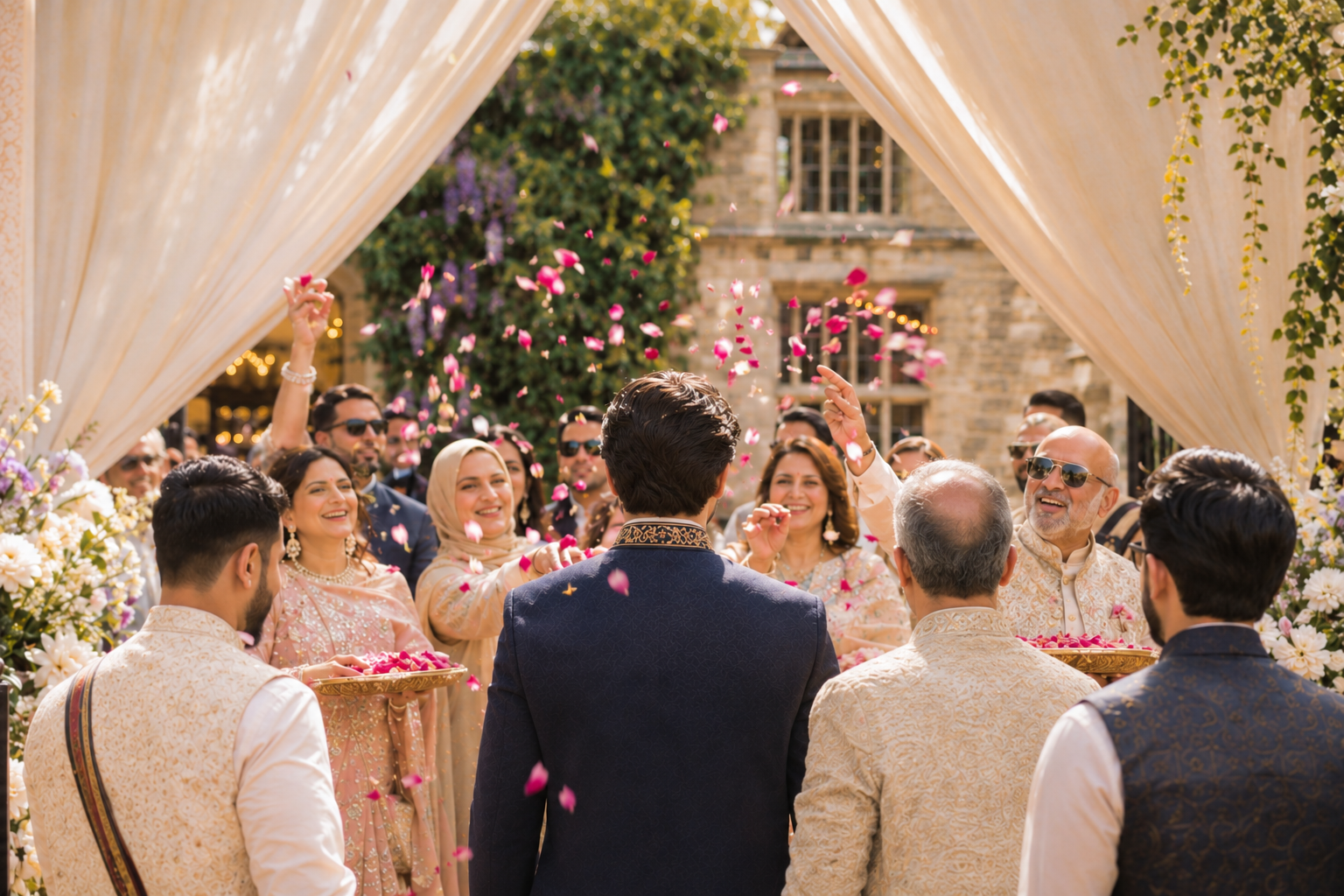
Family choice. These descriptions are background and family choice. A 2025 paper in Pakistan Social Sciences Review, in a literature-review sentence that cites other work, describes the barat, as it spells it, as the groom’s procession to the bride’s house and a sign of the families joining and becoming allies. In its interviews in four Pakistani cities, participants described rituals such as mehndi, baraat and rukhsati as being actively re-innovated, and one Karachi bride said her parents objected when she wanted a simple barat.
UK sources describe what venues offer. Ditton Manor in Berkshire says baraat processions vary according to cultural background and family preference, and describes the groom’s arrival at South Asian Muslim weddings as often a baraat with dhol drummers, decorated cars and sometimes a horse. Two non-UK sources describe the word and the arrival. Platts’ 1884 Urdu dictionary defines barāt as the procession of the bridegroom to the bride’s house, a marriage procession, and a 2025 paper on remembered village weddings in Gujranwala district, Punjab, Pakistan, describes the barat as arriving in the afternoon with decorated carts and staying for two nights. We found no UK study of how British Pakistani families hold a baraat.
The venue pages in this guide cover Asian weddings in general. Froyle Park’s Asian weddings page covers Hindu, Sikh, Muslim and multicultural weddings together, and the Stowe and Woodhall Manor pages are general Asian wedding pages. When you write to a venue, say what you mean in plain terms: who arrives, how, with what sound and for how long.
What will the venue let you do on arrival?
Venue term. Each venue below is describing its own offer, and none is a rule for another venue.
- Froyle Park in Hampshire says dhol drums are permitted between 11:00am and 6:00pm for up to 10 minutes and must be pre-booked by the venue on your behalf. It says its exclusive nominated dhol provider is the only one permitted. Its Asian weddings page adds that dhol drumming is subject to time restrictions and recommends discussing your baraat arrangements with the venue in advance.
- Stowe says its long driveway suits a baraat with horses, dhol drummers and dancing.
- The White Abbey Ballroom in Bradford says it hosts baraat arrivals among the ceremonies and celebrations it handles.
- Woodhall Manor in Suffolk says its events team will help coordinate logistics when the groom arrives on horseback or in a classic car.
The Stowe and Woodhall Manor pages show no time, noise or route limits for a baraat. That leaves the question open, so ask both what they would set.
Can the dhol play, and who books it?
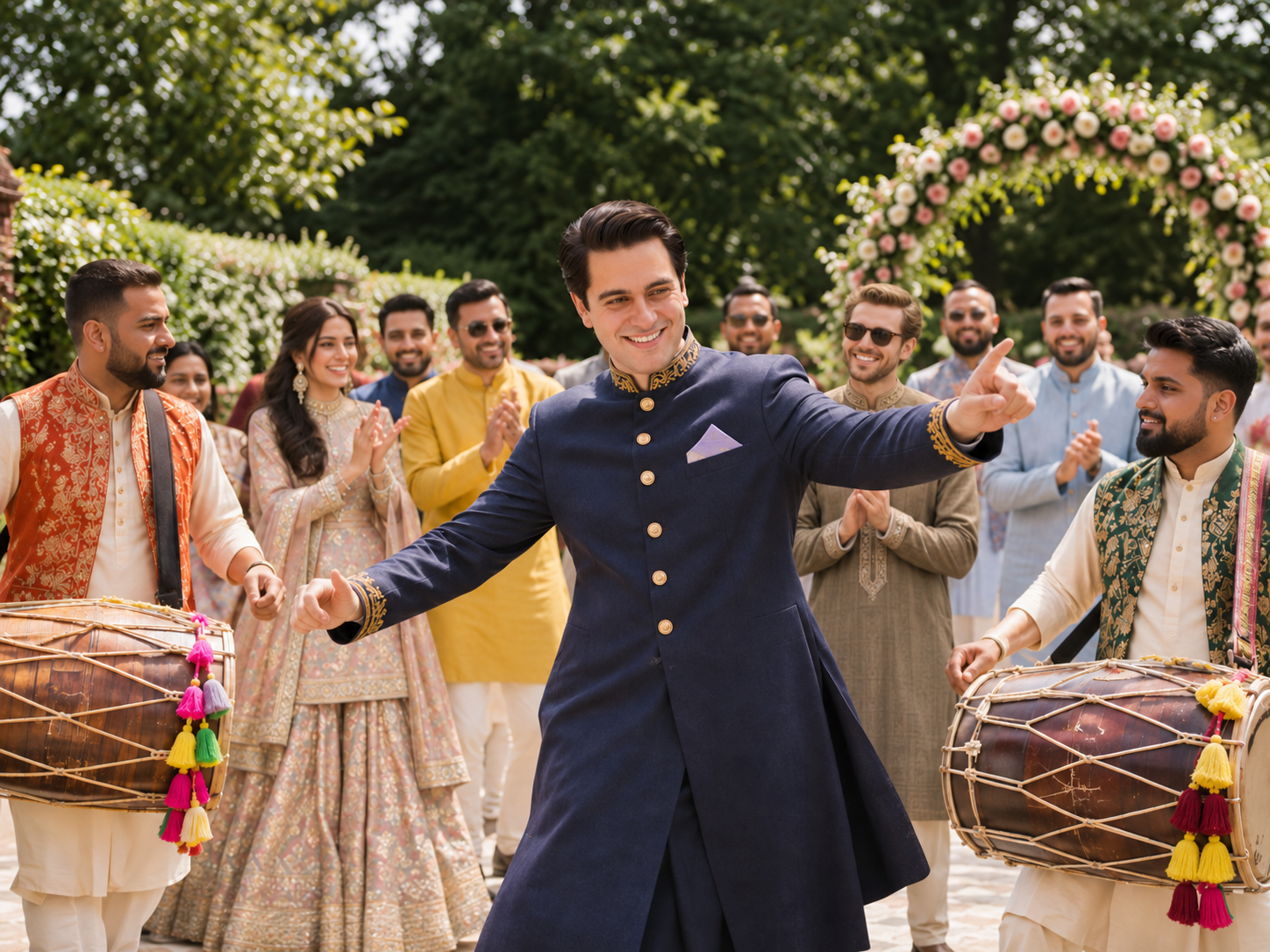
Venue term. One entertainment agency, in advice for bands and DJs, says public liability insurance is required to be allowed to perform at venues and that a venue can refuse a band that is not insured. It also advises asking the venue for its Noise Management Plan, which it describes as a document required by the local council. Ask your dhol player whether they hold public liability insurance and whether your venue wants to see it. Ask the venue whether it has a noise plan and a sound limiter.
Current law. GOV.UK’s Temporary Events Notice (TEN) page does not mention baraats or processions, and it does not say whether a dhol set at your venue needs a TEN, so ask the venue whether its licence covers music and dancing. In England and Wales, GOV.UK says to contact your council for a TEN to carry out a licensable activity on unlicensed premises, and lists providing entertainment such as music and dancing as one. It says you also need a TEN if a licensable activity is not in your existing licence, for example holding a wedding reception at a community centre. The page says to apply at least 10 clear working days before the event, shows a fee of £21 and a limit of fewer than 500 people at all times, staff included (the page is undated; checked 20 October 2026).
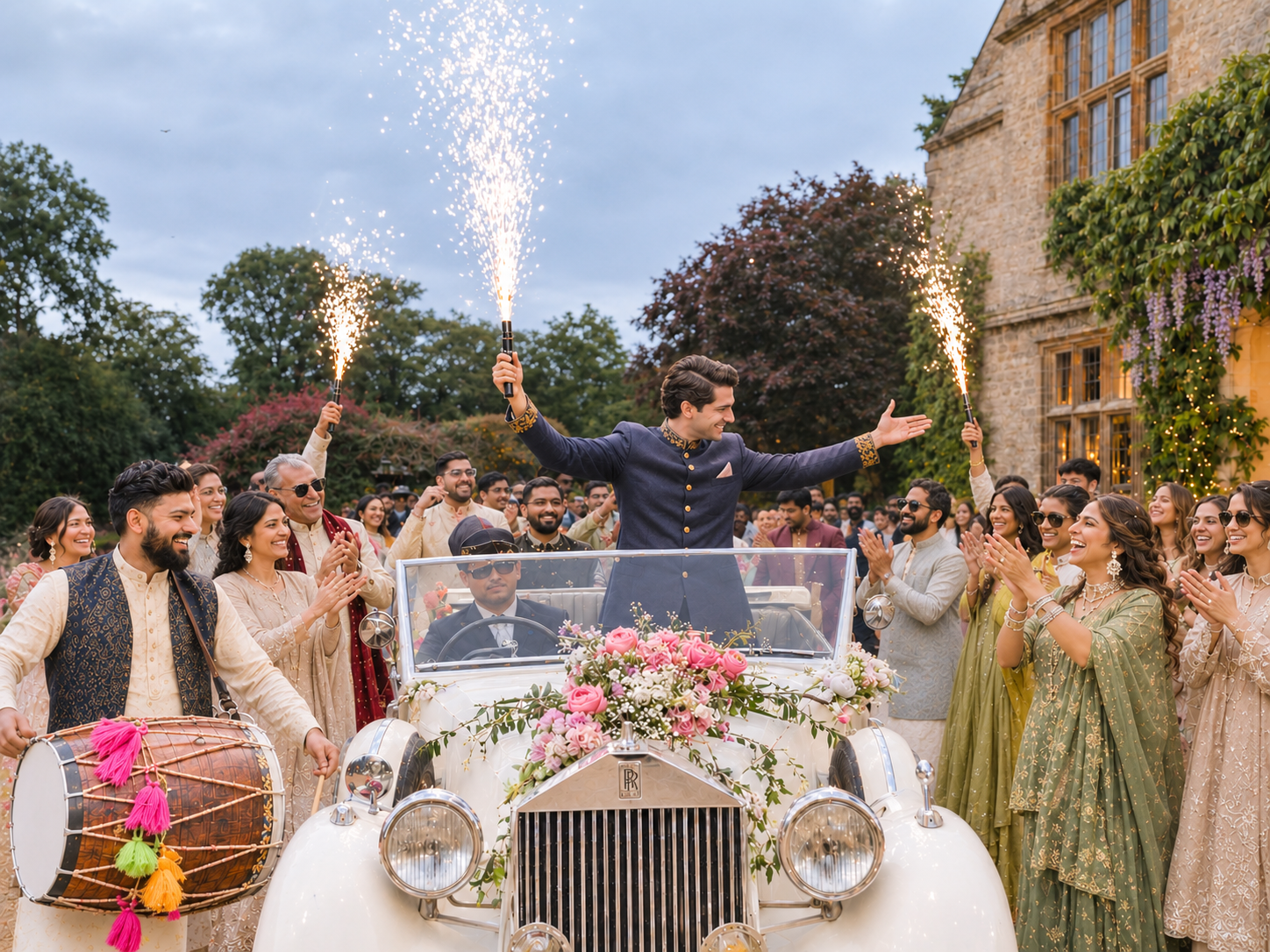
Horse or car?
Family choice. Whether a horse or a car leads the baraat is for your families to settle. One UK horse-hire supplier says its horses and handlers are all fully insured, which is the supplier’s own statement. GOV.UK hosts a 2000 code of practice for horse-drawn vehicles used on the road, mainly aimed at vehicles carrying paying passengers, which may matter if your family wants a carriage.
Current law. The Highway Code on GOV.UK says a horse must not be taken onto a footpath or pavement. That is a general road rule and does not mention weddings.
Venue term. Froyle Park asks to be told in advance if the groom plans to arrive on horseback. Your venue can say where a horse can wait and walk, and the supplier can say which insurance and handlers it brings.
We found no source that says whether a horse at a wedding needs a licence or council permission. This guide does not cover rules for a car convoy to a venue, such as stopping, horns or parking. Check with the venue, the supplier and your council.
Do you need to tell the police about your route?
Current law. In England and Wales, section 11 of the Public Order Act 1986 doesn’t mention weddings. Nothing we found says whether a baraat is covered, so if your route uses a public road, ask the local police early. The Act requires written notice to the police for a public procession held for certain purposes, one of which is to mark or commemorate an event, unless it is one commonly or customarily held in that police area, or giving any advance notice isn’t reasonably practicable. The notice gives the date, start time, route and an organiser’s name and address, goes to a police station where the procession starts, and is normally delivered at least 6 clear days ahead. Each organiser commits an offence in the circumstances the section lists, which include notice not given and a date, time or route that differs from the notice.
We also found nothing on whether a baraat counts as customary in any police area. GOV.UK and three councils describe events on the road in their own terms. GOV.UK’s page on protests and marches says by law the organiser of a public march must tell the police in writing 6 days beforehand; it does not say whether a baraat counts as one. Bradford Council says an event on the highway or needing a road closure requires a Road Closure Application Form. Its event application page gives timescales for supporting documents of 6 weeks for smaller events and 12 weeks for larger ones. Leicester City Council’s guidance (last updated 18 September 2018) says events on the highway must be registered with and licensed by the Highway Authority. Birmingham City Council’s noise page is written for residents bothered by a neighbour’s noise: it suggests speaking to the neighbour first, then using its online form if the problem continues. None of these four pages mentions weddings or baraats, so ask your own council whether anything applies to your route. A baraat that stays on the venue’s own driveway may never reach a public road, and the venue can tell you where its land ends.
Fireworks, sparklers and smoke
Current law. GOV.UK guidance for display organisers says Category F2, F3 and F4 fireworks may only be used between 7am and 11pm, except on Bonfire Night, when the cut-off is midnight, and on Diwali, New Year and Chinese New Year, when it is 1am. The Fireworks Regulations 2004, which apply in England and Wales, say that no person shall use an adult firework during night hours, which they define as 11pm to 7am the following day, with named exceptions. The same GOV.UK guidance says a display should be on private land with the landowner’s permission, and that fireworks can’t be set off in a public place or street, or within 50 feet of a highway, so at a wedding they belong on the venue’s land, if the venue allows them. It lists sparklers among its Category F1 examples, so check the category on the packet and go by the venue’s own rule.
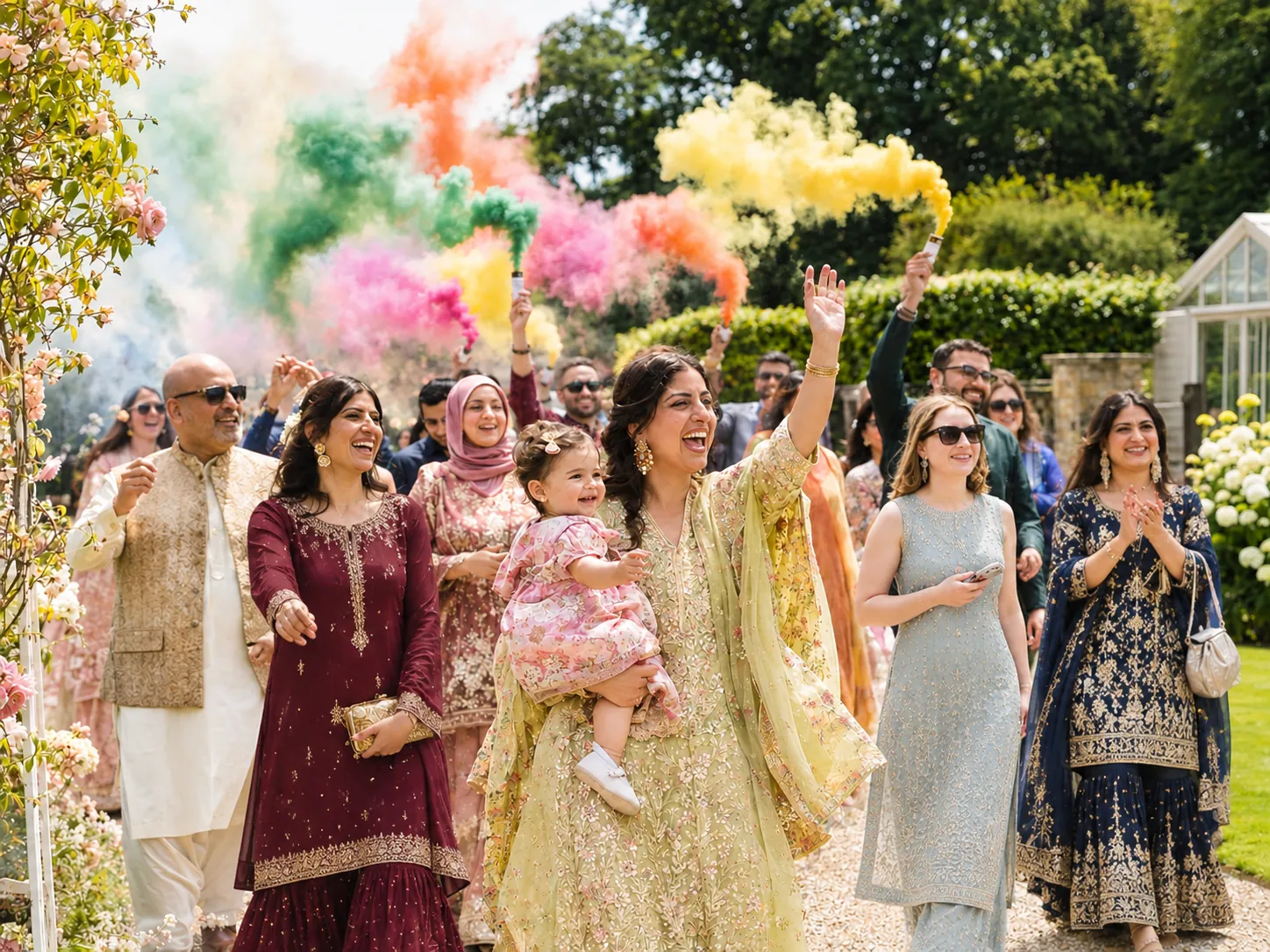
Venue term. Froyle Park says it is in a conservation area so fireworks are not permitted, that sparklers can be used at the front of the house and must be concluded by 9.30pm, and that haze is not permitted because it triggers the fire alarms.1 Ask your venue what it sets for fireworks, sparklers, smoke and flares, and until what time.
Scotland and Northern Ireland
Current law. The police-notice and fireworks rules above are for England and Wales, and this guide does not cover Scotland, so ask Police Scotland and your council what applies to a procession or fireworks there. This guide does not cover Northern Ireland either, so ask the Police Service of Northern Ireland and your council.
Family decisions and the day
Family choice. Your families decide who leads the procession, how long it runs, whether it uses a horse, a car or walking, which songs the dhol follows, and who pays. Write them down with each venue’s limits beside them. Wedvisa’s day timeline builder lets you build your wedding day schedule hour by hour, add your own items or start from a template, and share it with your photographer, venue and wedding party, so the arrival time and the dhol window sit in one plan.
Checklist
- Write down what your family wants the baraat to be: who arrives, how, with what sound and for how long.
- Ask each venue, in writing, what it sets for dhol times, horses, cars, fireworks, sparklers and smoke.
- Ask whether the venue has a sound limiter and a noise plan.
- Ask your dhol player about insurance and what the venue needs to see.
- Ask the venue whether its licence covers music and dancing, or whether you need a TEN.
- Ask your horse supplier which insurance and handlers it brings, and ask your council about permissions.
- Ask the local police early if the route uses a public road.
- Keep any fireworks on the venue’s land, and only if the venue says so.
- Put the arrival time and the dhol window in your day timeline.
At a glance
|
Question |
Kind |
Who to ask |
|---|---|---|
|
Dhol times and who plays |
Venue term |
Venue, dhol player |
|
Horse, car or walking |
Family choice |
Your families, venue, supplier |
|
Music and dancing licence, TEN |
Current law |
Venue, council |
|
Notice for a route on a public road |
Current law |
Local police |
|
Fireworks and sparklers |
Current law and venue term |
Venue, council |
|
Smoke, haze and flares |
Venue term |
Venue |