Wedding Planning Checklist UK: Everything You Need to Tick Off
Here's your full wedding planning checklist for a UK wedding, from venue hires and seating arrangements to the smallest details you might typically miss.
Most wedding "checklists" are really just timelines with tasks bolted on. This one's built differently — it's organised by area, so you can jump straight to the bit you're stuck on (budget, legal paperwork, suppliers, the final month) rather than scrolling through twelve months to find the one task you need. Tick off what applies to you, skip what doesn't, and use it as a working reference rather than a script.
Budget checklist
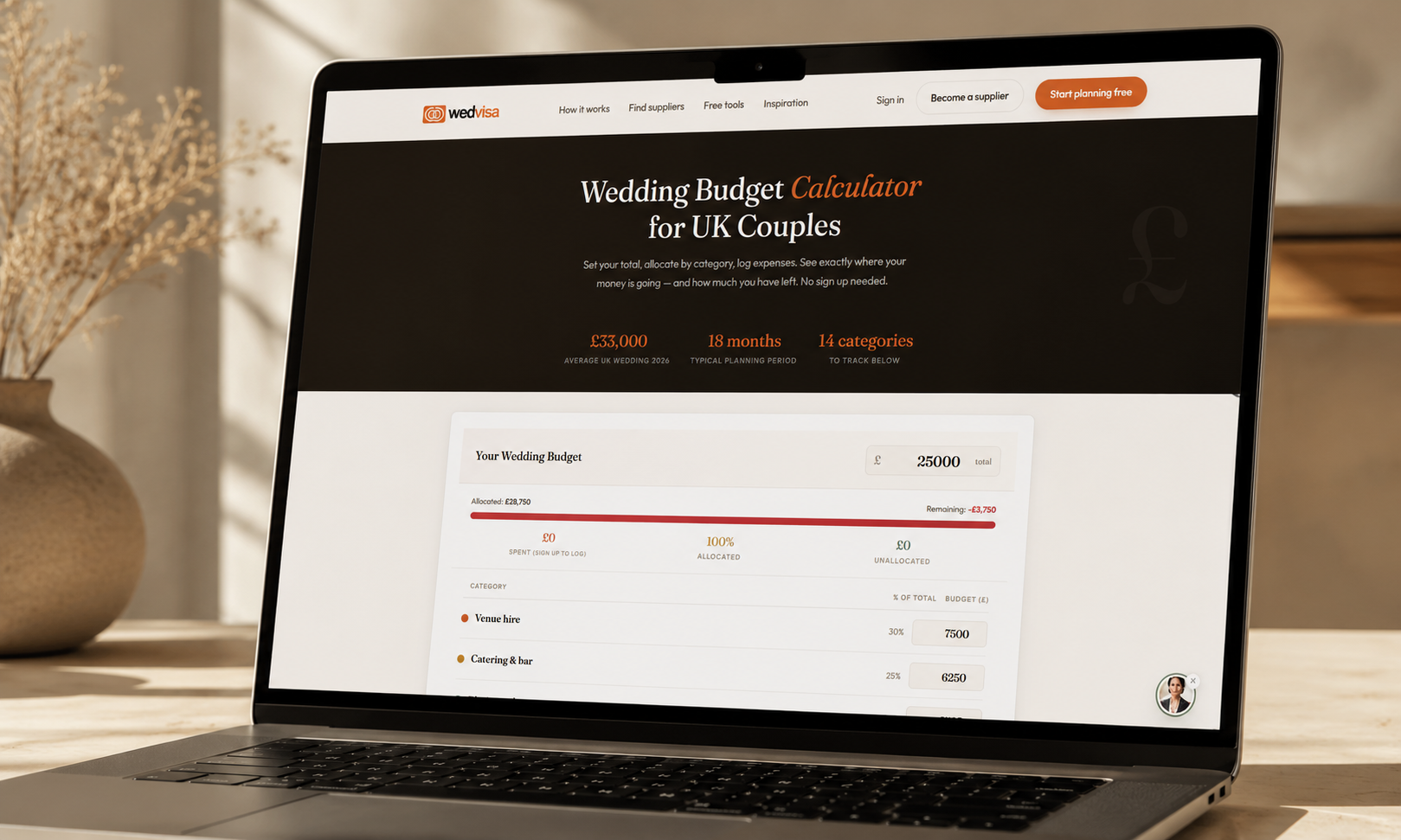
Wedvisa’s Free Wedding Budget Calculator Tool
- Agree your total budget with your partner (and anyone else contributing) before you look at a single venue
- Decide who's paying for what, and get it written down somewhere you'll both actually check
- Set aside a 10–15% contingency fund from day one
- Build a rough category breakdown so you know what "normal" spend looks like per item
For reference, the UK's two main wedding industry surveys put the current average cost of a wedding day at around £20,600–£22,000, excluding the ring and honeymoon (Bridebook's 2026 report: £20,604; Hitched's 2026 report: £21,990 — the difference is methodology, not disagreement). Couples with 50 guests or fewer typically spend well under £15,000; those with 150+ guests often clear £35,000.
A rough shape for where the money tends to go:
|
Category |
Typical share of budget |
|---|---|
|
Venue hire |
Largest single line, often 25–30% |
|
Catering (day + evening) |
Second largest, often 30–35% combined |
|
Photography & videography |
Together, often 12–15% |
|
Attire (dress, suit, rings) |
Roughly 10–15% |
|
Flowers & décor |
Roughly 8–12% |
|
Music & entertainment |
Roughly 5–8% |
|
Stationery, cake, transport |
The remainder |
One stat worth building your contingency around: research comparing the 2026 Hitched and Bridebook reports found that 56% of UK couples overspend their original budget, by an average of £4,800. If you want to see exactly where your own number would go before you commit to anything, Wedvisa's free wedding checklist tool is a place to start.
Guest list checklist
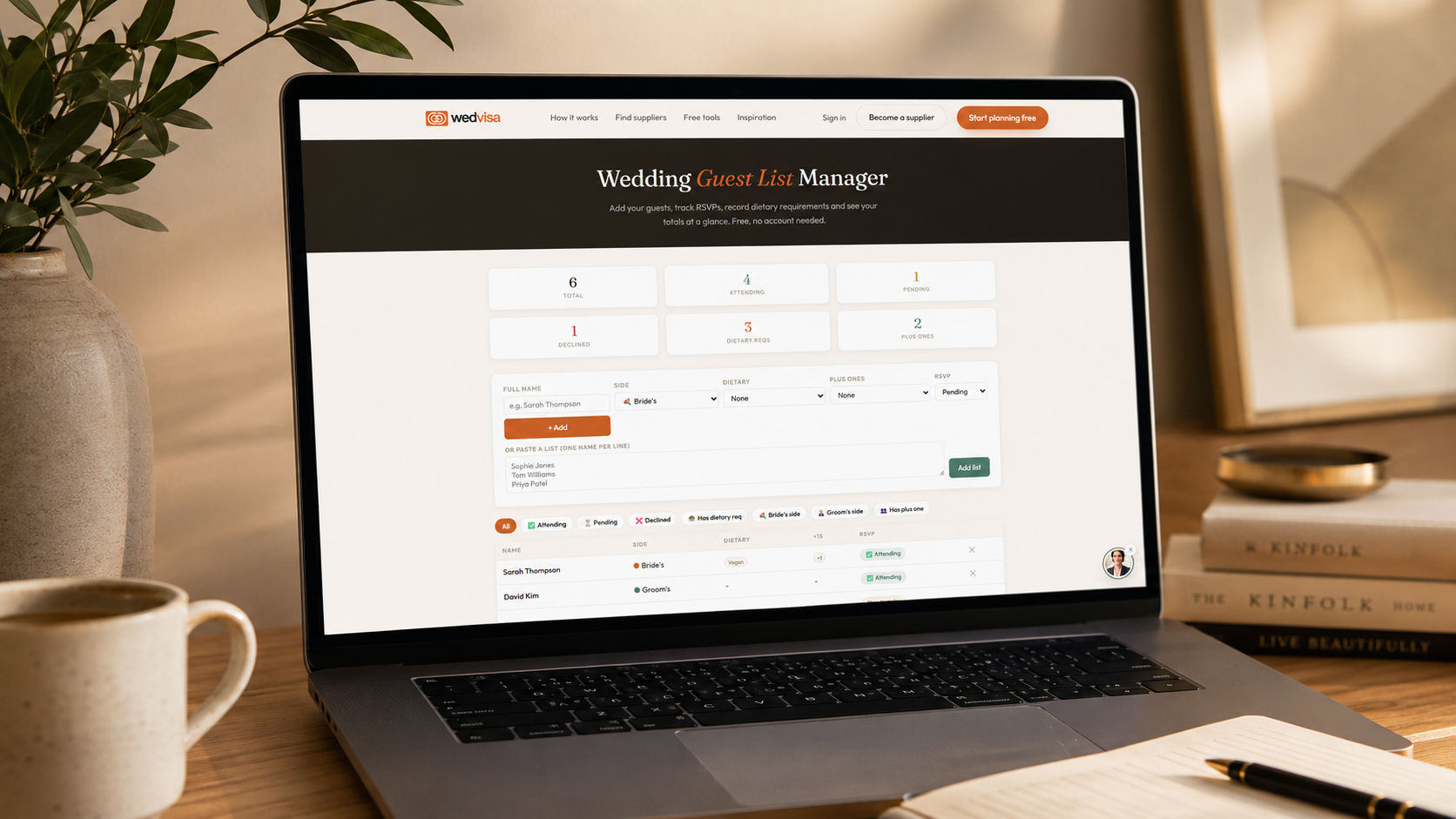
- Agree a realistic headcount with your partner before venue hunting starts
- Decide your policy on plus-ones and children early, and apply it consistently
- Keep a running list you both add to, rather than trying to remember everyone at once
- Revisit the number once you've seen real venue costs per head — it often changes things
Guest count is one of the biggest cost multipliers in UK wedding planning, and booking a venue before the list is settled is one of the most common — and expensive — mistakes couples make. Sort this before, not after, you fall for a venue.
Venue and date checklist
- Shortlist venues that suit your guest count, not the other way round
- Compare all-inclusive packages against dry-hire venues on total cost, not headline price
- Check whether your preferred season affects price — peak season (roughly May–September) and summer Saturdays cost the most
- Consider January, February or October if cost matters more than date
- Factor in region — London and the South East run well above the national average; Scotland, Wales and the North tend to be cheaper for a comparable day
- Confirm the venue holds the correct licence if you want any part of the ceremony outdoors
- Book the venue and date as soon as you've found the right one — everything else gets planned around this
Worth knowing: barns have overtaken hotels as the UK's most-booked wedding venue type, so if you're torn between the two, run the full cost comparison (catering, furniture, staffing) rather than comparing hire fees alone.
Legal paperwork checklist
This is the part of planning with actual deadlines attached, and requirements differ slightly across the UK's four nations.
England and Wales
- Give notice of marriage in person at your local register office — this can't be done by post, phone or online
- Do this at least 29 days before the ceremony (per GOV.UK's guidance); the wedding must then happen within 12 months of giving notice
- Confirm you've lived in your registration district for at least 7 days beforehand
- Budget £46.50 per person for the standard fee, or £63 per person if either of you is subject to immigration control (which can extend the wait to up to 71 days)
- Bring original proof of identity, address, and (if previously married) your decree absolute or a late spouse's death certificate — see the full document checklist on GOV.UK
- If you want a humanist or independent celebrant ceremony, book a separate registry ceremony too — celebrant-led ceremonies aren't legally binding here
Scotland
- Submit a Marriage Notice (Form M10) at least 29 days before the wedding, per mygov.scot's guidance
- Note there's no residency requirement, unlike England and Wales
- If choosing a humanist ceremony, know that it's fully legally binding in Scotland — around 30% of Scottish marriages are now humanist
Northern Ireland
- Give notice at least 28 days before the ceremony (per nidirect's guidance), though 10–12 weeks is recommended
- Budget £22 per person for notice, plus £36 if a registrar conducts the ceremony
All nations
- Diarise your notice appointment for 10–12 weeks before the wedding regardless of the legal minimum, to leave a buffer for any paperwork issues
Supplier booking checklist
Book first — these can only serve one wedding a day:
- Photographer
- Videographer
- Registrar or celebrant (confirm availability as soon as the venue is booked)
Book next, roughly 9–12 months out:
- Caterer (if your venue is dry-hire)
- Band or DJ
- Florist (6–12 months typically; 12–18 months for larger, design-led arrangements)
- Hair and make-up artist (6 months minimum, trial booked 4–8 weeks before the day)
- Wedding cake maker
- Dress and suit shopping started — gowns especially can take months to order and alter
Before signing with anyone new:
- Ask for full galleries or portfolios, not just highlight reels
- Read reviews from real weddings, not curated testimonials
- Get inclusions, payment schedule and cancellation terms in writing
- Check they carry public liability insurance
- Ask what their backup plan is if they're unwell on the day
Invitations and RSVP checklist
- Send save-the-dates 9–12 months out (nearer 12 months if you have international guests)
- Send formal invitations 6–8 weeks before the day if save-the-dates went out, or 4–6 months ahead if not
- Set an RSVP deadline 3–4 weeks before the wedding
- Collect dietary requirements alongside RSVPs, not separately
- Pass final numbers to your caterer and venue as soon as the RSVP deadline passes
Final months checklist
- Finalise ceremony content — readings, music, vows — with your registrar or celebrant
- Hold your cake tasting and confirm the final menu
- Take out wedding insurance once venue and catering deposits are paid (typically £50–£150, covering supplier failure, illness, or damage to attire and gifts — not cold feet)
- Complete final dress and suit fittings in the last 6–8 weeks
- Confirm delivery and setup times with every supplier
- Lock in the day-of running order and share it with your venue and wedding party
- Confirm a wet-weather plan if any part of the day is outdoors
Mistakes to check yourself against
- Have you set a budget and actually tracked spending against it, not just at the start?
- Did you finalise the guest list before booking the venue, not after?
- Do you have a wet-weather backup for anything outdoors?
- Have you set boundaries on the guest list and day plan, rather than trying to please everyone?
- Have you budgeted for hidden extras — service charges, corkage, overtime fees, cake-cutting fees?
- Did you choose suppliers on reviews and full portfolios, not just the cheapest quote?
Frequently Asked Questions
What's the first thing on a UK wedding planning checklist?
Budget and guest count, agreed together before you look at venues. Both shape nearly every decision that follows, and doing them out of order is the most common source of overspending and re-planning.
What's the average cost of a UK wedding?
Around £20,600–£22,000 for the day itself, according to the two main UK wedding industry reports (Bridebook and Hitched, 2026), excluding the engagement ring and honeymoon.
What order should suppliers be booked in?
Venue, photographer, videographer, and your registrar or celebrant first, since they can only work one wedding a day. Caterers, florists, bands and hair/make-up artists can typically follow, usually 9–12 months out.
What legal paperwork do I need for a UK wedding?
You must give notice of marriage in person at your local register office at least 29 days before the ceremony in England, Wales and Scotland (28 days in Northern Ireland), and the wedding must happen within 12 months of giving notice. Fees and small details vary across the UK's four nations.
Is a humanist wedding legally binding in the UK?
Only in Scotland, where humanist ceremonies have been legally recognised since 2005. In England, Wales and Northern Ireland, couples need a separate civil ceremony to make the marriage legal.
When should I send save-the-dates and invitations?
Save-the-dates 9–12 months out. Formal invitations 6–8 weeks before the day if save-the-dates were sent, or 4–6 months ahead if not, with an RSVP deadline 3–4 weeks before the wedding.
Do I need wedding insurance?
It's not legally required, but it's a sensible step once you've paid non-refundable deposits. Policies typically cost £50–£150 and cover supplier failure, illness, or damage to attire and gifts.
How many suppliers does a typical UK wedding need?
Most weddings involve a venue, caterer (if not included), photographer, videographer, florist, band or DJ, hair and make-up artist, celebrant or registrar, and a cake maker — though plenty of couples combine or drop categories to suit their budget and priorities.
Can I plan a UK wedding in less than 12 months?
Yes, particularly with a flexible date or an off-peak weekday. Focus first on the venue and the once-a-day suppliers (photographer, videographer, registrar), since those have the least flexibility — everything else can usually be compressed into a shorter window.