How to Plan a Wedding in the UK (Step-by-Step Guide)
Wedding planning in the UK requires months of effort, sleepless nights, budgeting, and management. It's always going to be hard, but it doesn't mean you have to lose your mind over it. Here is a guide to get you started, along with free tools that can make your job easier.
Planning a wedding in the UK is, for most couples, a 12 to 18 month project that touches everything from council paperwork to cake tastings. It doesn't need to be overwhelming, but it does help to know the order things should happen in — because booking a venue before you've settled your guest list, or leaving your legal paperwork until the last minute, is how couples end up stressed (and over budget).
This guide walks through the whole process in order: budget, guest list, venue, suppliers, legal requirements, and all the final-month details — with UK-specific costs, timeframes, and the law as it stands right now.
How Long Does It Take to Plan a Wedding in the UK?
Most planning guides converge on the same figure: 12–18 months, with the longer end of that range recommended if you want a summer Saturday at a popular venue.
The logic is simple: venues, photographers, and registrars can only serve one wedding per day, so the best ones get booked up well over a year out. Everything else — caterers, florists, cake makers — can usually be arranged with 6–9 months' notice.
If your date is more flexible, or you're happy with an off-peak weekday, you can compress this timeline considerably. But as a default, working back 12–18 months from your wedding day is the safest plan.
Step 1: Set Your Budget Before You Do Anything Else
This is the step couples most often skip — and it's the one that causes the most stress later. Decide your total budget, agree who's contributing, and write it down before you fall in love with a venue you can't afford.
The average UK wedding now costs around £20,600–£22,000, excluding the engagement ring and honeymoon. That figure includes everything from venue hire to flowers, but it varies hugely by guest count — couples hosting 50 guests or fewer spend roughly £12,000 on average, while those with 150+ guests spend closer to £37,000.
A rough category breakdown to budget against (Bridebook, 2026):
|
Category |
Typical average cost |
|---|---|
|
Venue hire (excl. catering) |
£6,040 |
|
Reception catering |
£5,406 |
|
Evening catering |
£2,002 |
|
Wedding planner |
£1,543 |
|
Dress |
£1,532 |
|
Videographer |
£1,514 |
|
Photographer |
£1,484 |
|
Décor |
£1,404 |
|
Florist |
£1,187 |
|
Reception music |
£1,061 |
|
Rings/jewellery |
£1,057 |
|
Menswear |
£859 |
|
Ceremony music |
£845 |
|
Transport |
£593 |
|
Celebrant |
£504 |
|
Hair & make-up |
£811 (combined) |
|
Stationery |
£378 |
|
Cake |
£360 |
Venue and catering together usually account for around half your total budget, so if you need to cut costs, these are the two areas where small changes — fewer guests, an off-peak date, a different day of the week — make the biggest difference.
One more thing worth knowing before you start: research from Weddings Hub's comparison of the Hitched and Bridebook 2026 reports found that 56% of UK couples overspend their original budget, by an average of £4,800. Build in a 10–15% contingency from the outset, and you'll be far less likely to join that statistic.
That is where Wedvisa’s free wedding budget calculator becomes useful, where you can see a full picture of where every single pound is being spent without spending more on a budgeting tool.
Step 2: Build Your Guest List before You Book Your Venue
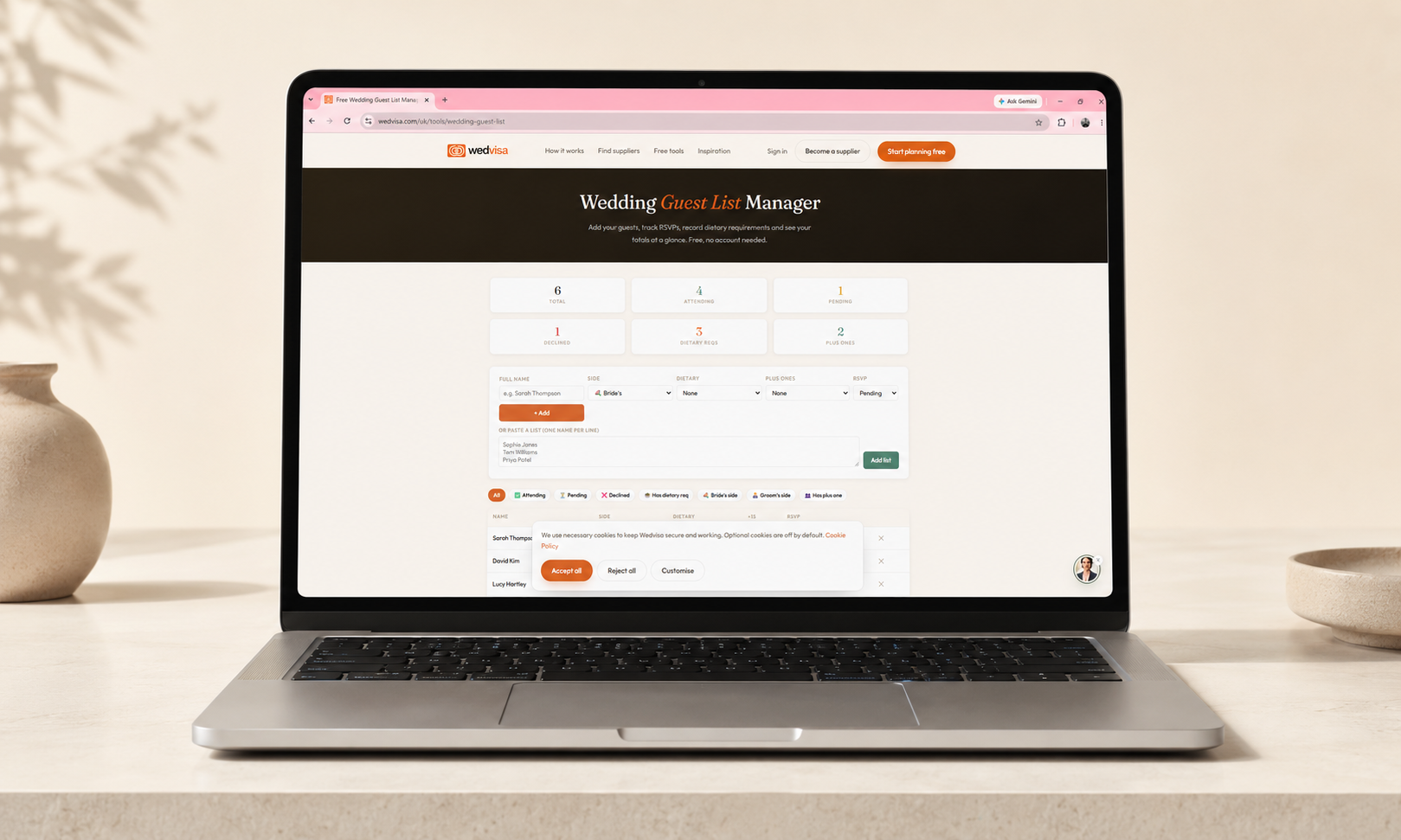
Wedvisa’s Wedding Guest List Manager Tool
It's tempting to fall in love with a venue first and work everything else around it, but guest count should come before venue choice — not after. A venue that's perfect for 150 guests will feel cavernous (and cost more per person) for 60, and a venue you love for its intimacy might simply not fit your extended family.
Booking a venue before the guest list is settled is one of the most frequent and costly errors couples make, alongside trying to please everyone with the guest list itself. Get a realistic headcount agreed with your partner first, then go venue hunting.
Step 3: Choose Your Date and Book Your Venue (12–18 months out)
Once you know your budget and roughly how many people you're inviting, you can start looking at dates and venues in earnest.
A few things shape this decision:
- Season and day of the week matter a lot for cost. Peak season runs roughly May to September, with summer Saturdays the most in demand and most expensive.
- Region affects price too. London is consistently the most expensive place in the UK to marry, with average costs well above the national figure, while regions further from the capital tend to be noticeably cheaper.
- Barn venues have overtaken hotels as the UK's most-booked wedding venue type. If you're weighing up a barn against a hotel or country house, it's worth comparing all-inclusive packages against dry-hire venues, since the gap in total cost (once catering, furniture, and staffing are added in) can be significant.
Once you've found "the one," book it. This is the decision that locks in your date, so everything else — suppliers, paperwork, even your own annual leave — gets planned around it.
Step 4: Lock in Your "once-a-day" Suppliers
With your date and venue confirmed, move straight on to the suppliers who can only do one wedding per day — because these are the ones that get booked out furthest in advance:
- Photographer and videographer — the best are often booked 12+ months ahead.
- Registrar or celebrant — contact your local register office (or your celebrant of choice) as soon as your venue is confirmed, to check they're available for your date.
This exact sequence is good precisely because these suppliers can't double-book, unlike caterers or florists who can often serve multiple events across a season.
Step 5: Sort the Legal Paperwork
This is the step couples most often leave too late — and unlike most wedding planning, it has hard legal deadlines. The requirements differ slightly across the UK's four nations.
England and Wales
You and your partner must "give notice" of your marriage at your local register office — a signed legal statement of intent. Per GOV.UK's official guidance, you must give notice at least 29 days before your ceremony, and the wedding must take place within 12 months of giving notice. You'll also need to have lived in the registration district for at least 7 days beforehand.
The standard notice fee is £46.50 per person (rising to £63 per person if either of you is subject to immigration control, which can also extend the notice period to up to 70 days). You'll need to bring proof of identity, address, and — if previously married — your decree absolute or a former spouse's death certificate; full details of what to bring are set out in GOV.UK's document checklist. Most local councils, including Warrington, run their own booking system for the notice appointment itself, so check your specific council's page once you know where you'll be giving notice.
Worth knowing: a humanist or independent celebrant ceremony is not legally binding in England and Wales — couples who want one still need a separate civil ceremony to make the marriage legal.
Scotland
Scotland's process is broadly similar but has two important differences. Each partner submits a Marriage Notice (Form M10) to the registrar for the district where the marriage will take place, with mygov.scot's guide to getting married in Scotland confirming the same 29-day minimum notice period. Unlike England and Wales, though, there's no residency requirement — you don't need to have lived in Scotland during the waiting period.
The other key difference: humanist ceremonies are legally binding in Scotland. They've grown hugely in popularity — data on humanist marriages in Scotland shows they've outnumbered religious ceremonies for several years running, and Fuze Ceremonies' analysis of 2024 marriage figures puts humanist weddings at around 30% of all Scottish marriages.
Northern Ireland
The process here mirrors England, Wales and Scotland, with one small difference: the minimum notice period is 28 days rather than 29, and notice can be given up to 12 months ahead. nidirect's guidance on giving notice for marriage recommends submitting your paperwork 10–12 weeks before the wedding to be safe, even though the legal minimum is shorter. The notice fee is £22 per person, with a further £36 charged for a registrar to conduct a civil ceremony.
Across all four nations: the safest approach is to diarise your notice appointment for around 10–12 weeks before your wedding date, even though the legal minimum is shorter — this gives you a buffer if any paperwork needs chasing up, and it's the timeframe most registrars themselves recommend.
Step 6: Book the Rest of Your Suppliers (9–12 months out)
With the once-a-day suppliers and your legal paperwork in motion, turn to everyone else:
- Caterer (if your venue is dry-hire) and band or DJ — both typically need 9–12 months' notice for popular dates.
- Florist — 6–12 months for most weddings, extending to 12–18 months for larger, design-led florals.
- Hair and make-up artist — in high demand, so booking 9–12 months ahead is recommended, with 6 months as an absolute minimum, and your trial scheduled for 4–8 weeks before the big day.
This is also the point to start dress and suit shopping — gowns in particular can take several months to order in and alter, so don't leave this until the 6-month mark.
Step 7: Save-the-Dates and Invitations
Send save-the-dates around 9–12 months out (8–12 months if you have international or destination guests, who'll need longer to plan travel). Formal invitations follow later — typically 6–8 weeks before the wedding if save-the-dates have already gone out, or 4–6 months ahead if you've skipped save-the-dates altogether. Set your RSVP deadline for around 3–4 weeks before the day, so you can confirm final numbers with your caterer and venue in good time.
Step 8: The Final Few Months
In the last 3–6 months, the focus shifts to confirming details rather than booking new suppliers:
- Finalise your ceremony content (readings, music, vows) with your registrar or celebrant.
- Have your cake tasting and confirm your final menu.
- Take out wedding insurance once you've paid your venue and catering deposits — policies typically cost £50–£150 and cover things like supplier failure, illness, and damage to attire or gifts (though not, notably, cold feet).
- In the final 6–8 weeks, do your last dress and suit fittings, confirm delivery and setup times with every supplier, and lock in your day-of running order.
How to Choose and Vet Wedding Suppliers
Booking a supplier is easy. Booking the right one is harder — and it's where most of the genuine risk in wedding planning sits, since you're often handing over a deposit to someone you've only met once or twice. A few checks are worth doing before you sign anything:
- Look at full galleries or portfolios, not just highlight reels. A photographer's Instagram shows their best ten shots; a full gallery shows how they handle a whole day, including dim receptions and awkward family group shots.
- Read reviews from real weddings, not just testimonials curated by the supplier.
- Get everything in writing — what's included, the payment schedule, and the cancellation policy. If it's not in the contract, it doesn't exist.
- Check they're insured. Public liability insurance is a basic sign of a legitimate, established business, and many venues require it anyway.
- Ask what happens if they're unwell on the day — a good supplier will have a backup plan, not a shrug.
This is exactly the gap that Wedvisa is built to close: instead of relying on a single Instagram feed or a friend's recommendation, you can discover and compare vetted UK suppliers — photographers, caterers, florists, and more — early in your planning, with reviews and portfolios in one place, so you're booking with confidence rather than crossing your fingers.
Common Wedding Planning Mistakes to Avoid
A few mistakes come up again and again in UK wedding planning advice, most notably:
- Not setting a realistic budget at the start — and then not tracking spending against it as deposits go out.
- Booking the venue before the guest list is finalised, leading to a space that's the wrong size.
- No wet-weather plan. If any part of your day is outdoors, confirm the venue's indoor backup when you view it — not on the morning of the wedding.
- Trying to please everyone. It's your wedding; set boundaries on the guest list and the day's plan early, kindly but clearly.
- Choosing the cheapest photographer. The flowers wilt, the cake gets eaten — the photos are what you're left with.
- Underestimating hidden costs — service charges, corkage, overtime fees, and cake-cutting fees can all add up if they're not factored in from the start.
Best Time of Year to Get Married in the UK
If cost is a major factor, timing your wedding for January, February or October will generally get you a noticeably better rate than a peak summer Saturday — the same venue can cost thousands of pounds less on an off-peak weekday than on a July or August Saturday.
If you have more flexibility on guest numbers than on date, remember that catering and entertainment costs scale with headcount more directly than almost anything else — a smaller guest list will often save you more than switching from a Saturday to a Friday.
Frequently Asked Questions
How do I start planning a wedding in the UK?
Start with your budget and a rough guest count — both shape every decision that follows. Once those are agreed with your partner, move on to choosing a date and booking your venue, ideally 12–18 months ahead of your wedding day.
How far in advance should I plan a wedding in the UK?
Most planning guides recommend 12–18 months, particularly for a summer Saturday at a popular venue. If your date is flexible or you're considering a weekday or off-peak month, you can plan in a shorter window, sometimes 6–9 months.
What is the average cost of a UK wedding?
Around £20,600–£22,000 for the wedding day itself, according to the two main UK wedding industry reports (Bridebook, 2026; Hitched, 2025), excluding the engagement ring and honeymoon. Costs vary widely by guest count and region, with London consistently the most expensive area.
What order should I book wedding suppliers in?
Book "once-a-day" suppliers first — venue, photographer/videographer, and your registrar or celebrant — since they can only serve one wedding on any given date. Caterers, florists, bands and hair/make-up artists can typically be booked a little later, around 9–12 months out.
How do I legally get married in the UK?
You need to "give notice" of marriage at your local register office at least 29 days before your ceremony in England, Wales and Scotland (28 days in Northern Ireland), and your ceremony must take place within 12 months of giving notice. Requirements and exact fees differ slightly across the UK's four nations.
How much notice do I need to give to get married?
A minimum of 29 days in England, Wales and Scotland, or 28 days in Northern Ireland. Most registrars recommend giving notice 10–12 weeks before the wedding date to allow time for any paperwork issues to be resolved.
Is a humanist wedding legally binding in the UK?
It depends where you marry. Humanist ceremonies are legally binding in Scotland, but not in England, Wales or Northern Ireland — couples marrying in those nations who want a humanist ceremony still need a separate, legally recognised civil ceremony.
What is the cheapest month to get married in the UK?
January, February and October tend to be the most affordable months, with venues often charging significantly less than for a peak summer Saturday in June, July or August.
How many guests should I invite to a UK wedding?
There's no fixed answer, but guest count is one of the biggest cost drivers — couples with 50 or fewer guests spend roughly a third of what couples with 150+ guests spend on average. Decide your guest list before booking your venue, rather than after.
Do I need a wedding planner in the UK?
It's optional. Many couples manage their own planning successfully using checklists and supplier marketplaces, while others — particularly those with full-time jobs, complex logistics, or a shorter planning window — find a planner's time and supplier relationships worth the cost.
Can I get married outdoors in the UK?
Yes, provided the venue holds the right licence. Since 2022, venues with an indoor licence for civil ceremonies can also host the ceremony in their linked outdoor grounds, as long as the registrar agrees the specific location is suitable.
What's the difference between a registrar and a celebrant?
A registrar is a government official who can legally marry you; a celebrant leads a personalised ceremony but can't make the marriage legally binding (except in Scotland, where humanist celebrants can). Many couples have a short legal ceremony with a registrar and a separate, more personal ceremony led by a celebrant.