Wedding Planning Tips for Busy Couple
Most wedding planning guides are written as though couples have unlimited evenings to spend comparing florists. These tips are for the ones who don't.
Being time-poor doesn't mean you have to have a smaller or less considered wedding — it just means the process needs to be more efficient than the standard advice assumes. Most wedding planning guides are written as though couples have unlimited evenings to spend comparing florists. These tips are for the ones who don't.
Protect the once-a-day bookings, then relax about the rest
Not every supplier needs the same urgency. Venues, photographers, videographers, and registrars or celebrants can only work one wedding per day, so they're the ones that disappear if you wait — often booked 12 months or more ahead for popular dates. Florists, cake makers and hair/make-up artists generally have more flexibility, since many can serve multiple events across a single weekend.
For a busy couple, this matters because it tells you exactly where to spend your limited planning time first. Lock in the venue, date, registrar/celebrant and photographer as early as possible, and everything else can genuinely wait without risk.
Batch your supplier meetings into single weekends
Spreading cake tastings, floral consultations and band showcases across separate weeks means constantly re-entering "wedding planning mode," which is exhausting when time is tight. Batching several evaluations into one or two dedicated weekend blocks keeps your comparisons fresh — you're judging three caterers back to back rather than trying to remember what the first one said three weeks later — and frees up the rest of your month entirely.
Use one tool for budget and tasks, not five spreadsheets
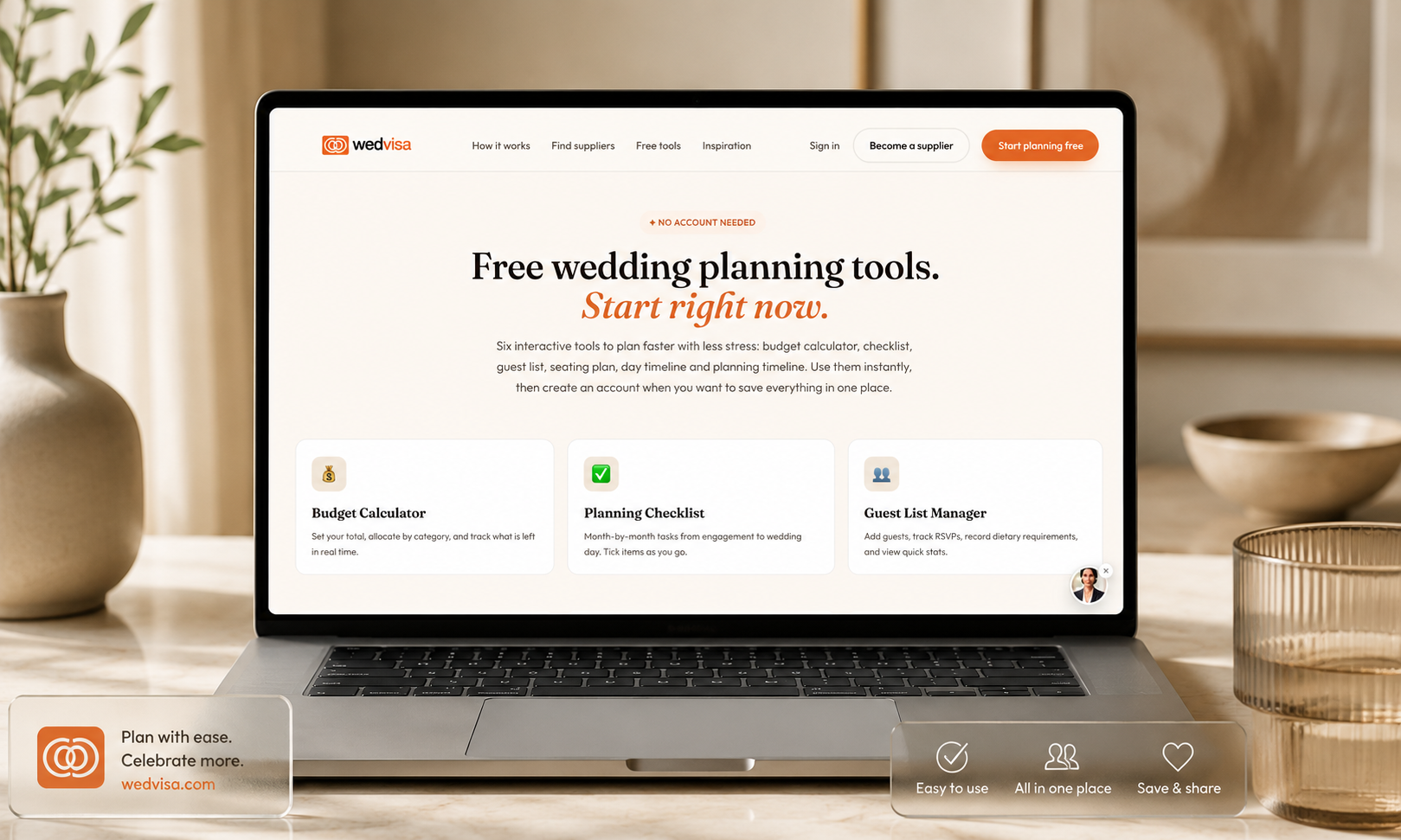
A lot of the mental load in wedding planning comes from tracking things across too many places — a budget spreadsheet here, a supplier list in your notes app, a guest list in a shared document, a checklist someone printed out. Centralising this into a single dashboard removes a genuine source of stress, not just an inconvenience.
The current average cost of a UK wedding day sits at around £20,600–£22,000, excluding the ring and honeymoon — and 56% of UK couples overspend their original budget by an average of £4,800, often simply because nothing was being tracked centrally.
Wedvisa's free wedding budget calculator gives you a single, live picture of the budget instead, and the wider planning toolkit covers checklists and supplier comparisons in the same place, so you're not maintaining several separate systems by hand.
Consider consolidating suppliers instead of managing five separate contracts
Rather than booking lighting, sound, a DJ, a photo booth and furniture hire as five different suppliers with five different contracts and contact points, some couples engage a single event production agency to cover several of these at once. It can cost slightly more than piecing it together yourself, but it collapses five relationships into one and removes a meaningful amount of coordination admin — a good trade for couples short on time rather than money.
Similarly, an all-inclusive venue package (bundling catering, furniture and often a day coordinator) removes several separate booking processes entirely, compared with a dry-hire venue where you're sourcing everything independently.
Build a wedding website instead of tracking RSVPs by hand
A single wedding website that collects RSVPs, meal choices and dietary requirements digitally removes an enormous amount of manual admin compared with tracking replies by text, email and word-of-mouth. It also means the data arrives in a structured format you (or your caterer) can actually use, rather than a scattered set of messages you have to reconcile by hand closer to the day.
Delegate specific, bounded tasks — not vague ones
"Can you help with the wedding?" creates more work than it saves, because it puts the thinking back on you to define what "help" means. Assigning a specific, self-contained task — "can you handle table favours" or "can you manage the hotel room block for out-of-town guests" — genuinely offloads the work, because the person doing it doesn't need to keep checking in with you about scope.
Hire a coordinator for the final stretch, even if you've DIY'd everything else
You don't need a full wedding planner from month one to get real value from professional help. Many couples who've handled sourcing and booking themselves bring in an independent coordinator 4–6 weeks before the wedding specifically to take over vendor management, build the final running order, and handle on-the-day logistics. It's a lighter-touch (and cheaper) version of full planning support, aimed exactly at the point where busy couples run out of spare time and attention.
If your venue provides an in-house event manager, check what's included before hiring separately — many can act as this central point of contact for load-in schedules, catering logistics and floor plans without extra cost.
Set decision deadlines for yourself
Comparing options endlessly — five more venues, ten more photographers — feels productive but often isn't, especially with limited time. Give yourself a hard deadline for each decision ("we choose a venue by the end of this month") and stick to it once you have two or three genuinely good options, rather than treating every choice as reversible until the last possible moment.
Ring-fence a specific time for "wedding admin"
Letting wedding planning bleed into every spare conversation and evening is one of the fastest ways for it to start feeling overwhelming. A short, regular slot — one evening a week, say — dedicated purely to wedding tasks keeps it contained, and makes the rest of your time together (and your working week) genuinely free of it.
Frequently Asked Questions
What's the biggest time-saver for busy couples planning a wedding?
Getting the booking order right. Once the venue, date, registrar/celebrant and photographer are locked in, the time pressure drops considerably, since almost everything else has far more flexibility.
Is it worth hiring a wedding planner if we're just short on time, not money?
A full planner isn't always necessary. Many time-poor couples get most of the benefit from an independent coordinator booked for the final 4–6 weeks, who takes over vendor management and on-the-day logistics without needing to be involved from month one.
How can we avoid overspending if we don't have much time to research?
Centralise your budget in one place from the start rather than tracking it loosely — a clear category breakdown makes it obvious early if something's drifting, rather than discovering it after several deposits are already paid.
Should we use a wedding website for RSVPs?
Yes, if time is tight. It removes the manual work of chasing and reconciling replies by text and email, and gives you dietary and guest data in a format you can hand straight to your caterer.
How do we stop wedding planning from taking over our free time?
Set a specific, regular block of time for it — one evening a week, for example — rather than letting it spill into every conversation. It's easier to stay motivated with clear boundaries than with planning happening constantly in the background.
Is it better to book an all-inclusive venue if we're short on time?
Often, yes. All-inclusive packages remove several separate booking processes (catering, furniture, sometimes coordination) compared with a dry-hire venue, which can be a meaningful time saving even if the headline cost is slightly higher.